
Blog Page

Our blog provides expert insights and updates on industrial equipment, focusing on products like valves, pumps, and heat exchangers. It aims to inform professionals in the field about the latest advancements and practical solutions in the industry.
 
Sort by:
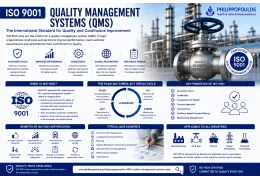
  • ISO 9001 Quality Management Systems (QMS)
    ISO 9001 Quality Management Systems (QMS)

    ISO 9001 is the internationally recognized standard for Quality Management Systems (QMS). It specifies the requirements for organizations to consistently provide products and services that meet customer expectations, applicable regulations and continual improvement objectives. The standard is applicable across all industries and is widely adopted by manufacturers of industrial valves, pressure equipment, piping systems, automation products and other engineered industrial solutions.

    Read more
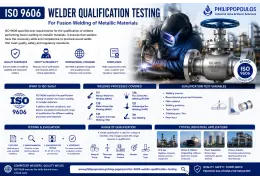
  • ISO 9606 Welder Qualification Testing
    ISO 9606 Welder Qualification Testing

    ISO 9606 is the international standard specifying the qualification testing requirements for welders performing fusion welding on metallic materials. It demonstrates that a welder has the practical skills required to produce sound welds that meet defined quality and safety requirements. The standard is widely applied in the manufacture of industrial valves, pressure vessels, piping systems, boilers, heat exchangers, structural steelwork, shipbuilding and power generation equipment.

    Read more
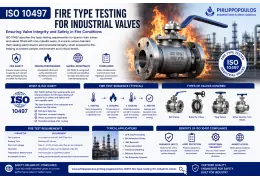
  • ISO 10497 Fire Type Testing for Industrial Valves
    ISO 10497 Fire Type Testing for Industrial Valves

    ISO 10497 is the international standard that specifies fire type testing requirements for industrial valves. The standard verifies that a valve can maintain acceptable pressure integrity, external leakage control and seat tightness after exposure to fire conditions. Fire-safe certification according to ISO 10497 is widely specified in oil and gas facilities, refineries, petrochemical plants, LNG terminals, hydrogen systems and other high-risk industrial applications where valve performance...

    Read more
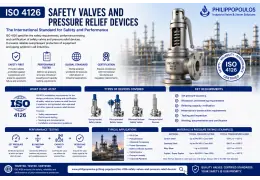
  • ISO 4126 Safety Valves and Pressure Relief Devices
    ISO 4126 Safety Valves and Pressure Relief Devices

    ISO 4126 is the international standard that specifies the design, manufacturing, testing and certification requirements for safety valves, pressure relief valves, bursting disc devices and other equipment used to protect pressure systems against excessive pressure. The standard is intended to ensure the safe protection of pressure vessels, boilers, piping systems, heat exchangers and industrial process equipment by automatically relieving excess pressure before hazardous conditions occur.

    Read more
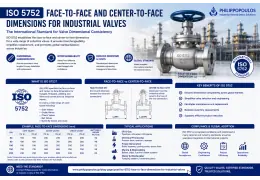
  • ISO 5752 Face-to-Face and Center-to-Face Dimensions for Industrial Valves
    ISO 5752 Face-to-Face and Center-to-Face Dimensions for Industrial Valves

    ISO 5752 is the international standard that specifies face-to-face (F2F) and center-to-face (C2F) dimensions for metallic industrial valves. Standardized dimensions allow valves from different manufacturers to be installed or replaced without modifying the piping system.

    Read more
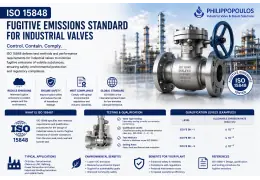
  • ISO 15848 Fugitive Emissions Standard for Industrial Valves
    ISO 15848 Fugitive Emissions Standard for Industrial Valves

    ISO 15848 is the international standard used to evaluate and classify fugitive emissions from industrial valves. The standard defines test procedures, classification criteria and qualification requirements for valves used in applications where external leakage to the atmosphere must be controlled.

    Read more
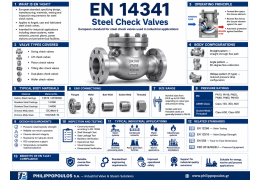
  • EN 14341 Steel Check Valves
    EN 14341 Steel Check Valves

    EN 14341 is the European standard specifying the design, manufacturing, material, testing and inspection requirements for steel check valves used in industrial applications. The standard applies to forged, cast and fabricated steel check valves installed in steam systems, water networks, process plants, power stations and petrochemical facilities.

    Read more
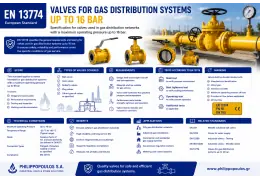
  • EN 13774 Valves for Gas Distribution Systems up to 16 bar
    EN 13774 Valves for Gas Distribution Systems up to 16 bar

    EN 13774 is the European standard specifying performance requirements for metallic isolating valves used in gas distribution systems with a maximum operating pressure of 16 bar. The standard applies to valves operating with fuel gases of the first, second and third family in accordance with EN 437 and provides additional requirements to relevant valve product standards.

    Read more
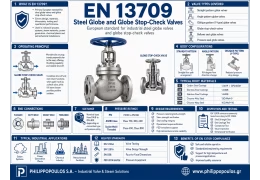
  • EN 13709 Steel Globe and Globe Stop-Check Valves
    EN 13709 Steel Globe and Globe Stop-Check Valves

    EN 13709 is the primary European standard covering steel globe valves and globe stop-check valves used in industrial process systems, steam networks, power generation facilities, chemical plants and petrochemical installations. The standard specifies requirements for design, materials, dimensions, testing and operational performance of wrought, cast or fabricated steel valves in straight, angle and oblique pattern configurations.

    Read more
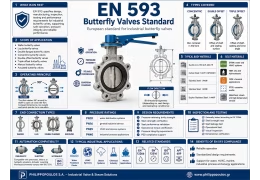
  • EN 593 Butterfly Valves Standard
    EN 593 Butterfly Valves Standard

    EN 593 is the European standard specifying design, manufacturing, inspection, testing and performance requirements for industrial butterfly valves. The standard establishes common engineering requirements to ensure safe operation, pressure integrity and reliable performance in industrial piping systems. Butterfly valves manufactured according to EN 593 are widely used in water treatment plants, district heating networks, HVAC systems, power generation facilities, marine applications,...

    Read more
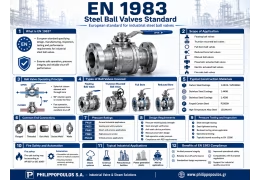
  • EN 1983 Steel Ball Valves Standard
    EN 1983 Steel Ball Valves Standard

    EN 1983 is the European standard that specifies the design, manufacturing, inspection, testing and performance requirements for industrial steel ball valves. The standard establishes requirements intended to ensure safe operation, pressure integrity and reliable shut-off performance in industrial piping systems. Steel ball valves manufactured according to EN 1983 are widely used in steam systems, power generation facilities, chemical plants, petrochemical installations, district heating...

    Read more
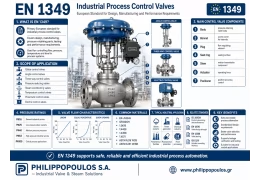
  • EN 1349 Industrial Process Control Valves
    EN 1349 Industrial Process Control Valves

    EN 1349 is the primary European standard for industrial process control valves. It specifies design, manufacturing, pressure-retaining, testing and performance requirements for valves used to control flow, pressure, temperature and level in industrial process systems.

    Read more
  • EN 12569 Industrial Valves Terminology Standard
    EN 12569 Industrial Valves Terminology Standard

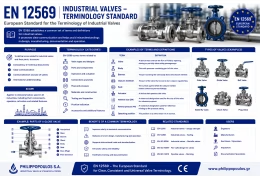
    EN 12569 is the European standard that establishes standardized terminology for industrial valves. The objective of the standard is to provide a common technical language for manufacturers, engineers, inspectors, contractors, suppliers and end users involved in the specification, design, operation and maintenance of industrial valve systems.

    Read more
  • EN 12516 Industrial Valve Design Strength Standard
    EN 12516 Industrial Valve Design Strength Standard

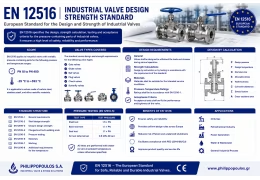
    EN 12516 is the primary European standard governing the strength design of industrial valves. It defines pressure-temperature ratings, wall thickness calculations, allowable stresses and design requirements for valves operating under pressure.

    Read more
  • Water Hammer in Steam and Condensate Systems
    Water Hammer in Steam and Condensate Systems

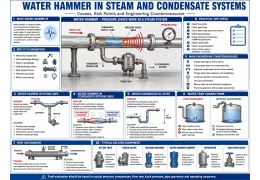
    Causes, Risk Points and Engineering Countermeasures Water hammer in steam and condensate systems is one of the most severe operating phenomena that can occur in industrial steam installations. It is not simply pipe noise. It is a mechanical impact load that can stress valves, flanges, steam traps, heat exchangers, supports, pipework and control instruments. In practice, most water hammer incidents in steam systems are related to condensate being present where controlled steam flow is...

    Read more
  • Steam Dryness Fraction in Steam Distribution Systems
    Steam Dryness Fraction in Steam Distribution Systems

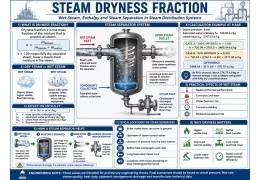
    Wet Steam, Enthalpy and Steam Separation Steam dryness fraction is used to describe the amount of dry saturated steam contained in a steam-water mixture. In real steam systems, water droplets may be present due to boiler carryover, heat losses in pipework, poor drainage or incorrect pipe sizing. For engineering purposes, steam dryness is not a theoretical parameter. It directly affects available thermal energy, heat transfer, steam trap operation, valve wear and the risk of water hammer.

    Read more
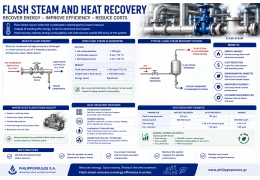
  • Flash Steam and Heat Recovery
    Flash Steam and Heat Recovery

    Flash steam is generated when hot condensate at a higher pressure is released to a lower pressure. This typically occurs downstream of steam traps, pressure reduction points, condensate headers or return systems operating at a lower pressure than the steam-consuming equipment. In terms of thermodynamic properties, flash steam is not different from saturated steam. The term describes the way it is generated: it is not produced in the boiler, but results from pressure reduction of hot...

    Read more
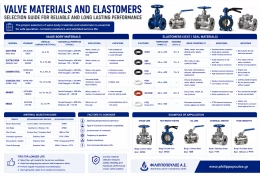
  • Valve Materials and Elastomers
    Valve Materials and Elastomers

    Valve material selection should not be based only on nominal pressure or valve size. Operating pressure, temperature, fluid compatibility, corrosion risk, mechanical loads, connection type, design standards and installation requirements must be evaluated together. The following tables provide indicative material equivalents according to EN, DIN, WNr and ASTM designations, together with typical temperature limits. These limits do not replace pressure-temperature ratings from applicable...

    Read more
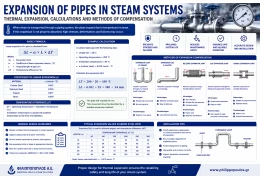
  • Expansion of Pipes in Steam Systems
    Expansion of Pipes in Steam Systems

    In steam and hot fluid systems, pipe length increases as temperature rises. Thermal expansion must be considered during system design in order to avoid high mechanical stresses, excessive loads on fixed points, pipe deformation and forces transmitted to valves, flanges, steam traps, heat exchangers and other equipment. Proper arrangement of pipe guides, supports, fixed points and expansion joints allows the pipework to move in a controlled manner and absorb the change in length caused by...

    Read more
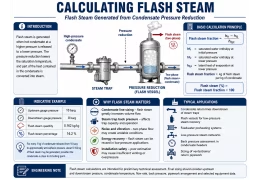
  • Calculating Flash Steam
    Calculating Flash Steam

    Flash steam is generated when hot condensate at a higher pressure is released to a lower pressure. The pressure reduction lowers the saturation temperature, and part of the heat contained in the condensate is converted into steam. This phenomenon commonly occurs downstream of steam traps, pressure reducing points, condensate return lines and flash vessels. Correct estimation of flash steam quantity is important for sizing condensate lines, flash vessels, vents and energy recovery systems.

    Read more
1234>|
Showing 1 to 20 of 64 (4 Pages)