Steam Heat Transfer: Fundamentals, Overall U-Value and Thermal Resistance


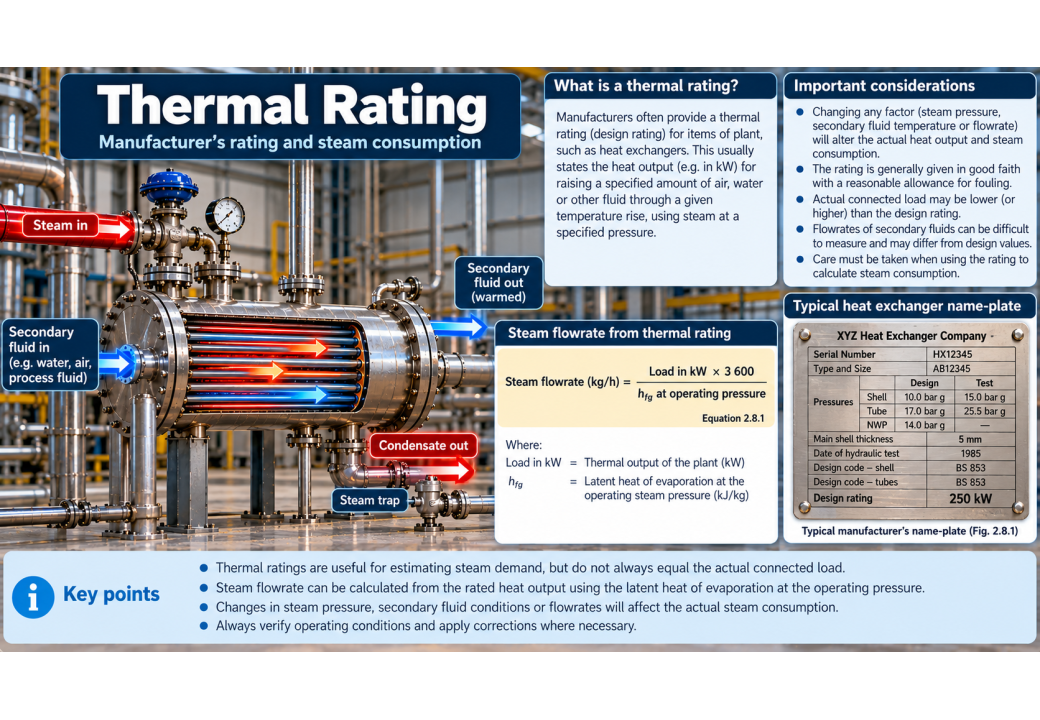
In a steam-heating system, the purpose of steam generation and distribution is to deliver heat at the process heat-transfer surface. Once heat duty and steam pressure are known, steam consumption can be established and used to size the boiler, distribution system and heat exchanger.

The three modes of heat transfer

  • conduction,
  • convection,
  • radiation.

Conduction

Q̇ = k · A · ΔT / L

Heat transfer increases with thermal conductivity, area and temperature difference and decreases with wall thickness.

Example

For an iron wall with k = 70 W/(m·°C), thickness 25 mm, area 0.15 m² and ΔT = 70°C:

Q̇ = 29.4 kW

Thermal conductivity

Material 25°C 125°C 225°C
Iron 80 68 60
Low-carbon steel 54 51 47
Stainless steel 16 17.5 19
Tungsten 180 160 150
Platinum 70 71 72
Aluminium 250 255 250
Gold 310 312 310
Silver 420 418 415
Copper 401 400 398

Values are in W/(m·°C).

Convection

Q̇ = h · A · ΔT

Convection may be forced or natural. Steam condensation is also a convective phase-change process.

Example

For area 0.36 m², h = 1,600 W/(m²·°C) and ΔT = 30°C:

Q̇ = 17.28 kW

Radiation

Thermal radiation transfers energy by electromagnetic waves and does not require a material medium.

The general heat-transfer equation

Q̇ = U · A · ΔT

The overall U-value includes the combined conductive, convective and fouling resistances.

Mean temperature difference

With saturated steam, primary-side temperature may be treated as essentially constant during condensation.

AMTD

ΔTAM = Ts - (T1 + T2) / 2

LMTD

ΔTLM = (T2 - T1) / ln[(Ts - T1)/(Ts - T2)]

Example 1

Steam at 2 bar(g), Ts = 134°C, water heated 20→50°C:

  • AMTD = 99°C
  • LMTD = 98.24°C

Example 2

Steam at 4 bar(g), Ts = 152°C, process fluid heated 10→120°C:

  • AMTD = 87°C
  • LMTD = 73.8°C

Using AMTD would calculate a heat-transfer area almost 15% smaller than required.

Real thermal resistances

  • air film,
  • condensate film,
  • steam-side fouling,
  • metal wall,
  • product-side fouling,
  • stagnant product film.

Condensate-film resistance

A continuous condensate film may be 100–150 times more resistant to heat transfer than steel and 500–600 times more resistant than copper.

Filmwise and dropwise condensation

Dropwise-condensation heat-transfer coefficients may be up to ten times higher than filmwise values, although maintaining dropwise conditions is difficult.

Air as a thermal barrier

Air may be 1,500–3,000 times more resistant to heat flow than steel and 8,000–16,000 times more resistant than copper. An air film only 0.025 mm thick may provide thermal resistance comparable with approximately 400 mm of copper.

Fouling and scale

Deposits increase total thermal resistance and reduce U. Correct boiler operation, moisture removal, air venting and cleaning help maintain heat-transfer performance.

Engineering checks

  • heat duty,
  • steam pressure and temperature,
  • product inlet/outlet temperatures,
  • AMTD or LMTD,
  • overall U-value,
  • fouling,
  • air venting,
  • condensate drainage.

Selection of heat exchangers, steam traps and condensate equipment, control valves and pipeline strainers should reflect the actual thermal and hydraulic conditions.

Conclusion

Actual steam heat transfer is governed by conduction, convection, mean temperature difference and the complete chain of thermal resistances. Air, condensate films and fouling can affect performance more strongly than the metal wall itself.

Frequently Asked Questions

What does the overall U-value represent?

The combined ability to transfer heat after accounting for all major thermal resistances.

What is the main heat-exchanger equation?

Q̇ = U·A·ΔT.

When should LMTD be used?

When the temperature difference changes substantially through the exchanger.

Why does condensate film reduce performance?

Because it adds significant thermal resistance.

Why is air harmful?

Because it has very low thermal conductivity and acts as an insulating layer.

What is dropwise condensation?

Condensation where droplets remain separate instead of immediately forming a continuous film.

How does fouling affect performance?

It increases thermal resistance and reduces the overall U-value.

 
Posted in: Engineering guides