
Blog Page

Our blog provides expert insights and updates on industrial equipment, focusing on products like valves, pumps, and heat exchangers. It aims to inform professionals in the field about the latest advancements and practical solutions in the industry.
 
Sort by:
  • Content of Air in Steam Systems
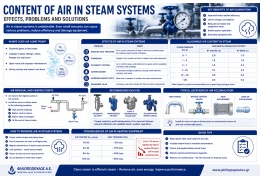
    Content of Air in Steam Systems

    The presence of air and other non-condensable gases in a steam system affects saturation temperature, heat transfer and equipment operation. Even a small percentage of air can cause a significant reduction in the actual steam temperature at the point of use. Correct air venting, removal of non-condensable gases and proper selection of steam traps and air vents are therefore important factors in the operation of industrial steam systems.

    Read more
  • Pressure Drop in Steam Lines
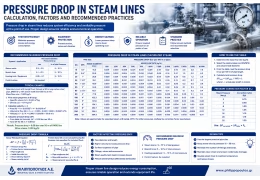
    Pressure Drop in Steam Lines

    Pressure drop in a steam distribution network directly affects the available pressure at the point of use, as well as the operation of control valves, pressure reducing valves, steam traps and heat exchangers. For preliminary technical checks, pressure drop may be estimated using the steam density, flow velocity and the total resistance coefficient of the pipework and installed components.

    Read more
  • Recommended Flow Velocities for Steam, Water and Air Lines
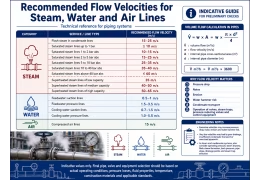
    Recommended Flow Velocities for Steam, Water and Air Lines

    The following values may be used as an indicative guide for preliminary checks of flow velocities in industrial steam, condensate, feedwater, cooling water and compressed air piping systems. Proper flow velocity selection affects pressure drop, noise, erosion, water hammer risk, condensate transport and the operation of valves, steam traps, pressure reducing valves and control equipment.

    Read more
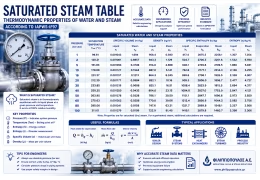
  • Saturated Steam Table
    Saturated Steam Table

    The following table presents basic thermodynamic properties of saturated steam as a function of absolute pressure. The data may be used as a technical reference for preliminary calculations and equipment selection in steam systems, including steam traps, control valves, pressure reducing valves, safety valves, condensate lines and heat exchange applications.

    Read more
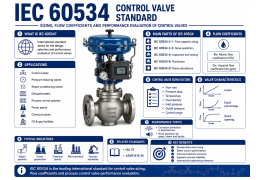
  • IEC 60534 Control Valve Standard
    IEC 60534 Control Valve Standard

    IEC 60534 is the primary international standard governing control valves, including sizing methods, flow coefficients, performance characteristics, noise prediction and control valve evaluation procedures.

    Read more
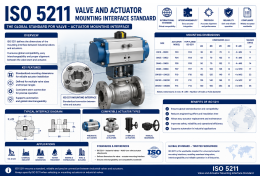
  • ISO 5211 Valve and Actuator Mounting Interface Standard
    ISO 5211 Valve and Actuator Mounting Interface Standard

    ISO 5211 is the international standard defining mounting interfaces between quarter-turn industrial valves and actuators. The standard enables reliable installation of pneumatic, electric and hydraulic actuators on valves from different manufacturers without requiring custom adapters.

    Read more
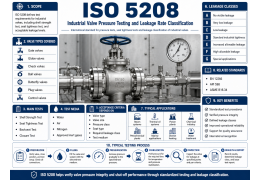
  • ISO 5208 Industrial Valve Pressure Testing and Leakage Rate Classification
    ISO 5208 Industrial Valve Pressure Testing and Leakage Rate Classification

    ISO 5208 is the international standard defining pressure testing procedures, leakage rate classifications and acceptance criteria for industrial valves. The standard is widely used to verify pressure integrity and sealing performance before valves are placed into service.

    Read more
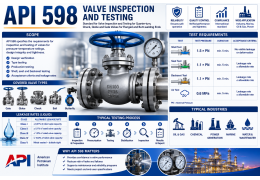
  • API 598 Valve Inspection and Testing
    API 598 Valve Inspection and Testing

    API 598 is the primary American Petroleum Institute standard governing inspection, pressure testing and acceptance criteria for industrial valves. It is widely specified in oil and gas facilities, refineries, petrochemical plants, power generation systems and industrial process applications.

    Read more
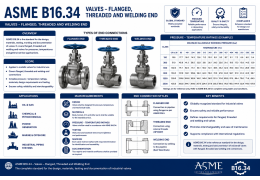
  • ASME B16.34 Valves Flanged, Threaded and Welding End
    ASME B16.34 Valves Flanged, Threaded and Welding End

    ASME B16.34 is the primary American standard governing the design, construction, pressure-temperature ratings, materials, wall thickness requirements and marking of industrial valves. It is widely specified for valves used in oil and gas facilities, petrochemical plants, power generation systems, process industries and industrial piping networks.

    Read more
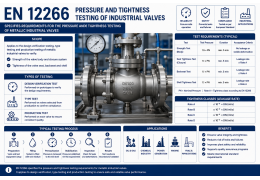
  • EN 12266 Pressure and Tightness Testing of Industrial Valves
    EN 12266 Pressure and Tightness Testing of Industrial Valves

    EN 12266 is the primary European standard defining pressure testing, tightness testing and acceptance criteria for industrial valves. The standard establishes uniform testing procedures used by manufacturers, inspectors and end users to verify the mechanical strength and sealing performance of industrial valves before delivery and commissioning.

    Read more
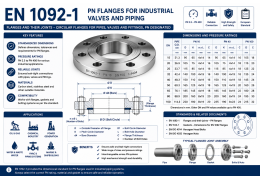
  • EN 1092-1 – PN Flanges for Industrial Valves and Piping
    EN 1092-1 – PN Flanges for Industrial Valves and Piping

    EN 1092-1 is a European standard for circular steel flanges used with pipes, valves, fittings and accessories in PN-designated piping systems. It specifies flange types, dimensions, sealing faces, tolerances, bolting, materials, marking and pressure/temperature ratings. For industrial valves, EN 1092-1 is essential for correct mechanical connection between the valve and the pipeline. Matching only DN or PN is not enough. Bolt hole pattern, sealing face, flange type and compatibility with the...

    Read more
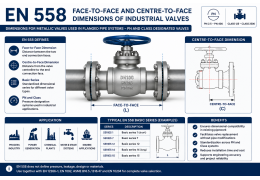
  • EN 558 – Face-to-Face and Centre-to-Face Dimensions of Industrial Valves
    EN 558 – Face-to-Face and Centre-to-Face Dimensions of Industrial Valves

    EN 558 specifies the face-to-face and centre-to-face dimensions of metallic industrial valves installed in flanged piping systems. It is an important standard for valve selection, replacement and installation because it helps confirm that the valve has the correct installation length. EN 558 is used for PN and Class designated valves and is especially useful when a valve must be replaced without modifying the existing pipework.

    Read more
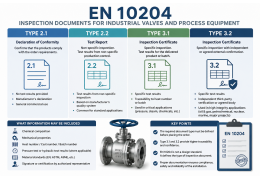
  • EN 10204 – Inspection Documents for Industrial Valves and Process Equipment
    EN 10204 – Inspection Documents for Industrial Valves and Process Equipment

    EN 10204 is the European standard that defines the different types of inspection documents supplied with metallic products, industrial valves, steam traps, piping components, pressure vessels and process equipment. The standard specifies how manufacturers document conformity with applicable material specifications, manufacturing standards and project requirements. EN 10204 does not define material properties. Instead, it defines how inspection and testing results are documented and...

    Read more
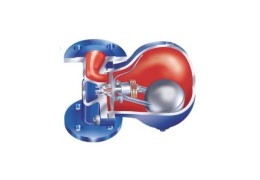
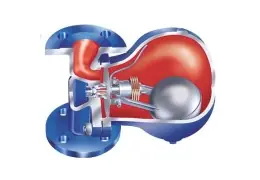
  • Ball Float Steam Traps: Selection, Operation, and Industrial Applications
    Ball Float Steam Traps: Selection, Operation, and Industrial Applications

    Ball float steam traps are mechanical steam traps used where continuous condensate removal is required under variable load conditions. They are commonly specified for steam-heated heat exchangers, process coils, calorifiers, air heaters, and other equipment where condensate must be discharged as it forms without causing temperature instability or waterlogging. A typical ball float steam trap uses a buoyant spherical float connected to a valve mechanism. As condensate enters the trap body,...

    Read more
  • How to Select the Right Steam Trap for Industrial Applications
    How to Select the Right Steam Trap for Industrial Applications

    A steam trap is a self-acting valve used to discharge condensate, air, and non-condensable gases from a steam system while limiting live steam loss. Correct selection depends on the duty, not only the pipe size. A trap that works on a steam main drip leg may be unsuitable for a heat exchanger, tracing circuit, sterilizer, or pressure-reducing station. ISO classifies automatic steam traps into three main operating groups: mechanical, thermostatic, and thermodynamic. ISO/DIS 6704 is...

    Read more
  • Industrial Globe Valves for Steam, Thermal Fluids, Process Utilities and High-Pressure Service
    Industrial Globe Valves for Steam, Thermal Fluids, Process Utilities and High-Pressure Service

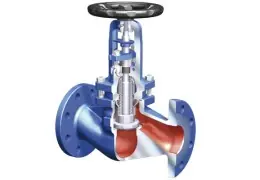
    Globe valves are selected when a piping system needs positive isolation with a more controllable closing characteristic than many quarter-turn or gate-type isolation valves. In steam, condensate, hot-water, thermal-oil and process-utility systems, the seat-and-disc geometry allows progressive restriction of the flow path, so the valve can be used for isolation and, with the correct plug/disc design, limited throttling duty. The category includes bellows-sealed and packed-gland globe valves,...

    Read more
  • What is Superheated Water and Where is it Used?
    What is Superheated Water and Where is it Used?

    Superheated water is an ideal solution for high-efficiency industrial heating, operating at temperatures up to 200°C with minimal energy loss. It runs in closed pressurized circuits, offering enhanced safety, energy savings, and high thermal stability in demanding applications.

    Read more
  • What is Thermal Oil and Where is it Used?
    What is Thermal Oil and Where is it Used?

    Discover how thermal oil enhances industrial heat transfer processes with high-temperature stability and low-pressure operation. Ideal for food, chemical, and energy sectors, thermal oil offers safe and efficient thermal energy distribution with minimal maintenance. Learn more about its key benefits, applications, and maintenance tips.

    Read more
  • Steam – A Key Source of Energy and Heat in Industry
    Steam – A Key Source of Energy and Heat in Industry

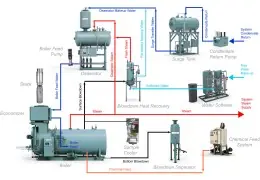
    Steam is one of the most important forms of energy in industrial applications, thanks to its high thermal efficiency and ease of distribution through pipe networks. It is produced by heating water in pressurized boilers and is widely used in processes such as heating, sterilization, mechanical energy transfer, and various manufacturing operations.

    Read more
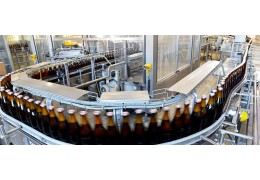
  • Valves and flow equipment for the food and beverage industry
    Valves and flow equipment for the food and beverage industry

    Food and beverage plants require controlled flow in steam, hot water, chilled water, condensate, compressed air, cleaning media and auxiliary process lines. Valve selection depends on the fluid, operating temperature, pressure, cleaning method and maintenance requirements of the installation. Typical food and beverage production lines use isolation valves, control valves, check valves, safety valves, pressure reducing valves and condensate drainage equipment. Correct sizing helps limit...

    Read more
|<1234>|
Showing 21 to 40 of 64 (4 Pages)