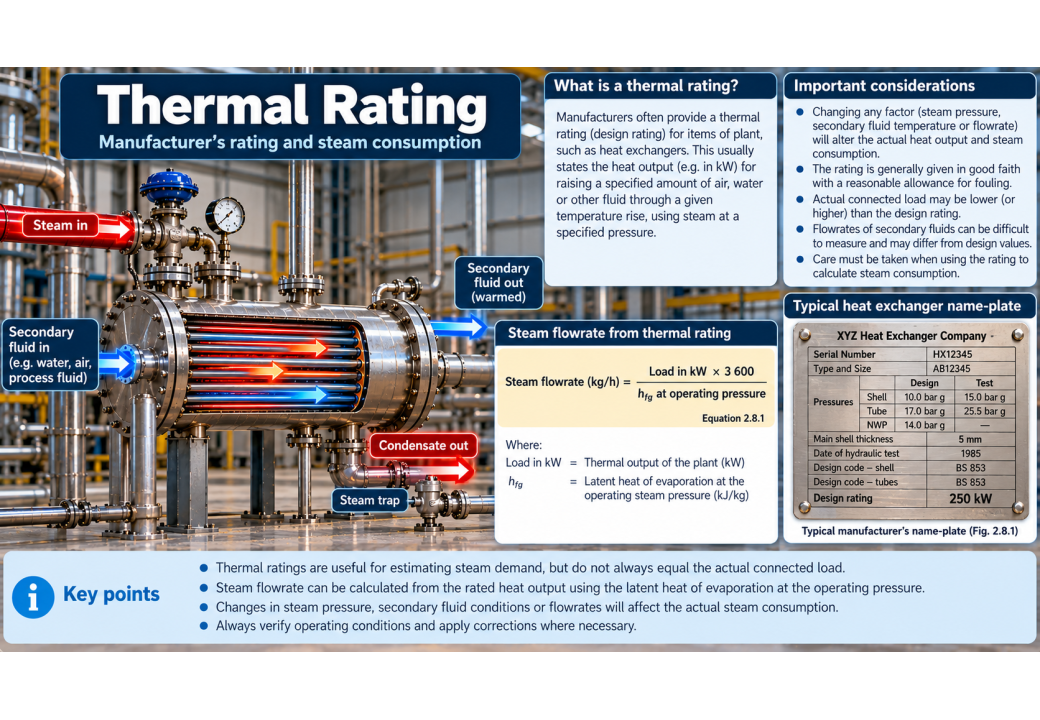
The thermal output stated on a heat exchanger nameplate or technical datasheet is useful only when interpreted in the...
Steam Quality in Industrial Systems: Dryness, Cleanliness and Air Removal
Steam quality is not defined by pressure alone. For an industrial process to operate correctly, steam must reach the point of use in the required quantity, at the required pressure and temperature, free from excessive air and other non-condensable gases, sufficiently clean and as dry as the system requires.
Each of these conditions affects heat transfer, process stability and the mechanical behaviour of the distribution system.
What good steam quality means in practice
- correct flowrate,
- correct pressure and temperature,
- freedom from air and non-condensable gases,
- cleanliness,
- dryness.
Correct steam quantity and distribution sizing
Every heating process requires a defined steam flowrate to provide the necessary heat flow. If available steam flow is below the actual load, process temperature may not be maintained and production rate may fall.
Steam load should be established before pipework and ancillaries are sized.
Correct pressure does not always mean correct temperature
Pure saturated steam has a defined relationship between pressure and saturation temperature. When air or another non-condensable gas is mixed with steam, however, the pressure gauge reads the total pressure of the mixture rather than the pressure exerted by steam alone.
The actual temperature can therefore be below the saturation temperature expected from total pressure.
How air enters a steam system
When a steam system shuts down, steam remaining in the pipework condenses. The resulting reduction in volume creates a vacuum that can draw air into the system.
During start-up, steam pushes air towards drain points and remote points. Steam traps and condensate equipment form an important part of the drainage and air-removal function.
Why air reduces heat transfer
Air does not condense with steam. As steam condenses, air can remain at the heat-transfer surface and form an insulating layer that increases thermal resistance.
Partial pressure in steam-air mixtures
Ptotal = Psteam + Pair
Absolute pressure must be used.
Example
For a mixture containing 75% steam and 25% air by volume at 4 bar(a):
Psteam = 0.75 × 4 = 3 bar(a)
The mixture temperature is approximately 134°C rather than approximately 144°C, which would be expected from pure saturated steam at 4 bar(a).
Dissolved gases in boiler feedwater
Make-up water and returned condensate can contain dissolved gases. When heated in the boiler, some of these gases are released and carried into the steam system.
Gas solubility decreases as temperature rises. The feedtank is therefore typically maintained at a temperature of at least around 80°C to assist the release of oxygen and carbon dioxide.
Steam cleanliness and pipeline contamination
Steam systems may contain rust, carbonate deposits, welding slag and jointing material. These particles can increase wear in bends, small orifices, steam traps, pressure reducing valves, control valves and instruments.
Pipeline strainers are used upstream of sensitive equipment.
How a pipeline strainer works
Steam passes through a perforated or mesh screen while larger solid particles are retained.
Installing the strainer on its side in a steam line:
- limits condensate accumulation in the body,
- reduces water-hammer risk,
- exposes a larger screen area to the flow.
Deposits on heat-transfer surfaces
Deposits create additional thermal resistance and may be associated with incorrect boiler operation, moisture carryover or inadequate water treatment.
Why steam becomes wet in distribution
Steam mains lose heat to their surroundings. Insulation reduces these losses but cannot eliminate them completely, so some steam condenses during distribution.
Poor feedwater treatment or peak boiler load may also cause priming and carryover of boiler water into the steam main.
How moisture affects performance
- it reduces actual evaporation enthalpy per kilogram of mixture,
- it can carry contamination and create deposits,
- it increases the liquid film on heat-transfer surfaces.
Steam moisture separators
A steam moisture separator removes entrained droplets and condensate from the steam flow.
The flow is forced to change direction. Heavier droplets impact internal surfaces and drain to the lower part of the separator, where condensate is discharged through a suitable steam trap.
From condensation to water hammer
Condensate formed in a steam main can collect at the bottom of the pipe. If drainage is insufficient, a solid slug of water may form and be carried along the line at approximately:
25–30 m/s
Why water hammer is dangerous
When a high-velocity condensate slug strikes a bend, tee, valve or other obstruction, its kinetic energy is converted rapidly into pressure energy.
The result may be severe impact loading, noise, vibration and damage to fittings or pipework.
Common sources of condensate accumulation
- low points in steam mains,
- sagging pipework from inadequate support,
- broken hangers,
- incorrect use of concentric reducers,
- incorrectly oriented strainers,
- inadequate drainage before a pipe rise.
Practical steam-quality checks
| Parameter | What to check | Possible effect if incorrect |
|---|---|---|
| Flowrate | Sufficient steam for the process load | Slow heating, reduced production |
| Pressure / temperature | Actual condition at point of use | Insufficient process temperature |
| Air / gases | Start-up and remote-point venting | Lower temperature and heat transfer |
| Cleanliness | Strainers and cleaning interval | Valve and orifice wear |
| Dryness | Removal of moisture and condensate | Reduced heat-transfer performance |
| Drainage | Low points and correct steam trapping | Water hammer |
Control valves, pressure reducing valves, strainers, separators and steam traps should be treated as parts of one steam system rather than as isolated components.
Conclusion
Steam quality is a combination of flowrate, pressure, temperature, cleanliness, air removal and dryness.
Air can lower the actual steam temperature relative to total indicated pressure while creating an insulating layer at heat-transfer surfaces. Solid contamination increases erosion and deposits, while moisture reduces the useful energy quality of steam and creates conditions for water hammer.
A correctly designed steam system must therefore provide the required flow, remove air and condensate, retain solid contamination and limit moisture carryover to the point of use.
Frequently Asked Questions
What is good steam quality?
Steam supplied at the required flowrate, pressure and temperature, with limited air, non-condensable gases, solid contamination and liquid water.
Why does air reduce steam temperature?
Because total pressure is shared between steam and air. Steam partial pressure is lower than the total indicated pressure and corresponds to a lower saturation temperature.
Why does air reduce heat transfer?
Air does not condense with the steam and can form an insulating layer on the heat-transfer surface.
Why are strainers used in steam lines?
To retain rust, welding debris, scale and other solids that may erode or block valves, traps and small passages.
What does a steam separator do?
It removes entrained water droplets and condensate from the steam flow and directs them to a drain point.
Why does steam become wet in a distribution system?
Because some steam condenses as the pipe loses heat, and boiler-water carryover may also add moisture.
What causes water hammer in a steam line?
A high-velocity slug of condensate striking a bend, tee, valve or other obstruction.
Why are steam-line strainers installed on their side?
To prevent condensate from collecting in the strainer body and reduce the associated water-hammer risk.