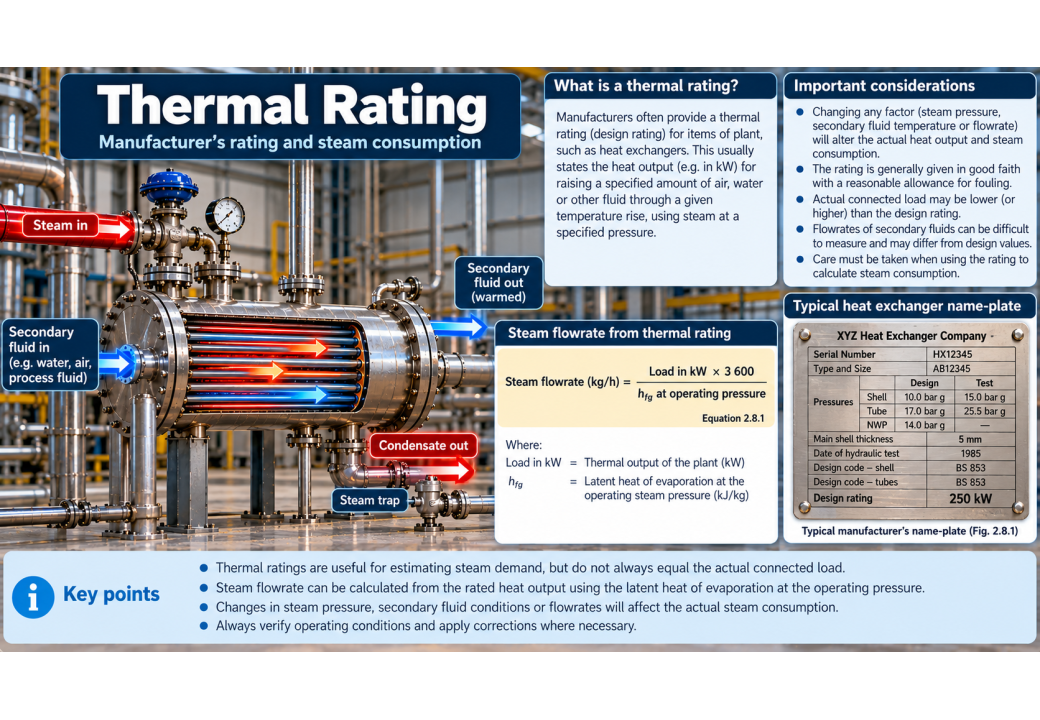
The thermal output stated on a heat exchanger nameplate or technical datasheet is useful only when interpreted in the...
What Is Steam? Saturation, Enthalpy, Dryness and Flash Steam
Steam is the vapour phase of water, and its behaviour is closely connected to pressure, temperature and the energy state of the water from which it is produced. For industrial steam engineering, it is not enough to state that water boils and becomes steam. It is necessary to understand saturation, the energy required for evaporation, the effect of pressure on specific volume, the meaning of dryness fraction and the mechanism that produces flash steam when hot condensate is reduced to a lower pressure.
These principles form the basis for understanding steam generation, distribution, heat use and condensate handling.
Water, ice and steam as three phases of H₂O
A water molecule consists of two hydrogen atoms and one oxygen atom. Depending on molecular energy, H₂O may exist as:
- ice,
- liquid water,
- steam.
In the solid phase, molecules occupy an ordered structure and mainly vibrate around fixed positions. When heat is added, molecular excitation increases until sufficient energy is available for the phase change to liquid water.
In the liquid phase, molecules have much greater freedom of movement while remaining close together. Additional heat increases molecular motion and temperature until the boiling condition corresponding to the prevailing pressure is reached.
In the vapour phase, molecules are much farther apart. Steam therefore has a substantially lower density than liquid water.
The triple point of water
Ice, liquid water and steam can coexist in thermodynamic equilibrium at one specific combination of pressure and temperature known as the triple point.
- 273.16 K
- 0.006112 bar(a)
If pressure is reduced further at the same temperature, ice can change directly into vapour without first becoming liquid. This is sublimation.
Water enthalpy and sensible heating
When liquid water is heated without a phase change, the added energy increases its temperature. This energy is represented by the specific enthalpy of water, hf.
At atmospheric pressure, approximately 0 bar(g):
- water boils at 100°C,
- approximately 419 kJ/kg is required to heat 1 kg of water from 0°C to 100°C.
For many calculations between 0°C and 100°C:
cp = 4.19 kJ/(kg·°C)
How saturated steam is formed
Once water reaches saturation temperature at constant pressure, further heat input does not produce a further temperature rise. Instead, the added energy changes liquid water into vapour.
Water and saturated steam in equilibrium at the same pressure are at the same temperature, but the steam contains much more energy per unit mass.
Pressure and saturation temperature
The boiling temperature of water changes with pressure. At atmospheric pressure the saturation temperature is 100°C. At 7 bar(g), the saturation temperature is approximately 170°C.
Steam at a temperature above the saturation temperature corresponding to its pressure is superheated steam. The temperature difference above saturation is the degree of superheat.
Enthalpy of evaporation and latent heat
The energy required to change saturated water at its boiling temperature into saturated steam, without a temperature change, is the enthalpy of evaporation, hfg.
When saturated steam condenses on a colder surface, the corresponding phase-change energy is released.
Total enthalpy of steam
hg = hf + hfg
At atmospheric pressure:
- hf = 419 kJ/kg
- hfg = 2,257 kJ/kg
- hg = 2,676 kJ/kg
How increasing steam pressure changes its properties
- saturation temperature increases,
- saturated-water enthalpy increases,
- enthalpy of evaporation decreases,
- steam density increases,
- steam specific volume decreases.
Steam is therefore commonly generated and distributed at elevated pressure. Pressures around 7 bar(g) or above provide a much smaller specific volume than atmospheric-pressure steam.
[INTERNAL LINK: Steam Pressure Reducing Valves]
Saturated steam properties between 0 and 7 bar(g)
| Pressure bar(g) | Saturation temperature °C | hf kJ/kg | hfg kJ/kg | hg kJ/kg | Specific volume m³/kg |
|---|---|---|---|---|---|
| 0 | 100 | 419 | 2,257 | 2,676 | 1.673 |
| 1 | 120 | 506 | 2,201 | 2,707 | 0.881 |
| 2 | 134 | 562 | 2,163 | 2,725 | 0.603 |
| 3 | 144 | 605 | 2,133 | 2,738 | 0.461 |
| 4 | 152 | 641 | 2,108 | 2,749 | 0.374 |
| 5 | 159 | 671 | 2,086 | 2,757 | 0.315 |
| 6 | 165 | 697 | 2,066 | 2,763 | 0.272 |
| 7 | 170 | 721 | 2,048 | 2,769 | 0.240 |
Why specific volume matters in steam distribution
At 0 bar(g), 1 kg of dry saturated steam occupies approximately 1.673 m³. At 7 bar(g), the same 1 kg occupies approximately 0.240 m³.
This reduction explains why elevated steam pressure allows a given mass flow to be distributed through piping of more practical dimensions.
Dry and wet steam
Ideally, dry saturated steam contains no liquid water. In an industrial saturated-steam boiler, however, producing completely dry steam is difficult because turbulence and splashing can entrain droplets.
For a representative case containing 5% water by mass, the dryness fraction is:
x = 0.95
Effect of dryness fraction on enthalpy
hfg,wet = x · hfg
hwet = hf + x · hfg
vwet ≈ x · vg
Example at 6 bar(g)
- dryness fraction x = 0.94,
- hf ≈ 697.5 kJ/kg,
- hfg ≈ 2,066.0 kJ/kg,
- vg ≈ 0.272 m³/kg.
h = 697.5 + (2,066.0 × 0.94) ≈ 2,639.5 kJ/kg
v ≈ 0.272 × 0.94 = 0.256 m³/kg
Temperature-enthalpy phase diagram
As water is heated to saturation, both its temperature and liquid enthalpy increase. At saturation temperature, further heat input produces evaporation and the condition moves through the two-phase region from saturated liquid toward dry saturated vapour.
Halfway across the two-phase region, the dryness fraction is 0.5. At the saturated-vapour boundary, it is 1.
Once all liquid has evaporated, further heat raises steam temperature and moves the condition into the superheated region.
The critical point
For water, the critical point occurs at approximately:
- 374.15°C
- 221.2 bar(a)
As the critical point is approached, the enthalpy of evaporation decreases until it becomes zero. Beyond the critical point there is no conventional, clearly defined boiling transition.
Flash steam
Flash steam is produced when saturated water at a higher pressure is reduced to a lower pressure. The excess liquid enthalpy at the lower pressure causes part of the water to evaporate.
Flash steam fraction = [hf(P₁) - hf(P₂)] / hfg(P₂)
Example: 5 bar(g) to atmospheric pressure
- hf at 5 bar(g): 670.9 kJ/kg,
- hf at 0 bar(g): 419.0 kJ/kg,
- excess energy: 251.9 kJ/kg,
- hfg at 0 bar(g): 2,257 kJ/kg.
Flash steam = 251.9 / 2,257 ≈ 0.11 kg steam/kg water
Approximately 11% of the original mass flashes into steam.
[INTERNAL LINK: Steam Traps & Condensate Equipment]
Practical implications for industrial steam systems
- steam pressure determines saturation temperature,
- increasing pressure significantly reduces specific volume,
- evaporation enthalpy forms a major part of saturated-steam energy,
- wet steam contains less useful energy per kilogram than dry saturated steam,
- pressure reduction of saturated condensate can generate flash steam,
- pressure, temperature and phase condition must be considered together.
[INTERNAL LINK: Boiler House Equipment]
Conclusion
Steam is a fluid whose condition depends on the interaction between pressure, temperature, enthalpy and dryness fraction.
During water heating, sensible energy is added first. At saturation temperature, further energy produces the phase change and becomes evaporation enthalpy. This energy is released again when the steam condenses.
Understanding these relationships is fundamental before calculating or evaluating steam generation, distribution, heat use or condensate return.
Frequently Asked Questions
What is saturated steam?
Saturated steam is steam at the saturation temperature corresponding to its pressure and capable of existing in equilibrium with liquid water.
Why does saturation temperature increase with pressure?
The boiling temperature of water depends on pressure. A higher pressure requires a higher temperature before the saturation condition is reached.
What is enthalpy of evaporation?
It is the energy required to convert saturated liquid water into saturated steam at the same pressure and temperature.
What does a dryness fraction of 0.95 mean?
It means that 95% of the mixture mass is steam and 5% is liquid water.
Why does steam specific volume decrease as pressure rises?
Increasing pressure increases steam density. Because specific volume is the inverse of density, its value decreases.
What is superheated steam?
Superheated steam is steam at a temperature higher than the saturation temperature corresponding to its pressure.
What is flash steam?
Flash steam is produced when saturated water or hot condensate is reduced to a lower pressure and part of its excess enthalpy causes some of the liquid to re-evaporate.
What is the critical point of water?
It occurs at approximately 374.15°C and 221.2 bar(a). Beyond this point there is no conventional, clearly defined liquid-to-vapour boiling transition.