
The thermal output stated on a heat exchanger nameplate or technical datasheet is useful only when interpreted in the...
Heat Exchanger Thermal Rating: From Nameplate Capacity to Actual Steam Load
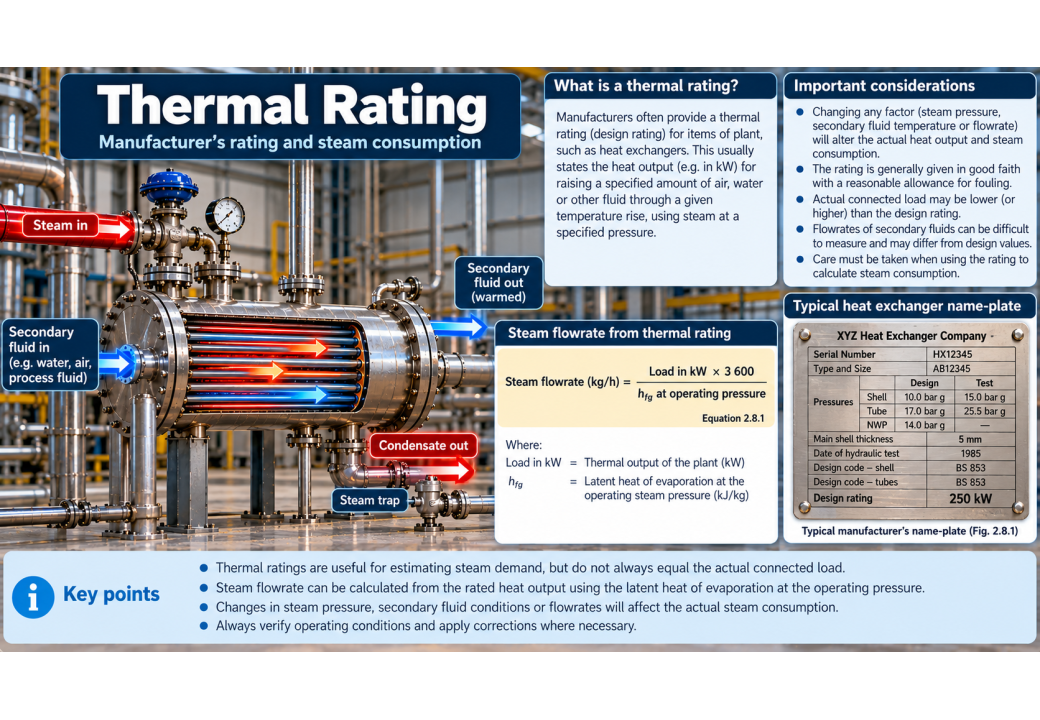
The thermal output stated on a heat exchanger nameplate or technical datasheet is useful only when interpreted in the correct context. A thermal rating does not mean that the equipment will always transfer the same amount of heat, nor does it mean that the rating is identical to the actual connected process load.
A design rating is based on defined conditions: a stated air, water or other secondary-fluid flowrate, a specified temperature rise and steam at a specified pressure. If any of these conditions change, predicted heat output and steam consumption also change.
What a thermal rating represents
A manufactured item of heating equipment is commonly rated to heat a stated quantity of air, water or another fluid through a defined temperature rise using steam at a specified pressure.
A reasonable allowance for fouling of the heat-transfer surface is generally included in the design rating.
Why nameplate capacity can be misleading
A common error is to assume thermal rating = actual heat load.
A heat exchanger may be capable of delivering 250 kW at its design conditions while the connected process requires only a fraction of that capacity.
The rating describes equipment capability. The connected load describes the heat actually required by the process.
Effect of secondary-fluid inlet temperature
If water, air or another secondary fluid enters colder than specified, heat demand increases because more energy is required to reach the desired final condition.
Effect of lower steam pressure
Lower saturated-steam pressure means lower saturation temperature. This reduces the temperature difference between steam and product and therefore reduces the exchanger's ability to transfer heat.
Actual secondary-fluid flow may differ from design flow
- Fan-belt slip can reduce air flow.
- Pump impeller wear can reduce liquid flow.
- Lower actual system resistance can increase flow above design.
Where practical, suitable flowmeters can be used to confirm actual operating flow.
Design rating and connected load
Design rating: the heat output the equipment can provide at specified design conditions.
Connected load: the actual heat required by the process.
A heat exchanger may therefore have significantly more capacity than the process currently requires.
Converting thermal load into steam flowrate
If actual heat load and operating steam pressure are known:
Steam flowrate (kg/h) = Load (kW) × 3,600 / hfg
where hfg is the specific enthalpy of evaporation at operating pressure.
Why operating pressure must be used
The value of hfg changes with steam pressure, so the evaporation enthalpy corresponding to the actual operating pressure must be used.
ṁs = Q̇ × 3,600 / hfg
A 250 kW nameplate
A nameplate stating Design rating: 250 kW does not prove that the exchanger continuously absorbs 250 kW or continuously consumes the corresponding rated steam flow.
Operating steam pressure is needed to calculate rated steam flow, while the actual connected load must be known to calculate actual steam consumption.
Thermal rating versus mechanical nameplate data
A nameplate may also contain design pressures, test pressures, construction details and design code. These quantities should not be confused with the thermal operating conditions used to establish the rating.
The role of fouling
A reasonable fouling allowance may be incorporated in the design rating, but actual plant fouling can differ from the original assumption and reduce heat-transfer performance.
Checking rated versus actual performance
| Parameter | Comparison | Possible effect |
|---|---|---|
| Inlet temperature | Actual vs design | Changes required heat duty |
| Steam pressure | Actual vs design | Changes temperature driving force |
| Secondary-fluid flow | Actual vs design | Changes thermal operating condition |
| Fan / pump condition | Actual mechanical performance | May reduce flow |
| System resistance | Actual vs expected | May increase flow |
| Fouling | Actual surface condition | Reduces heat transfer |
| Connected load | Actual process requirement | May be below rating |
When to use thermal rating for steam-consumption calculation
- Take the design rating in kW.
- Determine operating steam pressure.
- Obtain the corresponding hfg.
- Calculate steam flow in kg/h.
For actual consumption, establish the real connected load first.
Conclusion
Heat exchanger thermal rating is meaningful only when considered together with its design conditions. Secondary-fluid temperature, steam pressure, actual flowrate and fouling can all alter real thermal performance.
The key distinction is between rated capacity and actual connected load. Once actual heat duty and steam pressure are known, steam consumption can be calculated from the evaporation enthalpy.
Frequently Asked Questions
What is a heat exchanger thermal rating?
The heat output the equipment can provide under defined flow, temperature and steam-pressure conditions.
Is thermal rating the same as actual heat load?
No. The connected process load may be only a fraction of rated capacity.
What happens if steam pressure is lower?
Saturation temperature and temperature driving force are reduced.
How does a colder secondary-fluid inlet affect demand?
It increases the heat required to reach the same final condition.
Why can actual flow differ from design?
Fan-belt slip, pump impeller wear or different system resistance can change actual flowrate.
How are kW converted into steam kg/h?
Steam flow = kW × 3,600 / hfg.
Does a 250 kW rating mean the exchanger always uses 250 kW?
No. It is design capacity, not necessarily actual connected load.
Does thermal rating account for fouling?
A reasonable fouling allowance is generally included, but actual plant condition may differ.