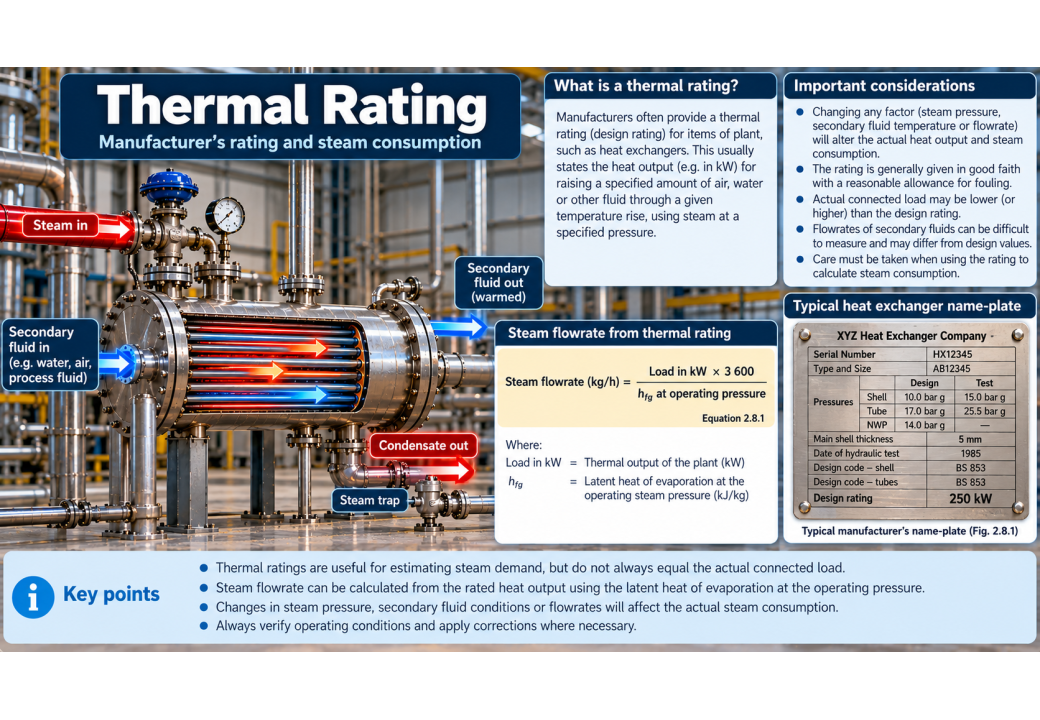
The thermal output stated on a heat exchanger nameplate or technical datasheet is useful only when interpreted in the...
Estimating Steam Consumption in Industrial Applications
Accurate steam-consumption estimation is fundamental to the design of an industrial steam system. Required steam flow affects pipe sizing, boiler capacity, control-valve sizing and steam-trap selection.
Methods of estimating steam consumption
- thermal calculation,
- direct measurement,
- equipment thermal or design rating.
A nameplate thermal rating should not automatically be treated as actual connected steam load because operating conditions can change the real heat output.
Warm-up load and heat-loss load
Steam normally supplies heat for two purposes:
- raising product temperature,
- replacing heat lost to the surroundings.
Total heat demand is the sum of these components.
Basic sensible-heating equation
Q = m · cp · ΔT
Batch and flow applications
| Application type | Characteristic | Examples |
|---|---|---|
| Batch / non-flow | Fixed mass heated over a defined time | Storage vessels, oil tanks, autoclaves |
| Flow | Continuous mass flow heated during passage | Heat exchangers, hot-water heaters, air heaters |
Batch application
Q̇ = m · cp · ΔT / t
Oil-heating example
- volume: 35 L,
- specific gravity: 0.9,
- mass: 31.5 kg,
- cp: 1.9 kJ/(kg·°C),
- 35°C → 120°C,
- time: 600 s.
Q̇ = 8.48 kW
Heat supplied by condensing steam
Q = ms · hfg
ṁs = Q̇ / hfg
Batch heat balance
ṁs · hfg = m · cp · ΔT / t
Kerosene-heating example
- mass: 400 kg,
- 10°C → 40°C,
- time: 1,200 s,
- cp: 2.0 kJ/(kg·°C),
- steam: 4 bar(g),
- hfg: 2,108.1 kJ/kg.
Q̇ = 20 kW
Steam consumption = 34.2 kg/h
Continuous-flow applications
Q̇ = ṁ · cp · ΔT
For steam heating:
ṁs · hfg = ṁ · cp · ΔT
Continuous water-heating example
- water flow: 1.5 L/s ≈ 1.5 kg/s,
- 10°C → 60°C,
- cp: 4.19 kJ/(kg·°C),
- steam: 3 bar(g),
- hfg: 2,133.4 kJ/kg.
Q̇ = 314.25 kW
Steam consumption = 530.3 kg/h
Warm-up and running load
During start-up, lower product temperature can create a higher heat load than normal running conditions. If start-up time is critical, equipment must be able to meet this condition.
Heat losses
Heat losses increase as process temperature rises. Where significant, they must be added to the warm-up or running load.
Large bulk-oil tanks
For large tanks, the bulk oil may be maintained at a lower temperature and only the outgoing flow heated to pumping temperature. Required duty depends on bulk temperature, pumping temperature and flowrate.
From calculation to equipment sizing
The calculated steam flow is used for pipework, control valves, heating surface and steam-trap sizing.
Heat exchangers should be selected from the actual heat load and operating temperatures.
Steam traps and condensate equipment should be sized for actual condensate load and start-up conditions.
On existing installations, flowmeters can provide direct operating data for comparison with calculated demand.
Practical calculation sequence
- Identify batch or flow application.
- Determine mass or mass flowrate.
- Establish inlet and outlet temperatures.
- Select cp.
- Calculate heat load.
- Add significant losses.
- Determine hfg at steam pressure.
- Calculate kg/h steam.
- Check start-up and full-load conditions.
- Size the connected equipment.
Conclusion
Steam consumption should be based on the real process heat load rather than pipe size or nameplate rating alone. Batch duties are strongly affected by heat-up time, while continuous-flow duties are governed mainly by product mass flow, specific heat and temperature rise.
Frequently Asked Questions
How is steam consumption calculated?
By dividing required heat-transfer rate by evaporation enthalpy at the operating steam pressure.
What is the difference between batch and flow heating?
Batch heating warms a fixed mass over a defined time, while flow heating continuously warms a mass flowrate.
Why does heating time affect steam flow?
A shorter time requires a higher mean heat-transfer rate for the same total energy.
What is warm-up load?
The heat required to raise product and equipment temperature.
What is heat-loss load?
The heat rate required to replace energy lost to the surroundings.
Is nameplate rating equal to actual steam consumption?
Not necessarily. Actual consumption depends on operating conditions.
When is flowmeter measurement useful?
On an existing plant operating under representative conditions.
Why should start-up load be checked?
Because start-up can require a higher instantaneous heat demand than steady operation.