Industrial steam systems: from the boiler house to condensate return


In an industrial plant, steam is more than a hot fluid. It is an energy carrier generated centrally, distributed through pipework and used to deliver controlled heat at the point of demand. The system depends on the pressure-temperature relationship of saturated steam and on the energy released when steam condenses.

From an engineering perspective, steam should be assessed as a complete loop: generation, distribution, pressure and flow control, heat transfer, condensate drainage, condensate return and energy monitoring.

Why steam is an effective heat-transfer medium

When water reaches the saturation temperature corresponding to its pressure, it starts to evaporate. The energy required for the phase change is stored as latent heat and is released again when the steam condenses.

The latent heat of steam is of the order of 2,100 kJ/kg, while water has a specific heat capacity of about 4.19 kJ/(kg·°C). On an equal-mass basis, steam may hold roughly five to six times as much potential energy as water.

For saturated steam, temperature is directly related to pressure. Changing pressure therefore changes saturation temperature. During condensation, steam transfers heat at nearly constant temperature for the local pressure.

Steam generation and boiler-house functions

In a typical shell boiler, hot combustion gases pass through the furnace tube and subsequent tube passes to transfer heat to the surrounding boiler water. Once saturation temperature is reached, steam forms and collects in the steam space before entering the distribution system.

Operating under pressure reduces steam volume, enabling substantial mass flow to be distributed through comparatively smaller pipework.

Feedwater is commonly heated to around 80°C before entering the boiler. Untreated water can promote foaming and scale, so water treatment and solids control are important boiler-house functions. Bottom blowdown removes settled solids, while controlled blowdown manages dissolved-solids concentration.

Steam distribution: pressure, pipework and steam quality

Steam flows through the system because of pressure difference. No circulating pump is required on the steam distribution side, although condensate return may require pumping.

Higher steam pressure means lower specific volume, so a given mass flow can often be distributed in smaller pipework. Final sizing depends on flow, pressure and allowable pressure drop.

Insulation reduces heat loss, but condensate still forms during start-up and normal operation. Strainers remove debris and separators remove entrained water droplets before sensitive equipment.

Condensate drainage and steam traps

Condensate should not be allowed to accumulate in steam mains or heat-transfer equipment. It can reduce heat transfer and contribute to corrosion, noise and water hammer.

A steam trap discharges condensate while limiting continuous live-steam loss. Float-operated, thermodynamic and thermostatic traps use different operating principles and suit different duties.

Pressure reduction and process control

Steam is often distributed at a higher pressure than the final user requires. A steam pressure reducing valve reduces pressure near the point of use and therefore adjusts saturation temperature.

Thermal duty is commonly controlled with a valve, sensor, controller and actuator. Pneumatic, electric and self-acting arrangements can all be used depending on the application.

Control valves form the final control element between the steam supply and the process.

Heat transfer at the point of use

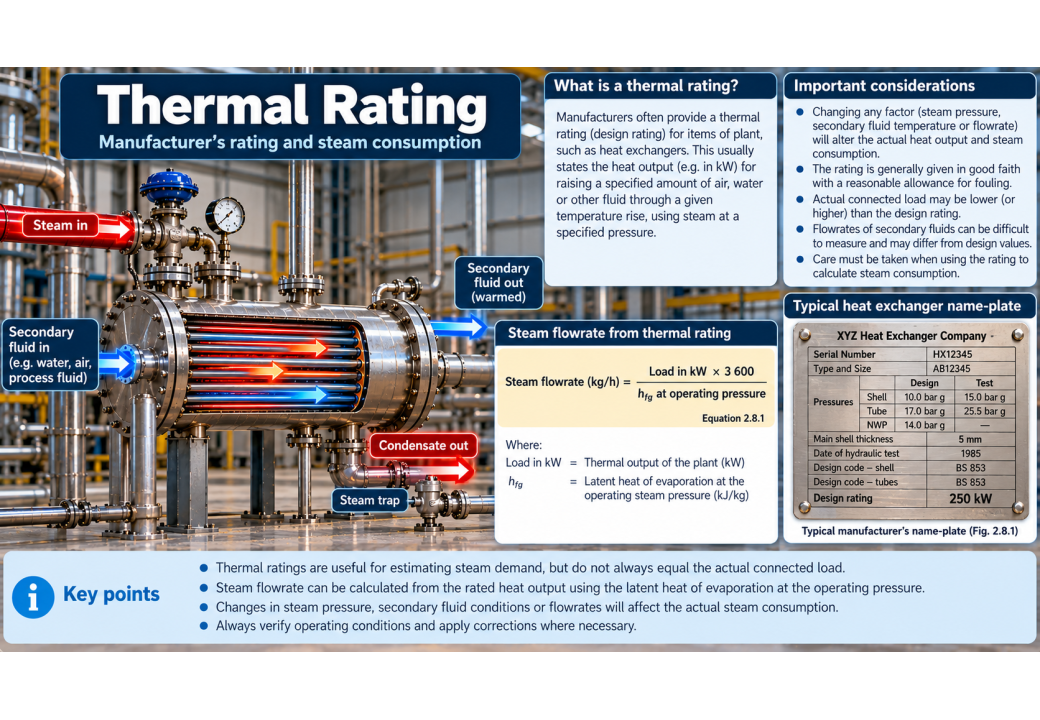
Steam can heat a product through a jacket, coil or heat exchanger. Typical users include jacketed vessels, autoclaves, air heaters, tank coils and liquid heating systems.

Because saturated steam releases latent heat while condensing, the steam-side heat-transfer surface can operate at a relatively uniform temperature.

Condensate return and heat recovery

Uncontaminated condensate remains hot and has already been treated as boiler water. Returning it to the feedtank preserves sensible heat and reduces make-up water and treatment demand.

When hot condensate is reduced to a lower pressure, part of it may re-evaporate as flash steam. Where a suitable lower-pressure load exists, this energy can be reused.

If differential pressure is insufficient for condensate return, mechanical or electric pumps may be required.

Automation, monitoring and maintenance

Steam systems may use local controls or be integrated into SCADA and energy-management systems. Steam flowmeters can be used to measure consumption by department or plant item.

Steam-trap monitoring can identify live-steam leakage and blocked drainage points and help direct maintenance effort.

Industrial applications of steam

Steam is used across food and beverage, pharmaceuticals, oil refining, chemicals, plastics, pulp and paper, sugar, textiles, metal processing, rubber and tyres, shipbuilding and power generation.

It is also used for heating, cooking, curing, fermentation, cleaning, melting, baking, drying, humidification and sterilisation.

Steam, hot water and thermal oil compared

No heat-transfer medium is universally preferable. Hot water is widely used for relatively low-temperature duties, while thermal fluids can be used at much higher temperatures. Steam provides substantial latent heat and does not require a circulation pump on the steam distribution side, but it requires condensate management, water treatment and blowdown.

Characteristic Steam Hot water Thermal oil
Heat-transfer basis Latent heat, about 2,100 kJ/kg Specific heat about 4.19 kJ/(kg·°C) Specific heat often about 1.69-2.93 kJ/(kg·°C)
Distribution Driven by pressure difference Circulation pump required Circulation pump required
Drainage Steam traps and condensate system No steam traps No steam traps

Application example: critical steam tracing

In one wax-product application, a 200 mm product line approximately 4 km long had to be maintained at 80°C, with the ability to reach 90°C during start-up. The product solidified below 60°C and could be damaged above 120°C.

Steam was available at approximately 9 bar(g) and 180°C. Two parallel insulated copper tracer tubes were used to reduce the risk of excessive local heating.

Total tracer length was approximately 11.5 km, with typical 50 m runs positioned around the product pipe and secured at 300 mm intervals.

How to assess a steam system at plant level

A steam system should be assessed as a complete energy system. Generation, distribution, insulation, condensate return, flash-steam recovery, make-up water, water treatment, automation, space and maintenance all affect the result.

The final engineering decision should be based on actual heat loads, pressures, temperatures and operating conditions.

Conclusion

An industrial steam system is a controlled thermal-energy transport system. Steam generation, feedwater quality, distribution pressure, drainage, steam traps, control valves, heat exchangers and condensate return are interdependent.

Frequently Asked Questions

Why is saturated steam suitable for controlled heating?

Because saturation temperature is directly related to pressure and steam releases latent heat at nearly constant temperature as it condenses.

Why is steam often distributed at a higher pressure?

Higher pressure reduces steam specific volume, allowing a given mass flow to be distributed through smaller pipework.

What is the function of a steam trap?

It discharges condensate while limiting continuous live-steam loss.

What problems can condensate accumulation cause?

It can reduce heat transfer and contribute to corrosion and water hammer.

Why should condensate be returned to the boiler house?

Because uncontaminated condensate remains hot and already treated.

When is a condensate pump required?

When gravity or available differential pressure is insufficient to return the condensate.

How is temperature controlled in a steam-heated process?

By changing steam flow and/or pressure with a control valve or pressure reducing valve.

Is steam always better than hot water or thermal oil?

No. Selection depends on the required temperature, thermal load, pressure and overall system conditions.

 
Posted in: Engineering guides