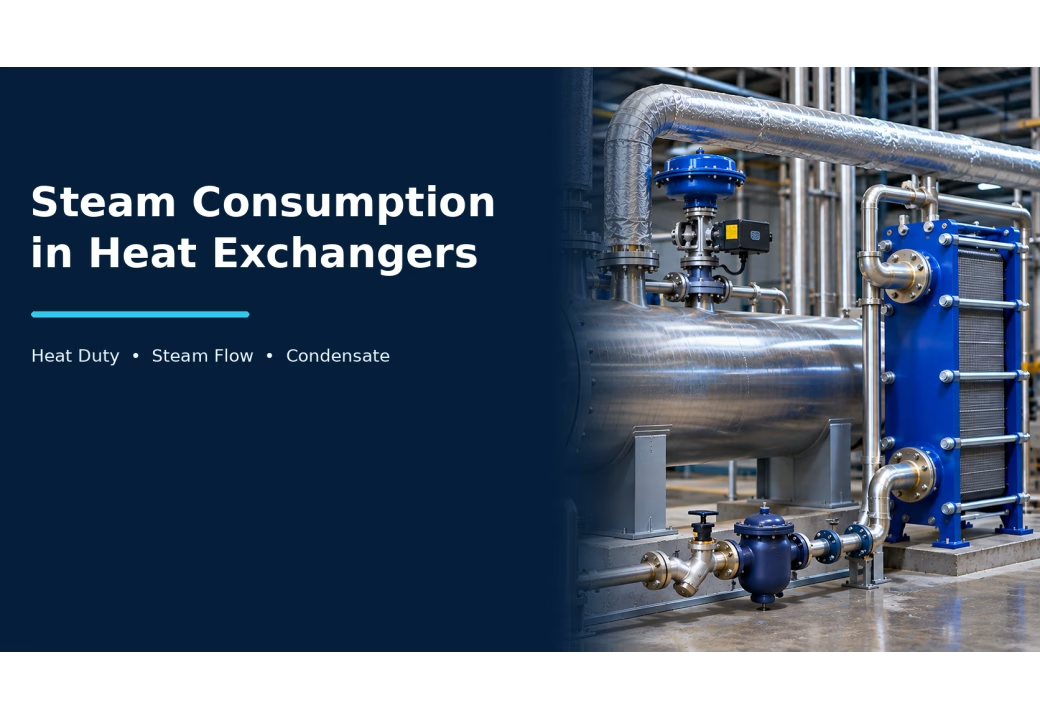
Steam-heated heat exchangers transfer thermal energy from steam to water or another process fluid through a...
Steam Consumption in Pipes and Air Heaters: Warm-up, Heat Loss and Condensate Loads
Steam entering a cold pipeline immediately condenses on the inside wall. During start-up, the metal mass of the main must be heated to operating temperature. Once the pipe is hot, a smaller continuous condensate load remains because heat is lost to the surroundings.
The distinction between warm-up load and running load is fundamental for steam-consumption estimates, condensate drainage and insulation assessment.
Steam-main warm-up load
ṁs = 60 · W · (Ts − Ta) · cp / (hfg · t)
Why slow warm-up is preferred
A longer warm-up time reduces peak condensate production and thermal and mechanical stress.
Typical specific heat values
| Material | cp kJ/(kg·°C) |
|---|---|
| Copper | 0.385 |
| Carbon steel | 0.490 |
| Chromium steel | 0.443 |
| AISI 302 | 0.480 |
| AISI 304 | 0.477 |
| AISI 316 | 0.468 |
| AISI 347 | 0.480 |
Worked warm-up example
- 100 m DN100 carbon-steel main
- 9 PN40 flange pairs
- 1 isolation valve
- 20°C initial temperature
- 14 bar(g), 198°C steam
- hfg = 1,947 kJ/kg
- 30-minute warm-up
Total metal mass: 1,798 kg
Mean warm-up condensate load: 161 kg/h
Steam traps during warm-up
Start-up is commonly the most demanding condition for steam traps and condensate drainage equipment. Within this sizing method, the warm-up load is multiplied by two before being distributed between the installed traps.
Running load
After warm-up, steam condensation is caused by continuing heat loss to the environment.
Effect of air movement
| Air velocity | Emission factor |
|---|---|
| 0–0.5 m/s | 1.0 |
| 1.0 m/s | 1.3 |
| 2.0 m/s | 1.7 |
| 3.0 m/s | 2.0 |
| 4.0 m/s | 2.3 |
| 6.0 m/s | 2.9 |
| 8.0 m/s | 3.5 |
| 10.0 m/s | 4.0 |
Effect of insulation
For DN100 at approximately 15 bar(g), representative insulation factors are:
- 50 mm: f ≈ 0.08
- 75 mm: f ≈ 0.07
- 100 mm: f ≈ 0.06
Running condensate calculation
ṁs = 3.6 · Q · L · f / hfg
For the worked line, effective length is 103 m and running condensate load is:
approximately 18.3 kg/h
| Condition | Condensate load |
|---|---|
| Warm-up | 161 kg/h |
| Running | 18.3 kg/h |
Without effective insulation, the running load in this example would be approximately fourteen times higher.
Steam air heating
In unit heaters and air-heater batteries, steam condenses inside tubes and transfers useful heat to an air stream.
A nominal volumetric heat capacity of 1.3 kJ/(m³·°C) can be used for practical air-heating calculations.
Finned tubes
Fins increase external heat-transfer area and allow a more compact heater. Actual manufacturer data should be used for finned elements.
Unit heaters
Unit heaters combine a steam heating battery and a fan in one casing. Output depends on steam pressure, fan speed, mounting and leaving-air temperature.
Air heater batteries
Air heater batteries are normally installed in ducted systems and may include multiple heating banks, filters, fans and adjustable fresh/recirculated-air louvres.
Steam consumption from rated output
ṁs = Q̇ · 3,600 / hfg
For 44 kW at 3.5 bar(g), hfg = 2,120 kJ/kg:
steam consumption ≈ 75 kg/h
Steam consumption from airflow
ṁs = 3,600 · V̇ · ΔT · cv / hfg
Air-heater battery example
- air flow: 2.3 m³/s
- 18°C → 82°C
- ΔT = 64°C
- steam at 3 bar(g)
- hfg = 2,133 kJ/kg
steam consumption ≈ 323 kg/h
Effect of tube arrangement
In natural convection, additional horizontal rows become progressively less effective. With ten pipes, the representative emission factor falls to approximately 0.63.
Forced airflow increases heat transfer and therefore steam condensation.
Control and drainage
Actual heating duty should be considered together with control-valve selection, condensate drainage, steam pressure and heater configuration.
Conclusion
Warm-up and normal running are different design conditions. In well-insulated mains, warm-up usually produces the highest condensate load, while insulation controls permanent energy loss.
For air heaters, steam consumption can be calculated from rated thermal output or from actual airflow and temperature rise.
Frequently Asked Questions
Why is warm-up load higher?
Because the entire metal mass of the main must be heated.
How can it be reduced?
By allowing a longer warm-up period.
How does insulation affect steam use?
It greatly reduces continuous running heat loss.
Which load is used for trap sizing?
The more demanding of warm-up and running duty should be checked.
How is heater steam use calculated from kW?
Using ṁs = Q̇·3,600/hfg.
Why are fins used?
To increase external heat-transfer area.