

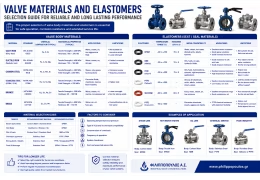
Valve material selection should not be based only on nominal pressure or valve size. Operating pressure, temperature,...
What is EN 1092-1?
EN 1092-1 is the part of the EN 1092 standard that covers steel flanges. It is used in industrial piping, valves, fittings, pumps, strainers, heat exchangers, vessels and other equipment connected by PN flanged joints.
The standard defines the main geometrical and technical requirements of the flange, including outside diameter, bolt circle, number and diameter of bolt holes, thickness, sealing face, flange type, materials and marking.
Where EN 1092-1 is used
EN 1092-1 is used for circular steel flanges with PN designations. It is commonly found in steam, condensate, water, thermal oil, compressed air, chemical fluid, HVAC, industrial process and energy systems.
For industrial valves, reference to EN 1092-1 indicates that the flanged connection follows the European PN system and not an ASME Class system.
What EN 1092-1 covers
| Item | What it defines | Importance in valve selection |
|---|---|---|
| PN | Nominal pressure designation | Helps select the flange and valve for the required pressure and temperature conditions. |
| DN | Nominal size | Must match the pipeline and valve size. |
| Bolt circle | Bolt hole circle diameter and bolt arrangement | Defines whether the valve can be bolted correctly to the line flange. |
| Bolt holes | Number and diameter of holes | Essential for mechanical compatibility during installation. |
| Sealing face | Form and surface finish of the gasket contact area | Affects gasket selection and tightness of the flanged joint. |
| Materials | Material groups for steel flanges | Related to pressure, temperature, fluid and corrosion requirements. |
| Marking | Information to be marked on the flange | Supports identification, traceability and compatibility checks. |
EN 1092-1 and PN
PN is a nominal pressure designation used to classify flanges, valves and fittings in European piping systems. It should not be considered independently from temperature and material.
The actual allowable operating pressure depends on the flange material and operating temperature. For this reason, technical selection should consider pressure/temperature ratings and not only the PN marking.
EN 1092-1 flange types
EN 1092-1 includes different types of steel flanges. The choice of flange type depends on the connection method, pressure, temperature, pipework, fluid and maintenance requirements.
| Flange type | Description | Typical use |
|---|---|---|
| Plate flange | Flat flange for welding or general use | Low to medium duty pipework, depending on the application. |
| Weld neck flange | Flange with welding neck | Higher pressure, temperature or mechanical load requirements. |
| Blind flange | Closed flange without a central bore | Line ends, vessel nozzles, inspection points or future extensions. |
| Threaded flange | Flange with internal thread | Special installations where welding is not used. |
| Loose flange / lapped flange | Flange used with collar or lapped end | Applications requiring easier alignment or a special joint arrangement. |
Sealing faces
The sealing face of the flange affects gasket selection and the performance of the flanged joint. In flanged valves, the valve flange face must be compatible with the pipe flange face and with the selected gasket.
Incorrect selection of sealing face or gasket can lead to leakage, uneven compression, gasket damage or joint failure during operation.
EN 1092-1 and industrial valves
In a flanged industrial valve, EN 1092-1 refers to the connection between the valve and the pipeline. It does not define valve function, seat tightness, pressure testing or material certification.
For a complete valve specification, EN 1092-1 is often combined with standards such as EN 558 for installation length, EN 12266-1 for pressure testing and EN 10204 for inspection documents.
| Standard | Subject | Role in valve selection |
|---|---|---|
| EN 1092-1 | PN flanges | Defines the flanged connection of the valve. |
| EN 558 | Face-to-face and centre-to-face dimensions | Defines the valve installation length. |
| EN 12266-1 | Pressure and tightness testing | Defines body and tightness testing of the valve. |
| EN 10204 | Certificates and inspection documents | Defines the documentation supplied with the product. |
EN 1092-1 and ASME B16.5
EN 1092-1 and ASME B16.5 are different flange systems. EN 1092-1 uses PN designations, while ASME B16.5 uses Class designations such as Class 150, 300 or 600.
PN and Class flanges should not be considered automatically interchangeable. Dimensions, bolt holes, diameters, sealing faces, materials, pressure, temperature and project requirements must be checked case by case.
What to check before ordering
- DN of the line and valve.
- PN of the flange, pipework and valve.
- Flange type according to EN 1092-1.
- Sealing face and gasket compatibility.
- Number and diameter of bolt holes.
- Bolt circle and mechanical compatibility with the existing installation.
- Flange material and operating temperature.
- Pressure/temperature rating for the selected material.
- Compatibility with EN 558 when the flange is part of a replacement valve.
- Testing and certification requirements, such as EN 12266-1 and EN 10204.
Example wording for a purchase order
In a purchase order for a flanged industrial valve, the requirement may be written as follows:
Flanged metallic industrial valve with flanges according to EN 1092-1, suitable for the DN, PN, material and operating temperature of the line, with face-to-face dimension according to EN 558, tested according to EN 12266-1 and supplied with EN 10204 3.1 certificate where required.
Related equipment categories
- Globe valves
- Bellow seal valves
- Gate valves
- Ball valves
- Butterfly valves
- Check valves
- Control valves
- Strainers
Frequently asked questions about EN 1092-1
What is EN 1092-1?
EN 1092-1 is a European standard for circular steel PN flanges used with pipes, valves, fittings and accessories.
Does EN 1092-1 apply only to valves?
No. It applies to flanges for pipes, valves, fittings and accessories. For valves, it is used to ensure compatibility of the flanged connection.
What does PN mean on a flange?
PN is a nominal pressure designation. The actual allowable pressure depends on the flange material and operating temperature.
Is an EN 1092-1 flange compatible with an ASME Class flange?
Not necessarily. PN and Class systems have different dimensions and bolt patterns. Compatibility must be checked case by case.
Does EN 1092-1 define the valve length?
No. Valve installation length is defined by EN 558 or another relevant dimensional standard.