
Blog navigation

Latest posts

Valve Materials and Elastomers

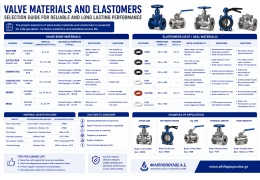
Valve material selection should not be based only on nominal pressure or valve size. Operating pressure, temperature,...

Read more

Engineering guides

Engineering Guides for Steam Systems, Piping and Industrial Valves

The engineering guides section of Philippopoulos S.A. provides practical technical information for the preliminary design, review and selection of equipment used in industrial steam, water, air and thermal fluid networks.

The guides cover topics such as saturated steam tables, recommended flow velocities, pressure drop in steam lines, air content in steam systems, flash steam calculation, thermal expansion of pipework, valve body materials and elastomer selection.

This content is intended for plant engineers, technical departments, maintenance teams, designers and procurement engineers who require technical data for valves, steam traps, piping, pressure reducing valves, heat exchangers and industrial network equipment.

 
Sort by:
  • Valve Materials and Elastomers
    Valve Materials and Elastomers

    Valve material selection should not be based only on nominal pressure or valve size. Operating pressure, temperature, fluid compatibility, corrosion risk, mechanical loads, connection type, design standards and installation requirements must be evaluated together. The following tables provide indicative material equivalents according to EN, DIN, WNr and ASTM designations, together with typical temperature limits. These limits do not replace pressure-temperature ratings from applicable...

    Read more
  • Expansion of Pipes in Steam Systems
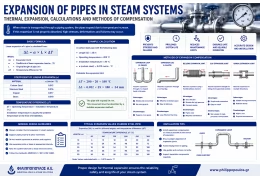
    Expansion of Pipes in Steam Systems

    In steam and hot fluid systems, pipe length increases as temperature rises. Thermal expansion must be considered during system design in order to avoid high mechanical stresses, excessive loads on fixed points, pipe deformation and forces transmitted to valves, flanges, steam traps, heat exchangers and other equipment. Proper arrangement of pipe guides, supports, fixed points and expansion joints allows the pipework to move in a controlled manner and absorb the change in length caused by...

    Read more
  • Calculating Flash Steam
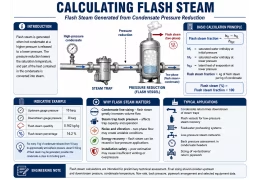
    Calculating Flash Steam

    Flash steam is generated when hot condensate at a higher pressure is released to a lower pressure. The pressure reduction lowers the saturation temperature, and part of the heat contained in the condensate is converted into steam. This phenomenon commonly occurs downstream of steam traps, pressure reducing points, condensate return lines and flash vessels. Correct estimation of flash steam quantity is important for sizing condensate lines, flash vessels, vents and energy recovery systems.

    Read more
  • Content of Air in Steam Systems
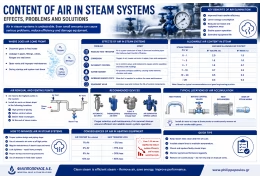
    Content of Air in Steam Systems

    The presence of air and other non-condensable gases in a steam system affects saturation temperature, heat transfer and equipment operation. Even a small percentage of air can cause a significant reduction in the actual steam temperature at the point of use. Correct air venting, removal of non-condensable gases and proper selection of steam traps and air vents are therefore important factors in the operation of industrial steam systems.

    Read more
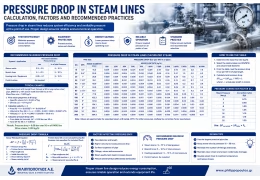
  • Pressure Drop in Steam Lines
    Pressure Drop in Steam Lines

    Pressure drop in a steam distribution network directly affects the available pressure at the point of use, as well as the operation of control valves, pressure reducing valves, steam traps and heat exchangers. For preliminary technical checks, pressure drop may be estimated using the steam density, flow velocity and the total resistance coefficient of the pipework and installed components.

    Read more
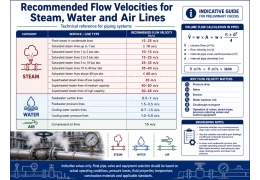
  • Recommended Flow Velocities for Steam, Water and Air Lines
    Recommended Flow Velocities for Steam, Water and Air Lines

    The following values may be used as an indicative guide for preliminary checks of flow velocities in industrial steam, condensate, feedwater, cooling water and compressed air piping systems. Proper flow velocity selection affects pressure drop, noise, erosion, water hammer risk, condensate transport and the operation of valves, steam traps, pressure reducing valves and control equipment.

    Read more
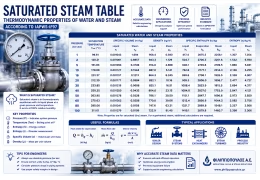
  • Saturated Steam Table
    Saturated Steam Table

    The following table presents basic thermodynamic properties of saturated steam as a function of absolute pressure. The data may be used as a technical reference for preliminary calculations and equipment selection in steam systems, including steam traps, control valves, pressure reducing valves, safety valves, condensate lines and heat exchange applications.

    Read more
Showing 1 to 7 of 7 (1 Page)