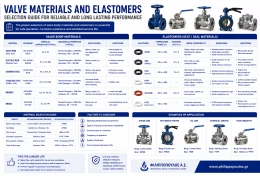
Valve material selection should not be based only on nominal pressure or valve size. Operating pressure, temperature,...
Valve Materials and Elastomers
TECHNICAL DATA
EN, DIN, WNr and ASTM Equivalents – Engineering Selection Guide
Valve material selection should not be based only on nominal pressure or valve size. Operating pressure, temperature, fluid compatibility, corrosion risk, mechanical loads, connection type, design standards and installation requirements must be evaluated together.
The following tables provide indicative material equivalents according to EN, DIN, WNr and ASTM designations, together with typical temperature limits. These limits do not replace pressure-temperature ratings from applicable standards or manufacturer technical documentation.
Carbon Steel
Carbon steel is commonly used for steam, hot water, condensate, thermal oil and general industrial services. It is suitable for relatively high temperatures, but low-temperature service and corrosive fluids require specific verification.
| Category | EN | DIN | WNr | ASTM | Indicative Temperature | Engineering Note |
|---|---|---|---|---|---|---|
| Forged carbon steel | P245N | C22.8 | 1.0460 | A106 / A350 LF2 | -20°C to +425°C -46°C to +425°C for LF2 |
Used for pressure parts, pipework and fittings. LF2-type grades are preferred where low-temperature toughness is required. |
| Cast carbon steel | GP240GH | GSC-25 | 1.0619 / 1.1156 | A216 WCB / A352 LCB | -29°C to +425°C -45°C to +345°C for LCB |
Typical valve body material for steam and industrial fluids. Selection between WCB and LCB depends mainly on minimum operating temperature. |
Stainless Steel
Stainless steels are selected when corrosion resistance, fluid cleanliness or low-temperature operation is required. The choice between 304, 304L, 316 and 316L should consider the fluid, chloride content, temperature and welding requirements.
| Category | EN / DIN | WNr | ASTM | Indicative Temperature | Engineering Note |
|---|---|---|---|---|---|
| Forged stainless steel 304 | X5CrNi18-10 | 1.4301 | A182 F304 | -196°C to +815°C | General stainless grade. Not the first choice where chlorides or localized corrosion are expected. |
| Forged stainless steel 304L | X2CrNi19-11 | 1.4306 | A182 F304L | -196°C to +425°C | Lower carbon content for improved behaviour in welded constructions. |
| Forged stainless steel 316 | X5CrNiMo17-12-2 | 1.4401 | A182 F316 | -196°C to +815°C | Molybdenum-bearing stainless steel, preferred over 304 in many corrosive applications. |
| Forged stainless steel 316L | X2CrNiMo17-12-2 | 1.4404 | A182 F316L | -196°C to +455°C | Common choice for chemical, pharmaceutical, food and welded applications. |
| Cast stainless steel 304 / 316 | GX6CrNi18-9 / GX6CrNiMo19-11-2 | 1.4308 / 1.4408 | A351 CF8 / CF8M | -196°C to +815°C | Typical cast stainless valve body materials. CF8M / 1.4408 is selected when better corrosion resistance than CF8 is required. |
| Cast stainless steel 304L / 316L | GX2CrNi19-11 / GX2CrNiMo19-11-2 | 1.4309 / 1.4409 | A351 CF3 / CF3M | -196°C to +425/+455°C | Lower carbon grades used to reduce sensitization risk in welded or thermally exposed applications. |
Cast Iron and Ductile Iron
Cast iron and ductile iron are mainly used in water, HVAC, cooling, heating and general utility networks. Their use in steam, thermal shock or severe mechanical loading applications should be carefully evaluated.
| Material | EN | DIN | WNr | ASTM | Indicative Temperature | Engineering Note |
|---|---|---|---|---|---|---|
| Cast iron | EN-GJL-250 / EN-GJL-200 | GG25 / GG20 | 0.6020 / 0.6023 | A48 class 30B / 35B | -10°C to +200°C | Suitable for non-shock water and general services. It should not be used in steam or water-hammer-prone systems without verification. |
| Ductile iron | EN-GJS-500-7 / EN-GJS-400-15 / EN-GJS-400-18 | GGG50 / GGG40 / GGG40.3 | 0.7050 / 0.7040 / 0.7043 | A536 Gr 80-55-06 / 65-45-12 / 60-40-18 | -15°C to +350°C -20°C to +350°C for GGG40.3 |
Better mechanical behaviour than grey cast iron. Common in butterfly valves, check valves and HVAC / industrial valves. |
Brass and Bronze
Copper alloys are mainly used in smaller sizes, water, air, utility services and selected marine applications. Chemical compatibility and dezincification resistance should be checked in aggressive waters or corrosive environments.
| Material | EN | DIN | WNr | ASTM | Indicative Temperature | Engineering Note |
|---|---|---|---|---|---|---|
| Brass | CW617N / CW614N / CW510L | CuZn40Pb2 / CuZn39Pb3 / CuZn42 | 2.0402 / 2.0372 | B124 C37700 / C38500 / C28500 | -10°C to +200°C | Common for water, air and utility lines. Not recommended without verification for aggressive fluids or high-temperature service. |
| Bronze | CC491K / CB491K | CuSn5Zn5Pb5-C / CuSn5Zn5Pb5-B | 2.1096 / 2.1097 | B62 C83600 / B30 C83600 | -10°C to +260°C | Used in water, marine and utility applications, depending on alloy composition and corrosion requirements. |
Elastomers for Butterfly Valves
In butterfly valves, the elastomer seat is often the limiting selection factor. The metallic body may be mechanically suitable, while the elastomer may be unsuitable for the fluid, temperature or operating mode. Chemical compatibility must always be verified.
| Elastomer | Indicative Temperature | Typical Use | Not Recommended For | Engineering Note |
|---|---|---|---|---|
| EPDM | -10°C to +110°C | Cold and hot water, sea water, alkaline products, sodium hydroxide. | Hydrocarbons, steam, gases, acids, oil, freon. | Good choice for water and HVAC. It should not be treated as suitable for oils or hydrocarbons. |
| NBR | -10°C to +90°C | Non-aromatic hydrocarbons, natural gas, greases, oil, compressed air, glycol, water. | Atmospheric exposure, petrol, solvents. | Often selected for oils and air. Its temperature limit is lower than EPDM and FKM. |
| FKM | -5°C to +180°C | Acids, greases, hydrocarbons, petrol, fuel, oil, gases. | Steam and hot water above approximately 130°C, freon, alkaline products. | Suitable for many chemicals and hydrocarbons. It is not a universal steam seat material. |
| Natural Rubber | -10°C to +60°C | Alcohols, acetone, food, abrasive fluids, powders. | Acids and hydrocarbons. | Useful in low-temperature abrasive services. Limited with chemicals and temperature. |
| Silicone | -30°C to +150°C | High temperature, air or inert gases. | Steam and hot water above approximately 100°C, solvents. | Used where temperature resistance and cleanliness are required, not as a general steam seat. |
| Food Silicone | -30°C to +150°C | Food applications. | Other applications without compatibility check. | Selected where food suitability and material cleanliness are required. |
Practical Material Selection Logic
In real engineering work, material selection should not start from an equivalence table. It should start from the operating conditions. The table is used to confirm standard equivalents and narrow down the acceptable options.
- Define the fluid: water, steam, condensate, air, natural gas, oil, sea water, chemical or food product.
- Define pressure and temperature: not only nominal values, but minimum, maximum and start-up conditions.
- Check material compatibility: body, disc, stem, seat, gaskets and elastomers.
- Check applicable standards: EN, DIN, ASTM, ASME, pressure-temperature rating, flanged connection, welded ends or threaded connection.
- Check operating mode: on/off, throttling, operating cycles, water hammer risk, differential pressure and flow velocity.
Important Engineering Notes
- Material temperature limits do not automatically mean that the valve is suitable over the full pressure and temperature range.
- Pressure-temperature ratings from the applicable valve standard and manufacturer data must be checked for pressure equipment.
- Elastomers often have a narrower operating range than the metallic body and may define the actual valve limit.
- Steam, hot water, thermal oil and chemical services require compatibility confirmation before final selection.
- EN / DIN / ASTM equivalence is useful, but should not be considered full interchangeability without checking chemical composition, mechanical properties and the applicable manufacturing standard.
Related Equipment
Philippopoulos S.A. supplies valves and equipment for industrial and marine systems, including butterfly valves, ball valves, globe valves, check valves, control valves, steam traps, pressure reducing valves, safety valves, strainers, separators and boiler house equipment.