

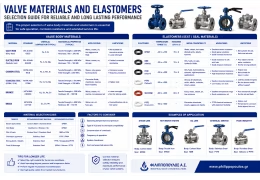
Valve material selection should not be based only on nominal pressure or valve size. Operating pressure, temperature,...
What is EN 558?
EN 558 is a European standard that defines the main installation dimensions of metallic industrial valves used in flanged piping systems. The key dimensions covered by the standard are face-to-face dimensions and centre-to-face dimensions.
The standard does not define shell strength, body material, tightness performance, test pressure or the type of certificate supplied with the valve. These are defined by other standards, such as product standards, flange standards, testing standards and inspection document standards.
What does face-to-face dimension mean?
The face-to-face dimension is the valve length between the two connection ends in the pipeline. For flanged valves, it is the distance between the two flange faces of the valve.
This dimension is critical for installation because it determines whether the valve can be correctly installed between the existing pipe flanges. When replacing an existing valve, the face-to-face dimension is one of the first items that should be checked.
What does centre-to-face dimension mean?
The centre-to-face dimension is mainly used for angle valves or valve designs where the flow direction changes. It describes the distance from the centreline of one connection to the face of the other connection.
The centre-to-face dimension is important in special piping arrangements, compact installations, angle-type valves and cases where the geometry of the pipeline does not allow easy modification.
Where EN 558 is used
EN 558 is used for metallic industrial valves installed in flanged piping systems. It covers PN and Class designated valves, including European and international valve series used in industrial installations.
The standard is especially useful in maintenance, replacement, retrofit, technical procurement and piping design projects where dimensional compatibility of the valve is essential.
Valve types covered
EN 558 applies to metallic industrial valves installed in flanged pipe systems. In practice, it is commonly relevant to many valve families used for isolation, control and non-return service.
| Valve type | Relation to EN 558 | Item to check |
|---|---|---|
| Globe valves | Definition of installation length | Face-to-face dimension by DN and PN or Class |
| Gate valves | Compatibility with existing pipework | Body length and construction series |
| Check valves | Verification of installation dimension | Face-to-face length and body type |
| Ball valves | Comparison of full bore or reduced bore designs | Length between flanges |
| Butterfly valves | Check of wafer, lug or flanged construction | Compatibility with flanges and installation space |
| Control valves | Check of replacement and installation length | Face-to-face dimension in relation to actuator and pipework |
Why EN 558 is important when replacing a valve
In many industrial plants, a valve must be replaced without modifying the existing pipework. If the new valve has a different face-to-face dimension from the existing valve, cutting, modification, a spool piece or changes to the flange arrangement may be required.
For this reason, the EN 558 series should be checked before ordering, especially when the valve is intended as a replacement in an existing installation.
EN 558, PN and Class
EN 558 covers valves designated by PN and Class. PN is mainly used in European systems, while Class is used in systems following American or international practice.
Having the same DN or NPS does not necessarily mean that two valves have the same installation length. The relevant face-to-face series, valve product standard, pressure designation and valve type should always be checked.
EN 558 and EN 1092-1
EN 558 and EN 1092-1 refer to different aspects of the installation. EN 558 refers to the valve installation length, while EN 1092-1 refers to PN flanges, including dimensions, bolt holes, facing types and pressure designations.
For a flanged valve, both should be checked: the valve face-to-face dimension and the flange compatibility with the pipework.
| Standard | Subject | Use in valve selection |
|---|---|---|
| EN 558 | Face-to-face and centre-to-face dimensions | Checks the valve installation length. |
| EN 1092-1 | PN flanges | Checks flange and bolting compatibility. |
| EN 12266-1 | Valve pressure testing | Checks body and tightness testing. |
| EN 10204 | Certificates and inspection documents | Defines the documentation supplied with the valve. |
EN 558 and ASME B16.10
In projects where European and American specifications are both used, EN 558 may need to be compared with ASME B16.10. ASME B16.10 is used for face-to-face and end-to-end dimensions of valves in ASME piping systems.
The choice between EN 558 and ASME B16.10 should be based on the project specification, piping system, flanges, design pressure and end-user requirements.
What to check before ordering
- Valve type, such as globe, gate, check, ball or butterfly.
- DN or NPS of the line.
- PN or Class of the valve and piping system.
- Connection type, such as flanged, wafer or lug.
- Face-to-face or centre-to-face dimension.
- EN 558 series, where stated by the manufacturer.
- Compatibility with existing pipework.
- Flange compatibility according to the applicable flange standard.
- Testing and certification requirements, such as EN 12266-1 and EN 10204.
Example wording for a purchase order
In a technical purchase order for an industrial valve, the requirement may be written as follows:
Flanged metallic industrial valve with face-to-face dimension according to EN 558, suitable for the nominal diameter and pressure designation of the line, tested according to EN 12266-1 and supplied with EN 10204 3.1 certificate where required.
Related equipment categories
- Globe valves
- Bellow seal valves
- Gate valves
- Ball valves
- Butterfly valves
- Check valves
- Control valves
Frequently asked questions about EN 558
What is EN 558?
EN 558 is a standard that defines face-to-face and centre-to-face dimensions of metallic industrial valves for flanged piping systems.
What does face-to-face mean in a valve?
Face-to-face is the distance between the two connection ends of the valve. For flanged valves, it is the distance between the two flange faces.
Why is EN 558 important when replacing a valve?
It is important because it confirms whether the new valve has the correct installation length to fit into the existing pipework without modification.
Does EN 558 define the valve operating pressure?
No. EN 558 covers installation dimensions. Operating pressure, shell strength and materials are defined by other standards and by the technical specification.
Does EN 558 replace EN 1092-1?
No. EN 558 covers the valve length, while EN 1092-1 covers PN flanges. For flanged valves, both should be checked.