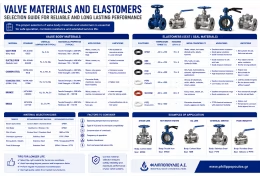

Valve material selection should not be based only on nominal pressure or valve size. Operating pressure, temperature,...
Content of Air in Steam Systems
TECHNICAL DATA
Effect of Air on Saturation Temperature
The presence of air and other non-condensable gases in a steam system affects saturation temperature, heat transfer and equipment operation. Even a small percentage of air can cause a significant reduction in the actual steam temperature at the point of use.
Correct air venting, removal of non-condensable gases and proper selection of steam traps and air vents are therefore important factors in the operation of industrial steam systems.
Effect of Air on Saturation Temperature
In a pure saturated steam system, pressure and temperature have a defined relationship. When air is present in the system, part of the total pressure is created by air rather than steam. As a result, the partial pressure of steam is reduced and the actual saturation temperature is lower than the value expected from the total pressure reading.
As an indication, at an operating pressure of 7 barg, pure saturated steam has a temperature of approximately 170°C. If the air content reaches about 20% by volume, the actual steam temperature may fall to approximately 160°C.
Air Content in Steam Systems Table
The following table shows the required gauge pressure for air-contaminated steam in order to achieve the same saturation temperature as pure steam at the corresponding pressure.
| Saturated Steam Temperature ts (°C) |
Gauge Pressure with Pure Steam P (barg) |
1% Air Required Pressure (barg) |
3% Air Required Pressure (barg) |
6% Air Required Pressure (barg) |
9% Air Required Pressure (barg) |
12% Air Required Pressure (barg) |
15% Air Required Pressure (barg) |
|---|---|---|---|---|---|---|---|
| 120.23 | 1 | 1.02 | 1.06 | 1.13 | 1.20 | 1.27 | 1.35 |
| 133.54 | 2 | 2.03 | 2.09 | 2.19 | 2.32 | 2.41 | 2.53 |
| 143.62 | 3 | 3.04 | 3.12 | 3.25 | 3.40 | 3.52 | 3.71 |
| 158.84 | 5 | 5.06 | 5.18 | 5.38 | 5.60 | 5.82 | 6.06 |
| 184.05 | 10 | 10.11 | 10.34 | 10.70 | 11.09 | 11.50 | 11.94 |
| 201.36 | 15 | 15.16 | 15.48 | 16.02 | 16.58 | 17.20 | 17.82 |
| 214.84 | 20 | 20.21 | 20.65 | 21.34 | 22.07 | 22.87 | 23.70 |
Why Air Causes Problems in Steam Systems
| Technical Issue | Effect on the Steam System | Equipment Selection Note |
|---|---|---|
| Reduced temperature | The actual temperature at the point of use is lower than expected. | Air venting and correct vent location should be checked. |
| Reduced heat transfer | Air acts as an insulating layer on heat transfer surfaces. | Heat exchangers, heating coils and process heaters can be affected. |
| Delayed start-up | Air must be removed before steam can fully reach the equipment. | Thermostatic air vents and suitable start-up steam traps are useful. |
| Corrosion | Air and oxygen increase the risk of corrosion in pipework and equipment. | Correct drainage, venting and feedwater treatment are required. |
| Control instability | The actual temperature may differ from the expected pressure-temperature relationship. | Important in temperature control valves and processes with narrow operating limits. |
Engineering Notes for Design and Maintenance
- Steam systems should include suitable air venting points at high points and line ends.
- During start-up, air should be removed quickly to reduce warm-up time.
- In heat exchangers and coils, air reduces heat transfer performance and may create cold zones.
- Steam trap selection should consider not only condensate discharge, but also air venting capability.
- Operating temperature should be compared with steam pressure to identify possible air contamination.
Related Equipment for Steam Systems
Philippopoulos S.A. supplies equipment for industrial and marine steam systems, including steam traps, thermostatic air vents, separators, strainers, isolation valves, control valves, pressure reducing valves, safety valves, condensate pumps and boiler house equipment.