
Blog navigation

Latest posts

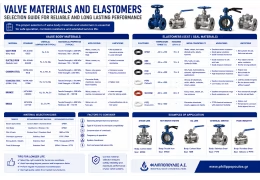
Valve Materials and Elastomers

Valve material selection should not be based only on nominal pressure or valve size. Operating pressure, temperature,...

Read more

Pressure Drop in Steam Lines


Technical Reference for Steam Piping Systems

Pressure drop in a steam distribution network directly affects the available pressure at the point of use, as well as the operation of control valves, pressure reducing valves, steam traps and heat exchangers.

For preliminary technical checks, pressure drop may be estimated using the steam density, flow velocity and the total resistance coefficient of the pipework and installed components.

Basic Calculation Formula

Δp = C × ρ × w2 / 2

  • Δp: pressure drop
  • C: flow resistance coefficient of the pipe or component
  • ρ: steam density, in kg/m³
  • w: steam velocity, in m/s

In practice, the total resistance coefficient is calculated by adding the individual resistance coefficients of the pipework and fittings:

Ctotal = Cpipe + Cvalves + Celbows + Ctees + Cfittings

Typical Factors Increasing Pressure Drop

Pipeline Component Effect on Pressure Drop Engineering Note
Long pipe runs Increased friction losses The effect increases as steam velocity increases.
Angle valves Medium to high resistance The change in flow direction creates additional pressure losses.
Globe valves Higher resistance than full-bore isolation valves Suitable for control duties, but with higher local pressure drop.
Fully open gate valves Low resistance Mainly used for isolation, not for regulation.
90° elbows Local pressure loss Multiple elbows in short pipe runs can significantly increase losses.
Tee pieces Local resistance due to branching or change of direction The loss depends on flow direction and tee configuration.
Special valves and fittings Variable resistance Manufacturer technical data should be checked.

Pressure Drop Calculation Example

For a DN 50 steam line including a pipe run, valves, a tee piece and elbows, the total resistance coefficient is calculated by adding the individual resistance values.

Component Quantity / Data Coefficient C
DN 50 pipeline Length 20 m 8.1
Angle valve 1 piece 3.3
Special valves 2 pieces 5.6
Tee piece 1 piece 3.1
90° elbows 2 pieces 1.0
Total ΣC 21.1

Operating Data

  • Steam temperature: 300°C
  • Absolute steam pressure: 16 bar
  • Steam velocity: 40 m/s

Indicative result: Δp ≈ 1.1 bar

Engineering Notes

Pressure drop should be considered when sizing steam lines, especially where control valves, pressure reducing valves, strainers, separators, steam traps and multiple changes of direction are installed.

Excessive pressure drop may result in insufficient pressure at the point of use, reduced heat transfer performance, unstable control and increased flow velocity. High steam velocities may also increase noise, erosion, energy losses and the risk of water hammer.

Final equipment selection should consider operating pressure, temperature, flow rate, steam density, steam quality, pipe losses and the technical characteristics of each valve or component.

Related Equipment for Steam Systems

Philippopoulos S.A. supplies equipment for industrial and marine steam systems, including isolation valves, control valves, pressure reducing valves, safety valves, steam traps, strainers, separators, condensate pumps and boiler house equipment.

Note: The above formulas and values are intended for preliminary technical checks. Final sizing should be based on actual operating conditions and the technical data of the selected equipment.

 
Posted in: Engineering guides