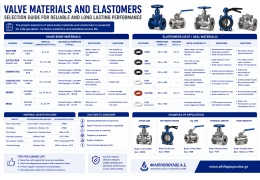

Valve material selection should not be based only on nominal pressure or valve size. Operating pressure, temperature,...
Expansion of Pipes in Steam Systems
TECHNICAL DATA
Thermal Expansion in Steam and Hot Fluid Pipework
In steam and hot fluid systems, pipe length increases as temperature rises. Thermal expansion must be considered during system design in order to avoid high mechanical stresses, excessive loads on fixed points, pipe deformation and forces transmitted to valves, flanges, steam traps, heat exchangers and other equipment.
Proper arrangement of pipe guides, supports, fixed points and expansion joints allows the pipework to move in a controlled manner and absorb the change in length caused by temperature variation.
Basic Principle of Thermal Expansion
Linear pipe expansion depends on the original pipe length, the temperature difference and the pipe material. For steel pipework, expansion can be estimated during preliminary checks using the following equation:
ΔL = α × L × ΔT
- ΔL: change in pipe length, in m or mm
- α: coefficient of linear thermal expansion of the material, in 1/K
- L: original pipe length
- ΔT: temperature difference, in K or °C
For preliminary calculations of steel pipework, an indicative coefficient of linear expansion of approximately 12 × 10-6 1/K is often used. The final value depends on the pipe material and actual operating conditions.
Pipe Expansion Calculation Example
Indicative example for a steam pipe:
| Data | Value |
|---|---|
| Pipe length | 45 m |
| Temperature difference | 265 K |
| Indicative change in length | approximately 156 mm |
This change in length should not be ignored. In long steam lines, thermal expansion can generate significant forces at fixed points and transfer loads to valves, flanges, equipment nozzles and pipe supports.
Technical Factors to Consider
| Factor | Effect on the System | Design Note |
|---|---|---|
| Pipe length | The longer the pipe run, the greater the total expansion. | Expansion should be checked in long straight pipe sections. |
| Temperature difference | Expansion increases in proportion to temperature variation. | Important during cold start-up and in high-temperature steam service. |
| Pipe material | Each material has a different coefficient of thermal expansion. | Material-specific values should be used according to pipework standards. |
| Fixed points | Receive forces generated by restrained pipe expansion. | They should be mechanically checked and located correctly. |
| Pipe guides | Guide pipe movement in the required direction. | Critical near expansion joints and in straight pipe runs. |
| Expansion joints | Absorb axial, lateral or angular movement. | Selection should consider pressure, temperature, movement and operating cycles. |
| Valves and equipment | May receive loads from incorrectly supported pipework. | Valves should not be used as pipe supports. |
Role of Expansion Joints, Guides and Fixed Points
Expansion joints are used to absorb changes in pipe length and reduce the loads transmitted to the piping system. To operate correctly, they must be combined with suitable fixed points and pipe guides.
- Fixed points define the movement limits of the pipework.
- Guides allow axial movement and limit unwanted lateral displacement.
- Expansion joints absorb the expected movement and protect equipment from mechanical stress.
- Supports must consider the weight of the pipe, insulation, fluid and installed equipment.
Relation to Steam Valves and Equipment
Thermal expansion does not affect only the pipework. If expansion is not properly absorbed, forces may be transmitted to isolation valves, control valves, pressure reducing valves, strainers, separators, steam traps, safety valves and heat exchanger nozzles.
For this reason, pipe layout, expansion direction, support spacing and mechanical unloading of connections should be considered when selecting and installing steam equipment.
Related Equipment
Philippopoulos S.A. supplies equipment for steam and hot fluid systems, including expansion joints, isolation valves, control valves, pressure reducing valves, steam traps, strainers, separators, safety valves, condensate pumps and boiler house equipment.