
Blog navigation

Latest posts

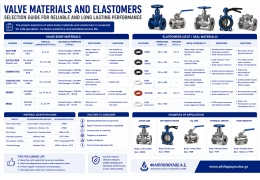
Valve Materials and Elastomers

Valve material selection should not be based only on nominal pressure or valve size. Operating pressure, temperature,...

Read more

Calculating Flash Steam


Flash Steam Generated from Condensate Pressure Reduction

Flash steam is generated when hot condensate at a higher pressure is released to a lower pressure. The pressure reduction lowers the saturation temperature, and part of the heat contained in the condensate is converted into steam.

This phenomenon commonly occurs downstream of steam traps, pressure reducing points, condensate return lines and flash vessels. Correct estimation of flash steam quantity is important for sizing condensate lines, flash vessels, vents and energy recovery systems.

Basic Calculation Principle

When condensate is close to the boiling point at its initial pressure and is released to a lower pressure, the flash steam percentage can be calculated from the difference in saturated water enthalpy before and after pressure reduction.

Flash steam fraction = (hf1 - hf2) / hfg2

  • hf1: saturated water enthalpy at the initial pressure
  • hf2: saturated water enthalpy at the lower pressure
  • hfg2: latent heat of evaporation at the lower pressure
  • Flash steam fraction: kg of flash steam per kg of condensate

To convert the result into a percentage:

Flash steam (%) = Flash steam fraction × 100

Calculation Example

Indicative example for condensate released downstream of a steam trap:

Operating Data Value
Gauge pressure upstream of the steam trap 10 bar
Gauge pressure downstream of the steam trap 0 bar
Flash steam quantity 0.162 kg/kg
Flash steam percentage 16.2%

This means that for every 1 kg of condensate released from 10 barg to approximately atmospheric pressure, about 0.162 kg of flash steam may be generated, provided the condensate is close to its boiling point.

Why Flash Steam Matters

Technical Issue Effect on the System Design Note
Condensate line sizing Flash steam significantly increases the volume flow. The line should not be sized as a water-only line.
Steam trap back pressure Flash steam may increase condensate return pressure. Back pressure affects steam trap capacity and operation.
Noise and vibration Two-phase water-steam flow may create unstable conditions. Correct pipe slope, drainage and diameter selection are required.
Energy recovery Flash steam can be reused in lower-pressure steam applications. A flash vessel can be used to separate and recover usable steam.
Installation safety Incorrect estimation may cause overpressure or insufficient venting. Safety valves, vents and pipework should be checked.

Applications in Steam and Condensate Systems

  • Condensate return lines downstream of steam traps.
  • Flash vessels for recovery of low-pressure steam.
  • Feedwater preheating systems.
  • Low-pressure steam networks for auxiliary services.
  • Back pressure assessment in condensate headers.
  • Sizing of vents, drains and condensate return pipework.

Related Equipment

Philippopoulos S.A. supplies equipment for steam and condensate systems, including steam traps, flash vessels, separators, strainers, isolation valves, check valves, pressure reducing valves, safety valves, condensate pumps and boiler house equipment.

Note: Flash steam calculations are intended for preliminary technical assessment. Final sizing should consider upstream and downstream pressure, condensate temperature, flow rate, back pressure, pipework arrangement and the technical data of the selected equipment.

 
Posted in: Engineering guides