


Ball Valve 1301 Series | 4G Ghidini | Philippopoulos s.a.

Ball Valve 1301 Series | 4G Ghidini

Ghidini 1301 4G 2-Way Ball Valve

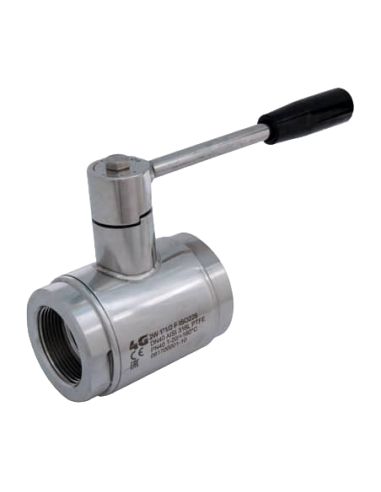
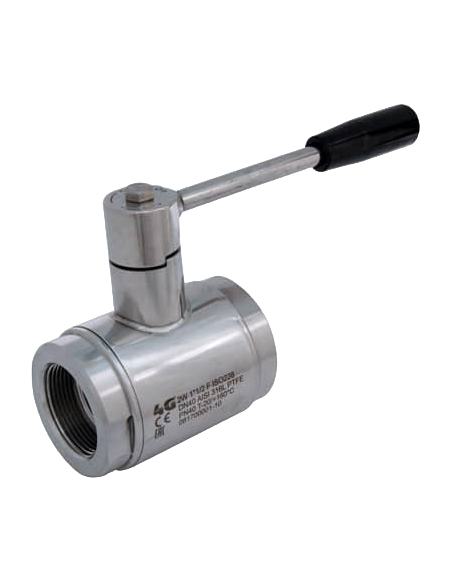
Type 1301 is a 2-way full-bore “Integral Seal” ball valve with a manual stainless-steel lever. It is used for flow isolation in industrial piping systems where low pressure drop, clean internal geometry and AISI 316L / 1.4404 stainless-steel construction are required.

Technical Data

  • Valve configuration: 2-way shut-off
  • Bore: full bore
  • Operation: manual stainless-steel lever
  • Body material: AISI 316L / 1.4404
  • Size range: 1/4” to 4” and 1” to 4”, depending on end connection
  • Seats: Virgin PTFE as standard
  • Operating temperature: -20°C to +160°C with standard seats
  • Pressure classes: PN 25, PN 40, PN 64, PN 100, depending on size and connection
  • External finish: polished

End Connections and Variants

The valve is available with ISO 228-1 threaded, NPT threaded, butt weld, DIN 11851, SMS, clamp, Aceptik and loose flanged ends. Connection selection should match the pipework standard, disassembly requirements, cleaning method and pressure class of the line.

  • Threaded ends: compact installation for utilities and general process lines.
  • Weld ends: reduced leakage paths where permanent pipe integration is acceptable.
  • DIN, SMS, clamp and Aceptik ends: used where hygienic access or frequent removal is required.
  • Loose flanged ends: suitable where bolted disassembly is required for maintenance.

Suitable Media and Applications

Typical services include process water, compressed air, inert gases, clean liquids, food and beverage fluids, and chemical media compatible with AISI 316L and PTFE. Full-bore geometry limits pressure loss and reduces hold-up points during on/off operation.

Sealing Options

The standard seat material is Virgin PTFE. PTFE with glass filler is available on request for service temperatures from -20°C to +170°C. Seat selection should be checked against temperature, differential pressure, cycling frequency, torque increase over time and chemical compatibility.

Operation and Actuation

The standard configuration is manual lever operation. If remote operation, interlocking or process automation is required, pneumatic or electric actuation should be evaluated against valve torque, cycle rate, fail position, available utilities and site control philosophy.

Standards and Certifications

On request, the valve can be supplied with antistatic execution for ATEX II 2G Ex h IIC T4 Gb / II 2D Ex h IIIC T135°C Db applications and with M.O.C.A. compliance according to CE 1935/2004 for food-contact service.

FAQ

  • Is it suitable for throttling? It is intended primarily for on/off isolation, not continuous throttling.
  • When should full bore be selected? When pressure drop, pigging access or reduced product retention is important.
  • What must be verified before ordering? Size, pressure class, end connection, seat material, media compatibility, temperature and certification requirements.
Standard (Options)
  • DIN
  • ANSI
Connection (Options)
  • NPT
  • Revolving Threaded Flanges
  • Butt Weld
  • Aceptik
  • Clamp
  • ISO 228-1
  • DIN 11851
  • SMS
Material (Options)
  • 1.4404
Pressure Rating (Options)
  • PN 25
  • PN 40
  • PN 64
  • PN 100
Seat (Options)
  • PTFE Virgin

Description

TWO-way ball valve “Integral Seal”

Drive: Inox lever

Flow: Full

Material: Aisi 316L (1.4404)

Measure:

from 1/4” to 4”

from 1” to 4”

Seals: Virgin P.T.F.E.

Operating temperature: -20°C+160°C

Outer finish: Polished

On request:

Antistatic device ATEX:

II 2G Ex h IIC T4 Gb

II 2D Ex h IIIC T135°C Db

M.O.C.A. CE 1935/2004

• Seals made of:

PTFE with glass -20°C+170°C