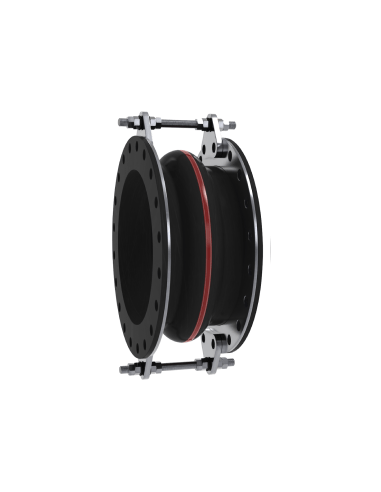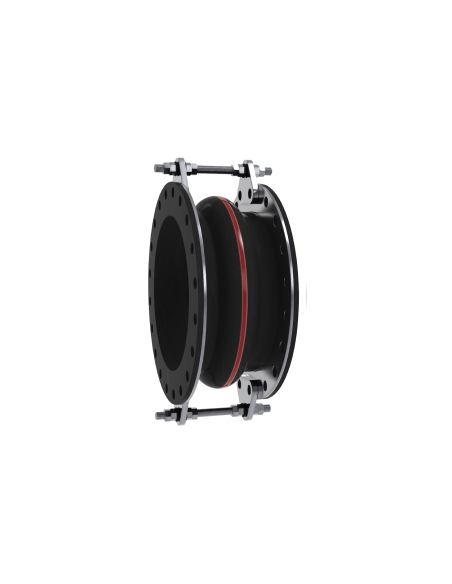

There are cases that on-site installation of the tie rods could be the best solution, specially when the expansion joint is connected directly to an equipment. Make sure that there is sufficient clearance behind the connecting flange.


Variations and optional devices for rubber expansion joints - Tie rod system to be assembled on site | Macoga

MACOGA Tie Rod System – On-Site Assembly Tie Rod System
Tie Rod System to be assembled on site is an optional movement-limiting arrangement for MACOGA elastomeric expansion joints. This configuration is selected when on-site installation of tie rods is more practical than factory assembly, particularly when the expansion joint is directly connected to pumps, heat exchangers, tanks, or other mechanical equipment. Sufficient clearance behind the mating flange is required for proper installation.
Functional Role
Tie rods are not simple support components. They are used to:
- limit overextension of the elastomeric body,
- control axial movement under operating pressure,
- reduce loads transmitted to equipment nozzles,
- prevent movement beyond design limits.
The system does not compensate for misalignment. Installation length, assembly tolerances, and actual movements must not exceed the expansion joint’s allowable limits.
Installation
Prior to final adjustment, verify pressure, temperature, media, installation position, anchoring, and elastomer condition. Flanges must be flat, clean, burr-free, and with aligned bolt holes. No additional gasket is placed between the elastomeric face and pipe flange.
Bolts are tightened in a cross pattern using a torque wrench, in stages. Tie rods are adjusted to allow specified movements without imposing permanent loads outside the design envelope.
Operational Check
During commissioning, perform leakage testing and, where tie rods are present, verify their function. Periodic maintenance includes inspection for deformation, corrosion, metallic part wear, elastomer condition, and possible misalignment of tie rods.
No actuator is included. Selection depends on DN, pressure thrust, allowable equipment loads, required movements, and available clearance behind the flange.
Datasheet and documents
Description
CERTIFICATES
MACOGA holds numerous industry approvals, including:
Ministry of Defense and NATO Member Countries
Tap to zoom