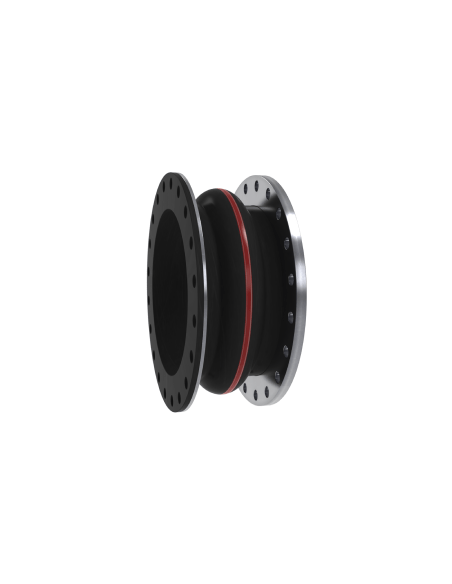

This solution is used when the holes of the mating flanges in the pipes are not aligned and there is no possibility of align them.


Variations and optional devices for rubber expansion joints - One loose flange model | Macoga

MACOGA One Loose Flange Model – Elastomeric Expansion Joint with One Loose Flange
The One Loose Flange Model is specified when the bolt holes of mating pipe flanges are misaligned and re-drilling or rotating the piping is not feasible. One flange of the expansion joint remains loose/rotatable, allowing precise bolt alignment during installation without modifying existing pipework.
Technical Role
This configuration addresses flanged connection geometry only; it does not increase pressure, temperature, or movement ratings. All operational limits remain as per the standard MACOGA series: DN, pressure class, elastomer material, flange type, vacuum capability, and allowable axial/lateral/angular movements.
Selection Criteria
- Replacement of existing expansion joints with non-standard drilling patterns.
- Piping systems where flange bolt holes are angularly misaligned.
- Large diameters where rotating spools or equipment is impractical.
- Retrofit in pump stations, cooling water, desalination, HVAC, or industrial lines.
Installation
The loose flange facilitates bolt alignment but must not be used to compensate for axial or lateral piping misalignment. Flange faces must be flat, clean, and free of burrs. No additional gasket is installed between the elastomeric face and pipe flange; the elastomeric flange itself provides the sealing surface.
Bolts should be tightened in a cross-pattern using a torque wrench, in stages, to prevent torsion or uneven compression on the joint body.
FAQ
Does pressure thrust change?
No. Axial pressure forces require anchors, tie rods, or other restrained arrangements.
Is there an actuator?
No. This is a passive mechanical flanged connection configuration.
What data is required for selection?
DN, PN or class, drilling standard, media, temperature, pressure, movements, vacuum, and flange drawing.
Datasheet and documents
Description
CERTIFICATES
MACOGA holds numerous industry approvals, including:
Ministry of Defense and NATO Member Countries
Tap to zoom
