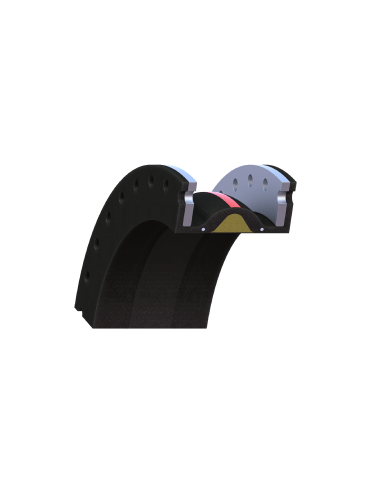
Filled arch-type expansion joints may be supplied with a bonded-in-place soft rubber filler to provide a smooth interior bore. Filled arch design reduces possible turbulence and prevents the collection of solid materials that may settle from the solution handled and remain in the archway. Filled arch joints also have a seamless tube so the arch filler cannot be dislodged during service.


Variations and optional devices for rubber expansion joints - Filled arch | Macoga

MACOGA Filled Arch – Elastomeric Expansion Joint with Filled Arch Profile
The Filled Arch configuration is specified for MACOGA elastomeric expansion joints where a smoother internal bore is required. The arch is factory-filled with a soft elastomer, bonded in place, to reduce turbulence and prevent accumulation of solids within the arch profile.
Functional Role
Filled arch designs are used in pipelines where the process fluid may carry suspended solids, sludge, salts, process slurries, or liquids prone to sedimentation. The continuous internal surface minimizes dead zones and reduces the risk of material build-up in the arch area.
Technical Characteristics
- Factory-integrated soft elastomer fill.
- Smoother internal bore compared to open arch designs.
- Continuous internal liner prevents fill detachment during operation.
- Available as a custom option for MACOGA elastomeric expansion joints.
- Material selection per media: EPDM, NBR, SBR, CSM, Neoprene, or FKM/Viton, based on chemical compatibility.
Selection Criteria
- Wastewater, sludge, slurry, and industrial liquids containing solids.
- Cooling water lines with fouling or scaling risk.
- Applications where open arch profiles may trap material.
- Systems requiring reduced turbulence inside the expansion joint.
Difference from Inner Sleeve
The filled arch creates a continuous elastomeric internal profile by filling the arch. The inner sleeve is a separate internal liner (hard elastomer, metal, or fluoroplastic) designed to reduce friction and turbulence, but is not recommended for high-viscosity fluids that may cause packing or caking in the arch area.
Installation
No additional gasket is required between the elastomeric face and pipe flange. Flanges must be flat, clean, and free of burrs. Bolting should be cross-tightened with a torque wrench. The joint must not be twisted or compressed to compensate for misalignment.
No actuator is used. Selection is based on DN, pressure, temperature, media, solids content, required movements, vacuum conditions, and anchor arrangement.
Datasheet and documents
Description
CERTIFICATES
MACOGA holds numerous industry approvals, including:
Ministry of Defense and NATO Member Countries
Tap to zoom