


Ball Valve - UNIFLOW Fig. BV4M | Comeval | Philippopoulos s.a.

Ball Valve - UNIFLOW Fig. BV4M | Comeval

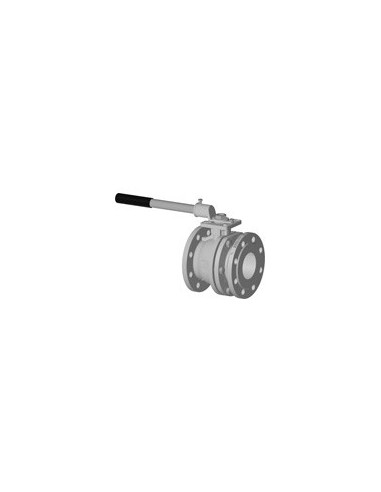
Comeval UNIFLOW Fig. BV4M Flanged Floating Ball Valve

The Comeval UNIFLOW Fig. BV4M is a split-body floating ball valve for manual or automated isolation service. It is supplied with flanged ends and a direct mounting arrangement for actuator installation without additional brackets where the selected configuration permits.

Construction

  • Valve type: floating ball valve, split body
  • End connection: flanged
  • Flange standards: DIN or ANSI execution, according to project specification
  • Body materials: 1.0619 carbon steel or 1.4408 stainless steel, depending on variant
  • Pressure rating: PN 40 for DN15–DN50; PN 16 for DN65–DN200
  • Seat material: PTFE
  • Flow direction: bidirectional shut-off
  • Operation: lever, gearbox, pneumatic actuator, or electric actuator

Suitable Media and Services

  • Water and industrial utility systems
  • HVAC heating and chilled-water circuits
  • Compressed air and non-aggressive gases
  • Lubrication and auxiliary oil systems, subject to seal compatibility
  • General process lines requiring on/off isolation

Operational Considerations

Selection should be based on pressure class, operating temperature, differential pressure, valve torque, cycling frequency, and compatibility of PTFE seats and body material with the process fluid. PTFE seating is normally used for tight shut-off in clean or moderately clean services; abrasive solids or crystallising fluids may reduce seat life.

Variant Selection

  • 1.0619 carbon steel: commonly selected for water, air, HVAC, and general industrial services where corrosion risk is controlled.
  • 1.4408 stainless steel: used where improved corrosion resistance is required, subject to chloride concentration and temperature limits.
  • Lever operation: suitable for smaller sizes and accessible manual isolation points.
  • Gearbox or actuator: used for larger sizes, higher operating torque, remote operation, or control system integration.

Standards and Interfaces

Flange drilling is specified as DIN or ANSI to match the pipeline class. The direct mounting interface supports actuator selection based on output torque, fail position, supply pressure, electrical classification, and required open/close time.

Typical Industrial Use Cases

  • Isolation valves on pump suction and discharge headers
  • HVAC plant rooms and distribution manifolds
  • Compressed-air branch isolation
  • Process utility skids and packaged equipment
  • Maintenance isolation in non-throttling service

FAQ

Can the BV4M be used for throttling?
It is primarily an isolation valve. Continuous throttling may damage PTFE seats and increase leakage risk.

Is the valve suitable for automation?
Yes. Pneumatic or electric actuators can be selected according to valve torque, differential pressure, duty cycle, and control philosophy.

What should be checked before ordering?
Confirm DN, pressure class, flange standard, body material, seat compatibility, operating temperature, actuator requirement, and leakage acceptance for the service.

Description

Floating ball valves, split body, with flanges, construction in investment casting st. steel 316, PTFE seat, bidirectional, direct mounting design, for stopping the flow in process applications. Operated by hand lever, gear or actuator.

Specification of the range:

Nominal size range DN15-200, design pressure PN40 (DN15-50) / PN16 (DN65-200), operated by hand lever, gear or diverse pneumatic and electric actuators styles and accessories.

Other typical denominations: Flanged steel floating ball valves

Applications: Water, HVAC, lubrication, gases, compressed air, process, etc.

Certifications: Flanged steel floating ball valves declaration of conformity, Flanged steel floating ball valves declaration of conformity atex, Eac declaration 010, Eac declaration 032

Certificates