

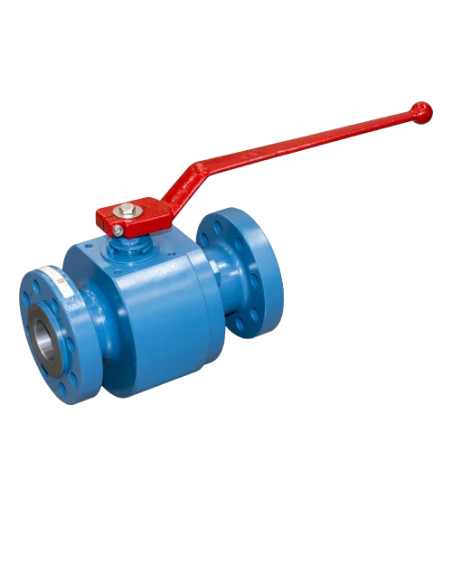

Ball Valve Class 600 - Type 560/560 B | JC | Philippopoulos s.a.

Ball Valve Class 600 - Type 560/560 B | JC

JC Class 600 Ball Valve Type 560/560 B

Two-way flanged ANSI ball valve for isolation duties in higher-pressure industrial piping. The JC 560/560 B series is specified in Class 600, with body materials ASTM A216 WCB, ASTM A351 CF8M or ASTM A352 LCC and Nylon seats.

Construction

  • End connection: ANSI flanged, typically ASME B16.5 Class 600
  • Pressure class: 600 lb
  • Body materials: WCB carbon steel, CF8M stainless steel, LCC low-temperature carbon steel
  • Seat material: Nylon
  • Function: quarter-turn on/off isolation
  • Media: water, industrial liquids, gases, hydrocarbons and compatible process fluids

Material Selection

  • ASTM A216 WCB: general process service, utilities and hydrocarbon lines within the applicable pressure-temperature rating.
  • ASTM A351 CF8M: corrosive or stainless-steel piping systems where chloride level, fluid chemistry and temperature are acceptable.
  • ASTM A352 LCC: low-temperature applications requiring suitable impact properties.

Nylon Seat Function

Nylon seats are used where higher differential pressure capability is required compared with common soft seats such as PTFE. Final selection shall consider temperature, shut-off differential pressure, fluid compatibility, line cleanliness and the presence of solids that may damage the seat.

560 versus 560 B

The 560 and 560 B variants should be checked against the manufacturer’s datasheet for bore arrangement, body construction, stem packing, operator interface and optional executions. Selection should be based on pressure rating, leakage requirement, flange standard and maintenance access.

Actuation and Operation

  • Manual lever or gear operator, depending on size and torque.
  • Pneumatic, electric or hydraulic actuation for remote isolation and interlock service.
  • Limit switches, solenoids and position feedback can be specified for process control systems.

Sealing and Leakage Considerations

  • Seat leakage and shell testing should be specified to the applicable project standard, commonly API 598 or equivalent.
  • Stem sealing shall be assessed for operating cycles, temperature and fugitive-emission requirements.
  • Fire-safe, antistatic or special packing options must be verified when required by the service.

Typical Industrial Applications

  • Oil and gas isolation lines
  • Fuel gas, liquid fuel and hydrocarbon networks
  • Chemical and petrochemical plants
  • Power generation auxiliary systems
  • High-pressure industrial gas and utility circuits

Selection Checks

For Class 600 service, confirm the ASME/ANSI pressure-temperature rating, flange compatibility, body and seat material compatibility, actuator torque margin, shut-off differential pressure and maintainability of stem packing and seats under site operating conditions.

FAQ

  • Can it be used for throttling? It is primarily an on/off isolation valve. Continuous throttling can damage soft seats.
  • Is it suitable for steam? Only if the seat, packing and pressure-temperature rating are confirmed for the steam condition.
  • What documents are normally requested? Material certificates EN 10204 3.1, pressure test reports, dimensional data and applicable conformity documents.
Standard (Options)
  • ANSI
Connection (Options)
  • Flanged
Material (Options)
  • ASTM A216 WCB
  • ASTM A351 CF8M
  • ASTM A352 LCC
Pressure Rating (Options)
  • 600 lbs
Seat (Options)
  • Nylon

Description

PRODUCT FEATURES

Split body, Full bore
Flanged connections
Blowout-proof stem
Non-removable antistatic devices
Cavity pressure balancing hole
Live Loaded Packing

STANDARDS

API 6D
PED
Quality Standard MSS SP 55
All wetted component materials meet NACE MR0175 / ISO15156 & NACE MR0103 / ISO17945
Fire-Safe API 607, ISO 10497, API 6FA
Fugitive Emissions : ISO 15848 / TA-LUFT
ATEX

INDUSTRIES

Oil & Gas
Chemical & Petrochemical
Pulp & Paper
Energy & Renewable
Food & Pharma
Marine
Mining
Special fluids transport


Certificates

Fire Safe API 607, ISO 10497, API 6FA

PED 2014/68/EU - CE marking

ATEX 2014/34/EU– (II2GD)

Russian Federation Certificate TRCU 10, TRCU 12, TRCU 32

Food processing and pharmaceutical industry FDA, USP CLASS VI COMPLIANCE (CE 1935/2004)

Safety Integrity Level (SIL) LEVEL 3 IEC 61508

CRN (Canadian Registration Number)

Fugitive Emissions ISO 15848 TA LUFT (VDI 2440)