

Control Valve 3-Way G3FA - Series | Clorius Controls

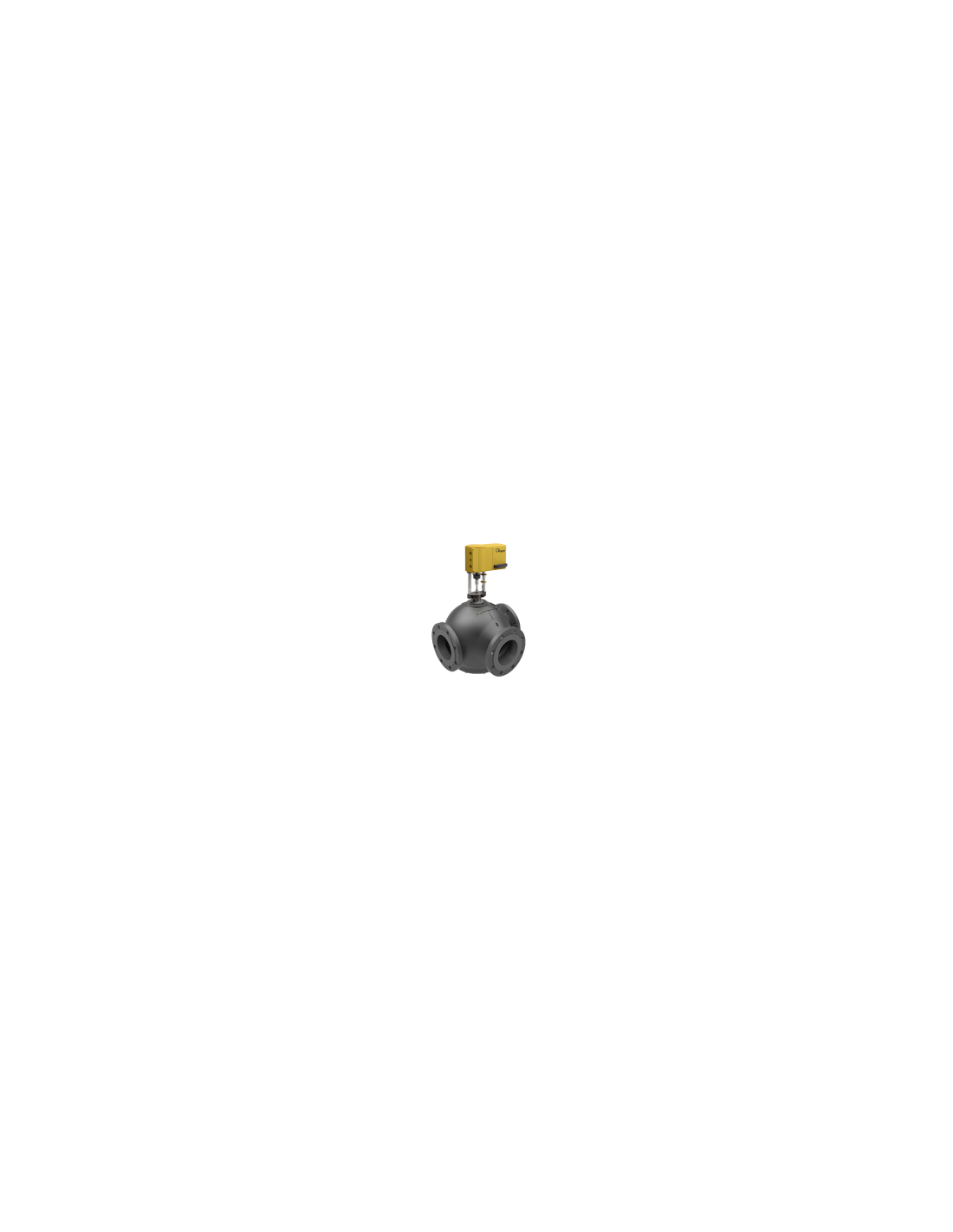
Clorius G3FA – Three-Way Control Valve DN80–DN300
The Clorius G3FA is a flanged three-way control valve made from spheroidal graphite iron EN-GJS-400-15, designed for flow mixing or separation in large capacity systems. It is applicable for fresh water, lubricating oil, and other liquid media in industrial processes, district heating, and marine installations, such as cooling of main and auxiliary engines. Compatible with Clorius AVM/AVF 234 electric actuators or pneumatic actuators.
Construction and Standards
- DN sizes: DN80, DN100, DN125, DN150, DN200/175, DN200, DN300/250, DN300.
- Pressure ratings: PN16 for DN80–DN200, PN10 for DN300/250–DN300.
- Flanges: EN 1092-2, optional JIS B 2210 10K.
- Seats and cone: aluminium bronze CuAl10Fe5Ni5.
- Shaft: stainless steel 1.4436.
- Seals: O-ring A75H, gasket Reinz-AFM34.
- Two balanced single seats.
- Flow characteristic: nearly linear.
- Seat leakage: ≤0.5% of Kvs.
- Regulating capability: Kvs/Kvr >25.
Kvs and Stroke
- DN80: Kvs 80 m³/h, stroke 11 mm.
- DN100: Kvs 125 m³/h, stroke 13 mm.
- DN125: Kvs 215 m³/h, stroke 18 mm.
- DN150: Kvs 310 m³/h, stroke 20 mm.
- DN200/175: Kvs 425 m³/h, stroke 22 mm.
- DN200: Kvs 555 m³/h, stroke 28 mm.
- DN300/250: Kvs 865 m³/h, stroke 28 mm.
- DN300: Kvs 1250 m³/h, stroke 45 mm.
Port Operation
Port AB / 1 is the common port. In the standard G3FA, with shaft loading, the A–AB path closes and B–AB opens. In the G3FA-I, ports A–AB are reversed: with shaft loading, A–AB opens and B–AB closes.
Soft Seat / Low Leakage Version
The G3FA Soft Seat is intended for marine engine cooling systems, including LDCL cooling water systems. The soft-seat arrangement reduces leakage between AB–B to ≤0.01%, compared to ≤0.5% in the standard G3FA. It is selected when internal leakage affects energy balance or operating temperature of the cooling loop.
Installation
The valve can be installed with a vertical or horizontal shaft. Actuator protection from moisture and vibrations is required. Minimum clearance height is 400 mm for AVM/AVF 234 and 745 mm for pneumatic actuators. In separation mode, pressure drop increases by approximately 35% and Kvs decreases by 14% compared to mixing.
Datasheet and documents

Description
Tap to zoom
