

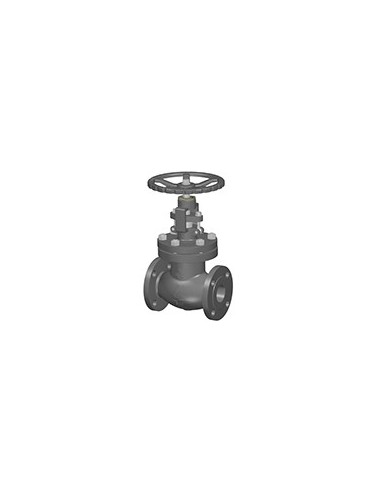

Globe valve - UNIFLOW 80-89 | Comeval | Philippopoulos s.a.

Globe valve - UNIFLOW 80-89 | Comeval

Steam Valve Comeval UNIFLOW 80/89

The Comeval UNIFLOW 80/89 is a metal-sealed globe valve designed for unidirectional flow isolation in process, power, HVAC, steam, gas, and industrial liquid applications compatible with construction materials. The globe geometry results in higher pressure drop compared to gate or ball valves but allows faster operation and throttling capability when equipped with an appropriate regulating plug.

Construction and Selection Range

  • Body: cast or forged, depending on series and pressure class.
  • Design: bolted bonnet, outside screw & yoke, rising handwheel.
  • Stem sealing: flexible graphite packing or bellows seal in special versions.
  • ANSI Class 150–2500 and PN16–420, depending on configuration.
  • Nominal sizes DN10–DN600 / 3/8"–24".
  • Connections: RF, RTJ, butt weld, socket weld, or threaded, per series.
  • Materials: ASTM A216 WCB, A217 WC1/WC6/WC9/C5/C12, A351 CF8/CF8M/CF3/CF3M, A352 LCB, and forged options A105N, LF2, F11/F22, F304/F316, F51/F53.

Standards and Testing

The 80 ANSI series is based on BS 1873 / ASME B16.34, with face-to-face ASME B16.10, flanges ASME B16.5, BW ends per ASME B16.25, marking MSS SP-25, and testing API 598. The forged 89/87 series refers to API 602, with threaded ends NPT/BSP/BSPT or SW per ASME B16.11. PED 2014/68/EU, EAC, and ATEX documentation available where required.

Selection Criteria

Selection is based on:

  • Medium, temperature, and chemical compatibility,
  • Operating pressure and pressure-temperature rating,
  • Allowable pressure drop,
  • Shut-off or regulation requirement,
  • Differential pressure during opening,
  • Need for hardened seats, V-port, regulating plug, or balancing plug.

For large DN or high differential pressure, a balancing plug or bypass is recommended to reduce opening torque. A filter is advised before the valve when particle erosion risk exists.

Operation and Maintenance

Installation follows the flow arrow. Horizontal piping with stem upwards is preferred, avoiding stem-down installations. In steam, gradual heating, condensate drainage, and slow operation are required to limit water hammer and thermal shock.

Packing leakage is initially addressed by gradual gland tightening. Excessive tightening increases operating torque and reduces packing life. Seat leakage requires surface cleaning or lapping and new gasket use during reassembly.

FAQ

Is it suitable for flow regulation?

Yes, with appropriate plug configuration such as throttling, regulating, or V-port. For simple isolation, a standard disc is selected.

When is a bellows seal preferred?

In applications where atmospheric leakage must be minimized beyond what conventional graphite packing allows.

Standard (Options)
  • ANSI
Connection (Options)
  • Flanged
  • Butt Weld
Material (Options)
  • ASTM A216 WCB
  • ASTM A217 WC1
  • ASTM A217 WC6
  • ASTM A217 WC9
  • ASTM A217 Grade C5
  • ASTM A217 Grade C12
  • ASTM A351 CF8
  • ASTM A351 CF3
  • ASTM A351 CF3M
  • ASTM A351 CF8M
  • ASTM A352 LCB
Pressure Rating (Options)
  • 150 lbs
  • 300 lbs
  • 600 lbs
  • 900 lbs
  • 1500 lbs
  • 2500 lbs

Description

Metal seated globe valves, unidirectional, for stopping the flow in process, power and oil&gas applications. The atmospheric sealing is achieved by flexible graphite rings or by bellows. Operated by handwheel, gear or actuator. Weir body leads to higher pressure drop compared to gate or ball valves but operation is quicker and this feature allows to use the valve as regulating valve when arranged with throttling plug.

Specification of the range:

Diverse design combinations by pattern of construction (straight through, angle, Y type), plug designs (marginal, regulating, non-return, balancing, V-port, stellited, soft seal), bellows seal and secondary sealing designs, end connections (flanged, BW, SW, threads), materials of construction (cast and forged) and trims, nominal size range (DN10-DN600 / 3/8-24"), design pressure range (PN16-420 / ANSI Class 150-2500), as well as operation style and accessories.

Other typical denominations:

Applications: HVAC,lubrication, steam, gases, etc.

Certifications: PED 2014/68/EU, EAC

Certificates