

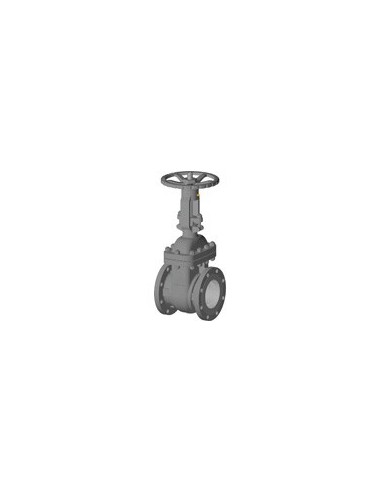

Gate valve - Fig. 91 | Comeval | Philippopoulos s.a.

Gate valve - Fig. 91 | Comeval

Gate Valve Comeval Fig. 91

The Comeval Fig. 91 is a metal-seated gate valve designed for flow isolation in high-pressure applications, primarily in steam, oil & gas, power, HTF, process fluids, gases, compressed air, and lubrication circuits. It is an on/off valve and should not be used for flow regulation or throttling.

Technical Configuration

  • Design: API 600 or API 6D
  • Pressure classes: ANSI Class 1500 / 2500 for Fig. 91
  • Ends: RF or RTJ flanges per ASME B16.5 / ASME B16.47, or BW per ASME B16.25
  • Face-to-face: ASME B16.10
  • Testing: API 598
  • Marking: MSS SP-25
  • Stem sealing: graphite packing or optional bellows seal
  • Operation: handwheel, gearbox, or actuator

Materials and Trim

Available versions include carbon, alloy, and stainless steels: ASTM A216 WCB, A352 LCB, A217 WC1/WC6/WC9/C5/C12, and A351 CF8/CF8M/CF3/CF3M. For WCB Class 1500, trims 1, 5, and 8 are noted with seats A105+13Cr or hard faced and gate WCB+13Cr or WCB+HF, depending on temperature, wear, and sealing requirements.

Operating Conditions

For Fig. 91 WCB Class 1500, PSmax is 255.3 barg with a temperature limit up to 425 °C, with reduced allowable pressure at maximum temperature. For CF3/CF3M Class 1500, temperature limits are up to 425–455 °C depending on material. Final selection should be based on pressure-temperature rating, fluid, corrosion, operating cycles, and differential pressure at opening.

Installation and Maintenance

The line should be cleaned before startup, as welding residues and particles can cause leakage at metal seats. For large DN and high ΔP, torque control or pressure balancing by-pass is recommended. Stem leakage is initially addressed by controlled packing gland tightening; in bellows version, it indicates potential bellows failure.

FAQ

Difference from Fig. 90?
Fig. 91 is for higher pressure classes, mainly Class 1500/2500.

When to choose RTJ?
In high pressure or when flange specification requires ring type joint.

When is hard faced trim needed?
In steam, high velocity, potential corrosion/erosion, or frequent operation.

Description

Metal seated gate valves, bidirectional, for stopping the flow in process, power and oil&gas applications. The atmospheric sealing is achieved by flexible graphite rings or by bellows. Operated by handwheel, gear or actuator.

Specification of the range:

Several design combinations by configuration, materials of construction and trims, end connections (flanged, BW, SW, threads), nominal size range (DN50-DN1200 / 2-48"), design pressure range (PN16-420 / ANSI Class 150-2500), as well as operation style and accessories.

Other typical denominations:

Applications: HVAC, lubrication, steam, gases, compressed air, process, HTF, etc.

Certifications: Comeval ped module h certificate of conformity, Eac certification 032, Eac declaration 010, Eac declaration 032, Gate valves declaration of conformity, Gate valves declaration of conformity atex

Certificates