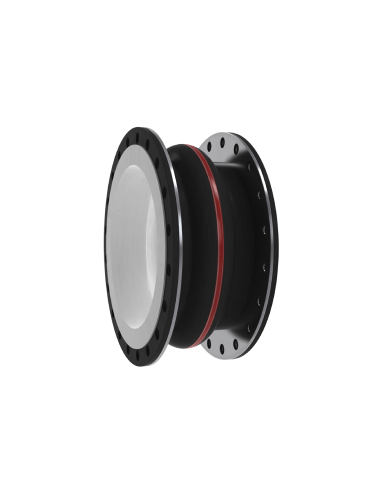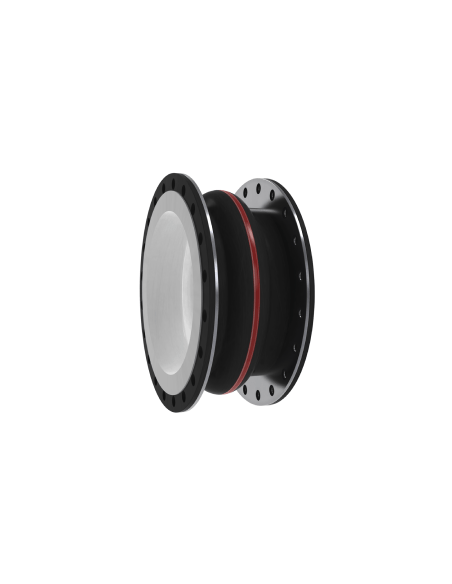

Macoga rubber expansion joints are available in many standard pipe sizes with fluoroplastic lining of PTFE and/or FEP. These lining is fabricated as an integral part of the expansion joint during manufacture and cover all wetted surfaces in the tube and flange areas. Fluoroplastic provides exceptional resistance to almost all chemicals within the temperature range of the expansion joint body construction.


Variations and optional devices for rubber expansion joints - PTFE lining | Macoga

MACOGA PTFE / FEP Lining – Elastomeric Expansion Joint Lining
The application of PTFE/FEP lining is specified for MACOGA elastomeric expansion joints where the conveyed medium exhibits high chemical aggressiveness and direct contact with the base elastomer must be avoided. The lining is integrated as part of the expansion joint construction, covering all wetted surfaces inside the body and flange contact areas.
Function of the Lining
Fluoroplastic lining is selected for compatibility with acids, alkalis, solvents, and aggressive chemicals, within the temperature limits of the base expansion joint design. The lining does not increase the pressure rating or allowable movements; these parameters are determined by the MACOGA series, nominal diameter (DN), elastomer type, flange design, and application layout.
Technical Selection Criteria
- Lining material: PTFE or FEP.
- Coverage: wetted surfaces of the internal tube and flanges.
- Applications: chemical process lines, corrosive liquid transfer, treatment units, auxiliary chemical networks.
- Required data: DN, pressure, temperature, chemical composition, concentration, operating cycles, vacuum service, and required movements.
- Flange standards: EN, ANSI, AWWA, JIS, or project-specific drilling, per series and design.
Difference from Inner Sleeve
PTFE/FEP lining provides chemical protection for wetted surfaces. The inner sleeve is a separate option, inserted into the bore to reduce turbulence and improve flow, but is not recommended for high-viscosity fluids that may cause buildup in the movement area.
Installation and Sealing
Piping flanges must be flat, clean, and free of burrs. No additional gasket is installed between the elastomeric surface and the flange. The expansion joint must not be twisted, compressed, or stretched to compensate for misalignment.
No actuator is involved. Selection is based on chemical compatibility, temperature, pressure, movement requirements, and pipe anchoring configuration.
Datasheet and documents
Description
CERTIFICATES
MACOGA holds numerous industry approvals, including:
Ministry of Defense and NATO Member Countries
Tap to zoom