

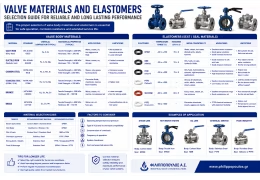
Valve material selection should not be based only on nominal pressure or valve size. Operating pressure, temperature,...
What is ASME B16.34?
Published by the American Society of Mechanical Engineers (ASME), ASME B16.34 establishes design requirements for industrial valves with flanged, threaded, butt-weld and socket-weld end connections.
The standard defines allowable pressure-temperature ratings, minimum wall thicknesses, material groups, marking requirements and design criteria for pressure-containing valve components.
Scope of ASME B16.34
ASME B16.34 applies to industrial valves intended for pressure service, including valves manufactured to various ASME and API standards.
- Gate Valves
- Globe Valves
- Check Valves
- Ball Valves
- Plug Valves
- Pressure Seal Valves
- Forged Steel Valves
Valve End Connections
Flanged Ends
Flanged valves are typically connected using ASME B16.5 or ASME B16.47 flanges.
Threaded Ends
Threaded valves generally use NPT threads according to ASME B1.20.1.
Butt-Welding Ends
Weld ends are manufactured according to ASME B16.25 requirements.
Socket-Welding Ends
Socket weld end preparations comply with ASME B16.11.
Pressure Classes
ASME B16.34 uses pressure classes rather than PN ratings.
| Class | Typical Service |
|---|---|
| 150 | General Industrial Service |
| 300 | Medium Pressure Applications |
| 600 | High Pressure Service |
| 900 | Very High Pressure Service |
| 1500 | Steam and Process Applications |
| 2500 | Critical High Pressure Service |
Pressure-Temperature Ratings
One of the key features of ASME B16.34 is the pressure-temperature rating system. Allowable working pressure depends on both the pressure class and the material group. As operating temperature increases, allowable pressure decreases.
Pressure-temperature ratings are essential for selecting valves suitable for the expected operating conditions of the system.
Materials Covered by ASME B16.34
Carbon Steel Materials
- ASTM A216 WCB
- ASTM A105
- ASTM A350 LF2
Stainless Steel Materials
- ASTM A351 CF8
- ASTM A351 CF8M
- ASTM A182 F304
- ASTM A182 F316
- ASTM A182 F316L
Alloy Steel Materials
- ASTM A217 WC6
- ASTM A217 WC9
- ASTM A182 F11
- ASTM A182 F22
- ASTM A182 F91
Minimum Wall Thickness Requirements
ASME B16.34 establishes minimum wall thickness requirements based on valve size, pressure class and material type. These requirements ensure adequate mechanical strength and pressure containment capability throughout the service life of the valve.
Valve Marking Requirements
Valves manufactured in accordance with ASME B16.34 are typically marked with:
- Manufacturer's Name or Trademark
- Nominal Pipe Size (NPS)
- Pressure Class
- Body Material Identification
- Flow Direction where applicable
- Traceability Information
Relationship with Other Standards
| Standard | Scope |
|---|---|
| ASME B16.34 | Valve Design Requirements |
| ASME B16.5 | Pipe Flanges and Flanged Fittings |
| ASME B16.10 | Face-to-Face Dimensions |
| ASME B16.25 | Butt-Welding Ends |
| API 598 | Inspection and Testing |
| API 600 | Steel Gate Valves |
| API 602 | Compact Steel Valves |
Typical Industrial Applications
Petrochemical Plants
Class 600 to Class 2500 valves are commonly used in high-pressure process services.
Steam Systems
Pressure seal gate valves, globe valves and check valves are widely used in high-pressure steam networks.
Power Generation Facilities
ASME B16.34 valves are installed in main steam, feedwater and auxiliary systems.
Oil and Gas Industry
The standard is extensively specified for upstream, midstream and downstream facilities.
Advantages of ASME B16.34 Compliance
- Defined pressure-temperature ratings
- Standardized design requirements
- Material consistency
- Improved traceability
- Global industry acceptance
- Compatibility with API valve standards
Frequently Asked Questions
What is ASME B16.34 used for?
It establishes design, material and pressure-temperature rating requirements for industrial valves.
What is the difference between ASME B16.34 and API 600?
ASME B16.34 provides general valve design requirements, while API 600 specifically applies to steel gate valves.
Can a valve comply with both ASME B16.34 and API 598?
Yes. ASME B16.34 governs design requirements, while API 598 governs inspection and testing.
Which pressure classes are most commonly used?
Class 150, Class 300 and Class 600 are the most commonly specified classes for industrial applications.
Conclusion
ASME B16.34 is one of the most important international standards for industrial valves. By defining pressure-temperature ratings, material requirements, wall thickness criteria and marking requirements, it provides a common framework for the design and specification of valves used in industrial, energy, petrochemical and process applications worldwide.