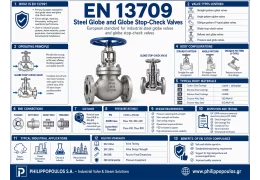
EN 13709 is the primary European standard covering steel globe valves and globe stop-check valves used in industrial...
Water Hammer in Steam and Condensate Systems
TECHNICAL DATA
Causes, Risk Points and Engineering Countermeasures
Water hammer in steam and condensate systems is one of the most severe operating phenomena that can occur in industrial steam installations. It is not simply pipe noise. It is a mechanical impact load that can stress valves, flanges, steam traps, heat exchangers, supports, pipework and control instruments.
In practice, most water hammer incidents in steam systems are related to condensate being present where controlled steam flow is expected, or to sudden condensation of flash steam in condensate return lines.
What Water Hammer Is
Water hammer occurs when a liquid mass is accelerated or stopped suddenly inside a pipe. In steam systems, this can happen when high-velocity steam carries condensate, when steam contacts cold condensate and collapses suddenly, or when vacuum forms inside a heat exchanger and condensate is not properly removed.
The result is a pressure shock wave. The load may be short in duration but very high in magnitude. For this reason, water hammer should be treated as a mechanical design issue, not only as an operating nuisance.
Water Hammer in Steam Lines
When a steam line is isolated by a stop valve, the remaining steam in the pipe condenses. Condensate collects at the low point of the pipe and cools down. When the valve is opened again, incoming steam meets cold condensate. Sudden condensation and liquid movement may cause severe water hammer.
The basic engineering countermeasure is proper drainage. Even short pipe sections should be drained if their geometry allows condensate accumulation.
| Problem | Mechanism | Engineering solution |
|---|---|---|
| Steam line shut-off and restart | Steam condenses, water cools down and then meets fresh steam during restart. | Install a suitable steam trap at a low point or drip leg. |
| Pipe route cannot be modified | Condensate remains trapped due to pipe geometry. | Provide local drainage, even for relatively short pipe runs. |
| Insufficient pipe slope | Condensate does not naturally flow towards the drain point. | Check pipe slope, supports and steam trap position. |
Water Hammer in Condensate Return Lines
In common condensate return headers, condensate from different users may have different temperatures and pressures. If hot condensate containing flash steam mixes with colder condensate, the flash steam can collapse rapidly. The sudden collapse of steam bubbles creates water hammer conditions.
The practical solution is to avoid uncontrolled mixing of condensate from different pressure or temperature levels. Where required, condensate from users operating at different pressures should return through separate lines.
| Condition | Risk | Engineering comment |
|---|---|---|
| Common condensate header | Mixing of hot and colder condensate streams. | Temperature, pressure and flash steam generation must be checked. |
| Users with different operating pressures | Different flash steam percentages after steam traps. | Separate return lines or a properly designed header arrangement are preferred. |
| Long distance to the condensate receiver | Condensate cooling and sudden flash steam collapse from hotter lines. | Pipe routing, insulation and header hydraulic behaviour should be reviewed. |
Water Hammer When Condensate Is Lifted
Condensate lifting in a vertical line significantly increases the risk of unstable operation. The line may operate with two-phase water-steam flow. If the flow stops and starts intermittently, or if the steam trap discharges cyclically, the condensate column may accelerate suddenly and cause impact loads.
These arrangements may require special measures such as a water hammer damper, correct check valve arrangement, back pressure assessment and, where possible, avoidance of lifting condensate directly by steam trap pressure.
Water Hammer in Water Tanks Connected to Condensate Lines
When condensate downstream of a steam trap enters directly into a water tank, flash steam generated by pressure reduction forms steam bubbles. If these bubbles collapse suddenly in colder water, strong local shocks may occur.
A practical arrangement is to introduce the condensate line into the tank through a pipe with small holes on its upper side. This limits the formation of large flash steam bubbles. In addition, routing the condensate line from the upper side of the tank reduces the risk of water flowing back from the tank into the condensate line when steam production stops.
| Poor arrangement | Consequence | Improved arrangement |
|---|---|---|
| Direct condensate inlet below water level. | Large flash steam bubbles and sudden condensation. | Perforated inlet pipe for smaller bubbles and smoother release. |
| Pipework allowing tank water to flow back into the return line. | Possible pipe filling and water hammer during restart. | Top entry into the tank and suitable check valve arrangement. |
Water Hammer in Heat Exchangers
When steam supply to a heat exchanger stops, the steam remaining in the steam space condenses. This may create vacuum. If condensate is not fully removed due to vacuum or drainage arrangement, incoming steam during the next start-up will meet cold condensate and water hammer may occur.
A vacuum breaker helps prevent vacuum formation inside the heat exchanger. This allows condensate to drain when steam supply stops and reduces the risk of water hammer at the next start-up.
Practical Site Check
In an existing installation where knocking, noise or vibration is observed, the check should not be limited to replacing a steam trap. The hydraulic behaviour of the complete system should be reviewed.
- Check low points where condensate may accumulate.
- Check slope of steam and condensate return lines.
- Check steam trap type and installation position.
- Check back pressure in condensate return lines.
- Check mixing of condensate from different pressure or temperature levels.
- Check for vertical lifts in condensate lines.
- Check whether vacuum breakers are required in heat exchangers and closed vessels.
- Check check valves, dampers and air vents where required.
Related Equipment
Philippopoulos S.A. supplies equipment for steam and condensate systems, including steam traps, strainers, separators, check valves, vacuum breakers, water hammer dampers, isolation valves, pressure reducing valves, safety valves, condensate pumps and boiler house equipment.