
Thermostatic (Bimetallic)
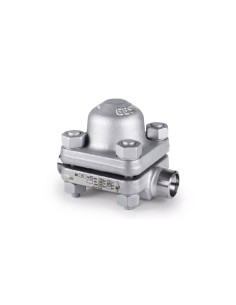
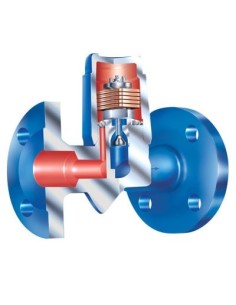
Bimetallic thermostatic steam traps are used to remove condensate from industrial steam systems, including distribution lines, steam tracing circuits, line drains, small heat exchangers, and services where controlled subcooling before discharge is acceptable. Operation is based on the thermal deflection of bimetal elements, which change the valve position as a function of condensate temperature, upstream pressure, and back pressure.
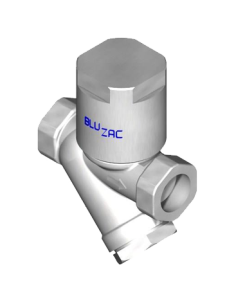
This category includes ARI CONA B, Gestra BK, BLU ZAC TSB, and ARI CONA All-in-one assemblies. Bimetallic steam traps are selected where thermostatic discharge with subcooling is required, automatic air venting during start-up is necessary, and operation over a wide pressure range is expected. In duties where condensate backup ahead of the trap is not permissible, such as heat exchangers requiring continuous immediate drainage, a float trap is typically assessed instead of a bimetallic design.
Selection is based on differential pressure, condensate load, allowable subcooling, steam temperature, return line pressure, installation position, and maintenance requirements. For ARI CONA B versions, regulator ranges are specified for differential pressures up to 13, 22, or 32 bar, with subcooling settings of approximately 15 K or 30 K depending on the variant. High-pressure executions up to PN630 are also available for special steam applications.
Both DIN and ANSI designs are available, with pressure ratings from PN16 to PN630. End connections include BSP, NPT, flanged, socket weld, butt weld, and union weld ends. Body and pressure-retaining materials include EN-JL1040, 1.0460, 1.0619+N, 1.4308, 1.4541, 1.4901, 1.4903, 1.7380, 10CrMo9-10, 13CrMo4-5, 16Mo3, and X10CrMoVNb9-1, selected according to pressure class, operating temperature, and mechanical strength requirements of the steam system.