
Blog navigation
Latest posts
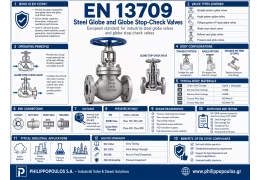
EN 13709 Steel Globe and Globe Stop-Check Valves

EN 13709 is the primary European standard covering steel globe valves and globe stop-check valves used in industrial...

Read more

Steam Dryness Fraction in Steam Distribution Systems


Wet Steam, Enthalpy and Steam Separation

Steam dryness fraction is used to describe the amount of dry saturated steam contained in a steam-water mixture. In real steam systems, water droplets may be present due to boiler carryover, heat losses in pipework, poor drainage or incorrect pipe sizing.

For engineering purposes, steam dryness is not a theoretical parameter. It directly affects available thermal energy, heat transfer, steam trap operation, valve wear and the risk of water hammer.


Dry Steam and Wet Steam

Dry steam means that the water is practically in the vapour phase. Wet steam is a mixture of steam and microscopic water droplets. These droplets do not carry latent heat in the same way as vapour and therefore reduce the useful thermal energy of the system.

Producing and maintaining 100% dry steam throughout a distribution system is difficult in practice. Even with correct boiler operation, moisture can be carried with the steam due to turbulence, high load, sudden load changes or insufficient separation at the boiler outlet.


Definition of Dryness Fraction

The dryness fraction, commonly written as x, represents the mass fraction of the mixture that is present as steam.

x = msteam / (msteam + mwater)

For example, if a mixture contains 95% steam and 5% water by mass, the dryness fraction is:

x = 0.95

The lower the dryness fraction, the higher the amount of water carried with the steam and the lower the available energy for the process.


Effect of Dryness Fraction on Enthalpy

The specific enthalpy of wet steam can be estimated from the saturated water enthalpy and the latent heat of evaporation:

h = hf + x × hfg

  • h: total specific enthalpy of wet steam, in kJ/kg
  • hf: saturated water enthalpy, in kJ/kg
  • hfg: latent heat of evaporation, in kJ/kg
  • x: steam dryness fraction

This relation shows why moisture in steam directly reduces usable energy. The portion of the mixture present as liquid water does not contain the latent heat it would carry if it were in vapour form.


Calculation Example at 8 bar

The following example compares steam at 8 bar with 100% and 90% dryness. Saturated steam values are used for the calculation.

Parameter Value
Steam pressure 8 bar
Saturated water enthalpy hf 720.94 kJ/kg
Latent heat hfg 2767.5 kJ/kg

Case A: 100% Dryness

h = 720.94 + 2767.5 = 3488.44 kJ/kg

Case B: 90% Dryness

h = 720.94 + (2767.5 × 0.90) = 3211.69 kJ/kg

The difference is:

3488.44 - 3211.69 = 276.75 kJ/kg

With 90% dryness, approximately 276.75 kJ/kg of thermal energy is not available compared with fully dry saturated steam. At high steam flow rates, this represents a significant loss of useful heat.


Practical Effects of Wet Steam

Technical issue Effect on the system Engineering comment
Reduced thermal performance Less latent heat reaches the heat exchanger or process. Higher steam flow may be required for the same heat duty.
Corrosion and wear Water droplets and solids increase mechanical stress. Control valves, seats, strainers and instruments may be affected.
Water hammer Condensate accumulation can create impact loads. Correct drainage, pipe slope and steam traps are required.
Control instability The actual steam energy varies with moisture content. Important in temperature control and narrow process limits.
Reduced equipment life Moisture accelerates wear in valves, steam traps and fittings. Moisture removal should be included in system design.


Dry Steam Production with a Steam Separator

A practical method for removing moisture from steam systems is the installation of a centrifugal steam separator. The separator uses change of direction, centrifugal action, impingement and velocity reduction to remove water droplets and heavier particles from the steam flow.

The separated condensate collects at the bottom of the separator and must be continuously discharged through a suitable steam trap. Without proper drainage, the separator cannot operate effectively.

Arrangement element Function Engineering note
Wet steam inlet The steam and droplet mixture enters the separator. Inlet velocity must remain within manufacturer limits.
Separator body Creates swirl, direction change or impingement. Heavier particles are separated from the steam flow.
Drier steam outlet Steam exits with reduced moisture content. Thermal performance and equipment protection are improved.
Lower condensate collection Collects separated water and solid particles. Must be connected to a suitable steam trap.
Drainage steam trap Discharges condensate without live steam loss. Selection should consider pressure, load and start-up conditions.


Typical Locations for Steam Separators

  • At the outlet of a boiler or steam generator when moisture carryover is present.
  • Upstream of steam control valves to protect the valve seat and improve control stability.
  • Upstream of pressure reducing valves or PRV stations.
  • Before heat exchangers, coils and critical process heating equipment.
  • In long horizontal pipe runs where condensate formation is expected.
  • At locations where noise, knocking or poor heating performance are observed.


Related Equipment

Philippopoulos S.A. supplies equipment for steam and condensate systems, including steam separators, steam traps, strainers, control valves, pressure reducing valves, safety valves, isolation valves, condensate pumps and boiler house equipment.

Note: The above relations and values are intended for preliminary engineering checks. Final assessment should be based on actual pressure, flow rate, steam quality, heat duty, pipework arrangement, drainage and manufacturer technical data.

 
Posted in: Engineering guides