
Burst Indicator Type SVT 02 | Striko | Philippopoulos s.a.


Burst Indicator Type SVT 02 | Striko

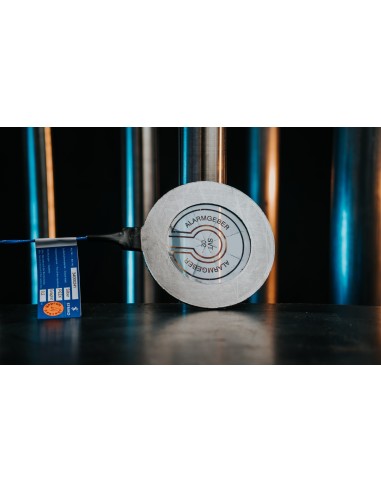
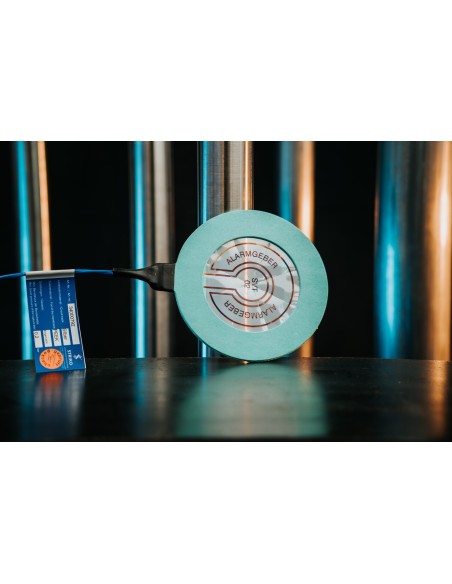
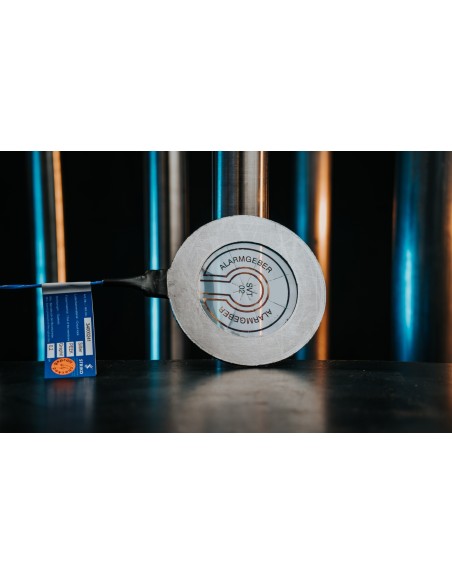
STRIKO SVT 02 Rupture Disc Burst Indicator

The SVT 02 is an electrical activation indicator for rupture discs. It is installed on the vent side, downstream of the disc or safety valve, and provides a signal when the relief device opens. The indicator is independent of the disc and can be used with STRIKO metallic or graphite rupture discs, as well as discs from other manufacturers.

Construction and Operation

The sensor consists of a PEEK membrane with a conductive silver track. Under normal conditions, the circuit is closed. Upon disc rupture, the membrane breaks and the circuit opens, sending a signal to PLC, DCS, alarm panel, or safety circuit.

Technical Data

  • DN: 25 to 600
  • Operating temperature: -30°C to +220°C
  • Max current: 50 mA
  • Max resistance before rupture: 20 Ω
  • Membrane: PEEK
  • Conductive track: Silver
  • Sealing: Klingersil C 4400, other materials available per application
  • Cable: Teflon sheath, 2 m length
  • Installation height: approx. 5 mm, suitable for retrofit

Installation

SVT 02 is supplied ready for installation with seals and connection cable. Compatible with DIN, ANSI, and JIS flanges, as well as direct disc-to-flange mounting without holder. Sealing material selection must consider temperature, chemical compatibility, and allowable flange compression.

ATEX and Intrinsic Safety

STRIKO indicators are classified as simple electrical equipment when connected to an intrinsically safe circuit. Installation must comply with EN 60079-11 and EN 60079-14, with appropriate barriers and zone documentation.

Typical Applications

Chemical lines, pressure vessels, scrubbers, reactors, gas lines, steam installations, and systems requiring confirmation of disc opening. For micro-leakage detection prior to full rupture, refer to SVT 05 leakage sensor.

Description

Burst Indicator Type SVT 02

The cost efficient alarm SVT 02 is recommended for all standard applications in a temperature range from -30℃ to +220℃. The delivery is completely ready for installation and includes seals and connecting cables. It is of course fit for use for DIN, ANSI and JIS flanges – and can be configured with other seals depending on the application case as well.

Advantages in the application

  • Quick identification of a malfunction
  • Simple assembly
  • Maintenance-free
  • Deliverable in nominal widths DN 25 to DN 600
  • In every system it can be combined with metal and graphite bursting seals, also with bursting discs from other manufacturers
  • Can be also used with bursting discs that can be attached without holder between the flanges.
  • Retrofitting is also possible thanks to low installation height (5mm)
  • the alarm is a separate component and independent of the bursting disc
  • Can also be used downstream of safety valves
  • Continuous temperature range from -30° to +220°

Specifications:

Temperature range

-30 ℃ to +220 ℃

max amperage

50 mA

max resistance before bursting

20 Ω

Conductor path material

Silver

Membrane

PEEK

Seals

Klingersil C 4400

Connecting cable

Teflon coated, 2 m long other sealing materials can be delivered upon request.

Note on ATEX:

All burst indicators / leakage sensors from STRIKO according to the type of protection are rated “i” intrinsic safety – “simple electrical equipment” when connected to an intrinsically safe circuit. The requirements on “simple electrical equipment” are covered in section 5.7 of the standards EN 60079-11:2012 or IEC 60079-11 Ed. 6:2011-06 “Explosive atmospheres – Part 11: Equipment protection by intrinsic safety ‘i’”.

Simple electrical equipment, designed in accordance with the requirements of section 5.7 of the standards EN 60079-11:2012 or IEC 60079-11:2011 and section 16.4 of the standards EN 60079-14: 2014 or IEC 60079-14 Ed. 5: 2013-11 “Explosive atmospheres – Part 14: Electrical installations design, selection and erection” do not require certification; see section 4.4.2 of EN 60079-14: 2014 or IEC 60079-14 Ed. 5: 2013-11.

Such parts are also not governed by directive 94/9/EC since they do not feature any potential source of ignition. The designation of simple equipment can be made by any person/institution, including the manufacturer or installer, and made by freely selectable designation marking or coding preferred for the installation/plant.

Certificates