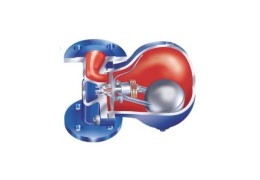

Ball float steam traps are mechanical steam traps used where continuous condensate removal is required under variable...
Industrial Globe Valves for Steam, Thermal Fluids, Process Utilities and High-Pressure Service
Globe valves are selected when a piping system needs positive isolation with a more controllable closing characteristic than many quarter-turn or gate-type isolation valves. In steam, condensate, hot-water, thermal-oil and process-utility systems, the seat-and-disc geometry allows progressive restriction of the flow path, so the valve can be used for isolation and, with the correct plug/disc design, limited throttling duty. The category includes bellows-sealed and packed-gland globe valves, straight-pattern, Y-pattern, angle-pattern, pressure-seal, cryogenic, forged, cast, compact and stop-check configurations.
Product scope covered
The category covers the following engineering families:
- ARI: FABA Plus, FABA Plus ANSI, FABA Supra C, FABA Supra C ANSI, FABA Supra I, FABA Supra I ANSI, and STOBU.
- Corex: V30.1 straight globe valve and V30.1 angle globe valve.
- ICP Valves: G150/300 forged globe valve and G800 forged globe valve.
- Comeval: Fig. 84 bellows-sealed globe valve, UNIFLOW 80/89 and UNIFLOW Fig. 89.
- Valvosider: DIN and ASME bellows-sealed, Y-type bellows-sealed, angle bellows-sealed, bolted-bonnet packed, Y-type packed, angle packed, pressure-seal, Y-type pressure-seal and cryogenic globe valves.
- Fluitek: compact design, bolted bonnet, Y-pattern bolted bonnet, stop-check bolted bonnet, Y-pattern pressure-seal, stop-check pressure-seal, pressure-seal, cryogenic extended-bonnet and nuclear-service bellows-seal globe valves.
- Neway: cast-steel and forged-steel packed globe valves, cast-steel and forged-steel bellows-seal globe valves, forged and cast pressure-seal valves, large forged valves, cryogenic valves and conventional power plant valves.
Valve Construction and Selection Logic
Bellows-sealed globe valves
Bellows-sealed globe valves are used when stem leakage must be reduced beyond what is normally expected from a conventional packing box. This is relevant in steam distribution, thermal-oil systems, ammonia, vacuum, odorous media, toxic fluids, or services where loss of medium has a direct energy or environmental cost.
Typical construction characteristics include:
- metallic bellows as the primary stem seal;
- graphite packing as secondary sealing;
- metal-seated, soft-seated or regulating plug options;
- straight, Y-pattern and angle bodies;
- PN or ASME Class pressure ratings depending on piping specification;
- flanged, butt-weld, socket-weld or threaded connections depending on model.
ARI FABA Plus uses a double metallic bellows with secondary graphite packing and is offered in PN16, PN25 and PN40 versions, with straight, Y-pattern and angle body options. The same product family includes seat options such as metal seat, stellited surfaces, PTFE-carbon soft seat, regulating plug and non-return plug.
ARI FABA Plus ANSI is the ASME/ANSI variant for Class 150 and Class 300 systems, with flanged, socket-weld and threaded configurations depending on figure. The product page gives pressure-temperature examples for SA216 WCB and SA105 bodies and notes EN ISO 15848-1 / TA-Luft fugitive-emission compliance.
Bellows chemical and industrial variants
ARI FABA Supra C and FABA Supra I differ mainly in bellows exposure to the flow path. The Supra C chemical version uses a flushed bellows arrangement and V-port plug as standard, making it relevant for chemical and process services where the bellows zone must not become a stagnant pocket. Supra I places the bellows outside the main flow path and is therefore preferred where turbulent or pulsating flow can mechanically stress the bellows.
For valve selection, the engineer should check:
- operating pressure and design pressure;
- operating temperature and pressure-temperature rating;
- allowable differential pressure across the disc;
- Kvs / Cv requirement;
- medium compatibility with body, trim, bellows and packing;
- seat leakage requirement;
- whether throttling is continuous, occasional or not permitted;
- pipe class: PN / EN or ASME Class;
- face-to-face, flange, weld-end and installation constraints.
Packed-Gland Globe Valves
Packed-gland globe valves use a stuffing box around the stem. They are common in steam, condensate, hot-water, air, oil and general industrial fluids where periodic packing inspection is acceptable. Compared with bellows-sealed valves, they are simpler at the stem seal but require maintenance attention for gland leakage.
ARI STOBU is a packed-gland globe valve offered in straight and angle configurations, flanged or butt-weld ends, and body materials such as EN-JL1040, EN-JS1049, 1.0460, 1.0619+N, 1.4408 and 1.7335. The product page states PN16–PN40 as standard ranges, with special PN63–PN160 versions in selected series.
Corex V30.1 straight and angle globe valves are packed valves for water, hot water, steam, air, oils and non-corrosive industrial fluids without coarse mechanical impurities. The angle version is used where a 90° piping direction change and shut-off function are required at the same point.
Straight Pattern, Y-Pattern and Angle Pattern
Straight-pattern globe valves
Straight-pattern globe valves are used where the piping run remains linear and pressure drop is acceptable. They are common in steam take-offs, utility headers, heat-exchanger isolation, boiler auxiliaries and process branches. Their seat geometry produces a higher pressure drop than a gate valve, so the engineer should verify pressure loss at design flow.
Y-pattern globe valves
Y-pattern valves reduce flow resistance compared with conventional straight globe valves by placing the stem and seat at an angle to the main flow path. They are selected for higher-flow services where globe-valve shut-off geometry is required but pressure drop must be controlled. Valvosider and Fluitek Y-pattern variants are available in bolted-bonnet and pressure-seal arrangements, including DIN and ASME configurations.
Angle-pattern globe valves
Angle globe valves combine shut-off with a 90° change in flow direction. They are useful at equipment connections, drains, process tie-ins and steam line layouts where an elbow and valve would otherwise occupy the same space. Valvosider and Corex include angle-pattern versions, while ARI FABA Plus and STOBU also support angle configurations depending on model.
Pressure-Seal Globe Valves for High-Pressure Systems
Pressure-seal bonnet construction is used where internal pressure contributes to bonnet gasket compression. This design is normally selected for high-pressure steam, feedwater, bypass, blowdown and power-generation services.
Valvosider pressure-seal DIN globe valves cover PN100, PN160, PN250, PN320 and PN420 with DN50–DN600 figures, using materials such as 1.0619, 1.7357 and 1.7380. The same page lists EN 12516, EN 12982 / EN 558, EN 1092, DIN 3239, EN 12266, EN 19, CE-PED and EN 10204 documentation references.
Valvosider ASME pressure-seal variants cover Class 600, 900, 1500 and 2500, while Neway pressure-seal cast-steel valves cover large ASME pressure classes and sizes for high-pressure industrial and power applications. Fluitek also provides Y-pattern and stop-check pressure-seal constructions for steam, feedwater, bypass and blowdown lines.
Forged and Cast Body Selection
Forged globe valves
Forged-body valves are typically used in smaller nominal diameters, higher pressure classes, severe thermal cycling, or where compact pressure-containing parts are required. ICP G150/300 covers ½"–2" / DN15–DN50 in Class 150 and Class 300 with ASTM A105 or ASTM A182 F316L body materials. It references BS 5352, ASME B16.34, ASME B16.5, ASME B16.10, API 598, EN 12266-1, EN 19, PED 2014/68/EU and ATEX Group II Cat. 2.
Neway forged-steel globe valves cover small-diameter and high-pressure duty, including ASME Class 150–4500 / PN16–PN760 depending on body, bonnet and end configuration. The pressure-seal forged version is listed for ASME Class 900–2500 / PN150–PN420.
Cast globe valves
Cast-steel globe valves are used where larger sizes or broader body configurations are required. Neway cast-steel globe valves are listed for NPS 2"–24" / DN50–DN600 and ASME Class 150–4500, while the cast-steel pressure-seal version extends into large high-pressure applications with RF, RTJ or BW ends and manual, gear, pneumatic, electric or hydraulic operation.
Neway cast-steel bellows-seal globe valves cover NPS 2"–30", ASME Class 150–1500 / PN16–PN260, with RF, BW or RTJ ends and body materials including carbon steel, stainless steel, alloy steel, low-temperature steel, duplex stainless steel and nickel-base alloys.
Cryogenic Globe Valves
Cryogenic globe valves use extended bonnets to move the packing away from the low-temperature zone. This reduces packing embrittlement, icing risk and loss of compression. They are relevant for industrial gases, LNG-related utilities, low-temperature storage and cold-box installations.
Valvosider DIN cryogenic globe valves are listed for PN25/40, PN63 and PN100, with DN ranges depending on figure. The page identifies 1.4552 body / bonnet material, graphite packing and standards including EN 12516, EN 12982 / EN 558, EN 1092, DIN 3239, EN 12266 and CE-PED.
Neway and Fluitek also include cryogenic globe valve variants. For these valves, selection should verify:
- minimum design temperature;
- bonnet extension length relative to insulation thickness;
- stem orientation;
- seat leakage requirement at low temperature;
- material impact testing;
- cavity pressure relief philosophy;
- cleaning and drying requirements before service.
Stop-Check Globe Valves
Stop-check globe valves combine manual shut-off with non-return function. In the open position, the disc can lift under forward flow; when backflow occurs, the disc returns to the seat. When the stem is driven down, the valve acts as a positive isolation valve.
Fluitek stop-check bolted-bonnet and stop-check pressure-seal valves are used where isolation and backflow protection are required in one body, particularly in steam, feedwater and power-plant auxiliary circuits.
Actuation and Operation
Manual handwheel operation is standard on many industrial globe valves. Gear operators are used when torque becomes excessive due to size, differential pressure or seating load. Actuation options depend on model and pressure class.
Common actuator and accessory options include:
- manual handwheel;
- gear operator;
- chain wheel for elevated installation;
- pneumatic actuator;
- electric actuator;
- hydraulic actuator;
- limit switches;
- position indication;
- locking or interlock devices;
- ISO 5210 top flange on selected high-pressure designs.
ARI STOBU includes pneumatic spring-closing or spring-opening options and electric ARI-PREMIO / PREMIO-Plus configurations in selected sizes. Valvosider pressure-seal valves list ISO 5210 top flange, gear, chain wheel, pneumatic, hydraulic and electric actuator options. Neway cast-steel bellows-seal valves also list manual, pneumatic, electric and hydraulic operation.
Suitable Media
Typical media compatibility must always be checked against body, trim, bellows, packing and gasket materials. Across the category, the main services include:
- saturated and superheated steam;
- condensate;
- hot water;
- thermal oil;
- process water;
- air and inert gases;
- ammonia in selected bellows-sealed configurations;
- oils and lubricants;
- hydrocarbon services where material selection is suitable;
- chemical utilities and compatible process fluids;
- cryogenic liquids and gases in extended-bonnet designs;
- nuclear-service process lines in qualified Fluitek bellows-seal configurations.
Material selection should not be made from the medium name alone. Chlorides, oxygen content, condensate chemistry, pH, solids, temperature, flashing, cavitation and cycling frequency can change the suitability of carbon steel, stainless steel, alloy steel, duplex, nickel alloy, trim hardfacing, PTFE soft seats and graphite packing.
Maintenance and Leakage Considerations
Stem leakage
- Bellows-sealed valves: the bellows is the primary stem sealing element; packing is secondary. Inspection focuses on bellows integrity, secondary packing condition and any leak detection arrangement.
- Packed-gland valves: packing compression must be checked periodically. Over-tightening can increase operating torque and accelerate stem wear.
- Live-loaded packing: useful where thermal cycling or fugitive-emission control requires more stable packing load.
Seat leakage
Seat leakage can result from:
- weld slag or pipe scale trapped at the seat;
- flashing or cavitation damage;
- excessive throttling on a stop-valve trim;
- high differential pressure without balancing plug;
- erosion from wet steam or high-velocity condensate;
- incorrect flow direction;
- thermal distortion after rapid start-up.
Commissioning checks
Before commissioning:
- flush the line before installing or closing the valve against debris;
- confirm flow direction against body arrow;
- warm steam lines gradually and drain condensate;
- verify bolting torque after thermal cycles where specified;
- check actuator travel and limit settings;
- verify that selected trim is suitable for throttling if throttling is expected.
FAQ
When should a bellows-sealed globe valve be selected?
Use a bellows-sealed valve when stem leakage is not acceptable because of emissions, safety, energy loss, odour, vacuum integrity, hazardous media, or maintenance access restrictions.
When is a packed-gland globe valve sufficient?
A packed-gland valve is suitable where periodic packing inspection is acceptable and the service does not require a bellows barrier. Steam, condensate, water, air and many utility fluids often use packed-gland valves if the plant maintenance plan allows gland adjustment.
Is a globe valve a control valve?
A globe valve can provide limited throttling when fitted with the correct plug or disc and when differential pressure, velocity, noise, cavitation and seat erosion are checked. It should not be treated as a modulating control valve unless the trim, actuator and duty cycle have been selected for that purpose.
Why select a Y-pattern globe valve?
A Y-pattern globe valve is selected when a lower pressure drop is required than with a conventional straight-pattern globe valve, while retaining globe-valve seating and isolation characteristics.
Why select a pressure-seal bonnet?
Pressure-seal bonnets are selected in high-pressure service where internal pressure helps energise the bonnet seal. They are common in high-pressure steam, feedwater, blowdown and power-generation systems.
Why do cryogenic globe valves use extended bonnets?
The extended bonnet keeps the packing away from the cold zone and above the insulation envelope. This helps maintain packing function and reduces icing and thermal damage around the stem seal.
What information is needed for procurement?
A technically complete enquiry should include DN/NPS, PN or ASME Class, body material, trim material, seat type, end connection, face-to-face requirement, medium, operating and design pressure, operating and design temperature, differential pressure, flow rate or Kvs/Cv, leakage requirement, actuator type, documentation requirements and applicable standards.