


Gate Valve - Through Conduit Bolted Bonnet | Fluitek | Philippopoulos s.a.

Gate Valve - Through Conduit Bolted Bonnet | Fluitek

Fluitek Through Conduit Bolted Bonnet Gate Valve

The Fluitek Through Conduit Bolted Bonnet is a full bore gate valve designed for fluid or gas transmission pipelines, primarily used in oil & gas, terminals, pipelines, and underground installations. It is not a throttling valve; operation should be fully open or fully closed.

Construction and Operation

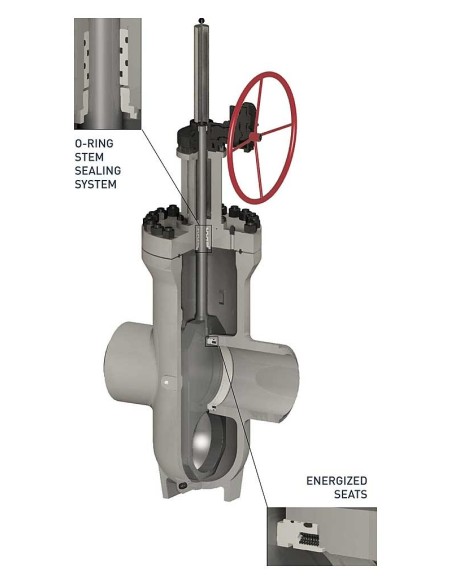
This valve utilizes a slab type gate and floating seat rings with springs. Fluid pressure energizes the upstream seat towards the gate, allowing for self-relieving body cavity and double block and bleed operation through body cavity venting.

Standards and Pressure Classes

  • Reference Standard: API 6D full bore
  • Standardization: ANSI
  • Pressure Classes: Class 150, 300, 600, 900, 1500, 2500
  • Connections: flanged or butt weld
  • Available with extension pups and stem extensions for buried service

Materials and Seat Options

Available materials include carbon steel, low temperature carbon steel, austenitic stainless steel, duplex, super duplex, and nickel alloys. Compliance with NACE MR0175 / MR0103 is noted.

Seat selection is fluid-dependent:

  • Soft seated with reinforced PTFE or Nylon for gases and clean fluids.
  • Metal-to-metal seated for fluids with solids or corrosive/abrasive components.
  • Secondary sealing capability with grease injection in soft seat configurations.

Stem Sealing

Options include O-rings, adjustable packing, enclosed Chevron-type packing, and lantern ring with grease injection fitting. Selection depends on pressure, temperature, buried service, and fugitive emissions requirements.

FAQ

When to choose over a ball valve?
In pipelines requiring full bore through-conduit geometry, DBB capability, and specific seat sealing philosophy.

Soft seat or metal seat?
Soft seat for clean gases/fluids. Metal seat for solids, erosion, or abrasive service.

What certifications are referenced?
ISO 9001:2015, PED 2014/68/UE, ATEX 2014/34/UE, IEC 61508/SIL, API 6A, API 6D, API 6DSS, and TR-CU.

Standard (Options)
  • ANSI
Connection (Options)
  • Flanged
  • Butt Weld
Material (Options)
  • Carbon Steel
  • Austenitic Stainless Steel
  • Duplex Stainless Steel
  • Super Duplex Stainless Steel
  • Low Temperature Carbon Steel
  • Nickel Alloys
Pressure Rating (Options)
  • 150 lbs
  • 300 lbs
  • 600 lbs
  • 900 lbs
  • 1500 lbs
  • 2500 lbs

Datasheet and documents

Description

Through conduit gate valves are an alternative to ball valves for transmission pipelines. The choice is very often based on past customer satisfaction, more than any technical consideration. FLUITEK ORSENIGO VALVES through conduit valves feature standard principles of this well known type of product. The disc is of slab type gate, seat rings are floating, energized by means of multiple springs, and the line fluid pressure pushes the upstream ring against the disc, thus assuring the sealing. The system allows the so called “self relieving” effect, i.e. any over-pressure acting in the body cavity is discharged in the line when force caused by the over-pressure on the seats exceeds the force provided by the springs. At the same time, the construction permits the double block and bleed functioning meaning that pressure applied contemporaneously upstream and downstream pushes both seats against the disc and opening the body cavity bleed relieves any pressure and fluid in the body cavity.

Standard construction is based on cast body, disc from plate or forging and all parts, particularly body cavity and disc, are precisely machined to control with high accuracy the parallelism and orthogonality of the parts. Two basic sealing systems are provided: soft seating and metal-to-metal seating. The first for gas and clean liquids service, the second for fluids containing solids or otherwise abrasive components. The soft seated construction is normally provided with secondary sealing system, i.e. with the ability of injecting a highly dense fluid (grease) into the seating area to help sealing mechanism in case of damage of the soft inserts.

A variety of materials are available: carbon steel, low temperature carbon steel, austenitic stainless steel, duplex and superduplex stainless steel and nickel alloys. Compliance with NACE MR-01-75 and NACE MR-01-03 is provided. Soft seated valves are provided with reinforced PTFE or Nylon inserts, depending on specific service and pressure class. Coatings include electroless nickel plating, nickel alloy overlays of seat pockets, tungsten carbide coating for metal-to-metal seated valves.

Standard of reference is API 6D full bore. Flanged and BW ends available. Construction with extension pups is also available, upon customer request. Stem sealing alternatives: o-rings, adjustable packing system, enclosed packing system with Chevron-type rings and lantern ring with grease injection fitting. Very often this type of valve is used in underground service and proper stem extensions are provided. Testing is per standard requirements, or per any supplementary test request by customers.

Certifications