

Frost Protected
Anti-freeze eye wash units are specified for outdoor installations, unheated process areas, chemical loading stations, and other locations where first-aid equipment is exposed to sub-zero ambient conditions. The engineering requirement is not only to provide flushing water, but to ensure that pipework, valves, and spray heads do not remain water-filled in sections exposed to freezing temperatures.
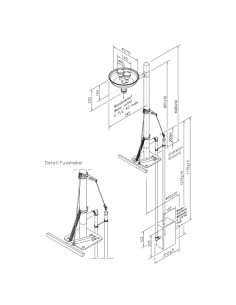
This category includes the self-draining B-Safety ClassicLine BR 880 085 and PremiumLine BR 880 095 eye wash units, the self-draining PremiumLine BR 305 395 with floor-level foot activation, and the heated PremiumLine BR 826 095 eye/face wash unit with bowl and cover. The self-draining designs use an automatic drain arrangement so residual water is discharged from the exposed section after operation. The heated unit uses insulation and self-regulating trace heating to prevent freeze-up under low ambient temperature conditions.
The BR 880 variants operate at 14 l/min, with an inlet pressure range of 1.5-5 bar and a 3/4 in. water connection. They use two 45° spray heads, an integral flow regulator, dust covers, and a mounting height of 900 mm ±200 mm. The PremiumLine version uses polished stainless steel on exposed pipework and spray assemblies, while the ClassicLine configuration combines stainless steel and polymer components with chemically resistant coating.
The BR 305 395 is of stainless steel construction with foot-pedal actuation and automatic drainage terminating at 1000 mm below grade. Rated flow is 14 l/min at 2.5-5 bar, with a 3/4 in. male connection. The BR 826 095 is a heated eye/face wash unit constructed from ABS, stainless steel, and brass. It delivers 12 l/min at 2.5-5 bar and requires 230 V / 50 Hz power supply. Freeze protection is provided by mineral wool insulation and a thermostat switching heating off at 14 °C and on at 4 °C.
Selection should verify compliance with EN 15154-2, ANSI Z358.1, and EN 1717 / DIN 1988. Engineering review should include ambient temperature range, drainage installation depth, available supply pressure, drain routing, nozzle contamination protection, and provisions for periodic functional testing. For heated units, confirm power availability, hazardous-area suitability where applicable, and maintenance condition of thermostat, insulation, and heat-trace wiring.