
Blog navigation
Latest posts
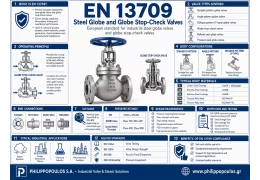
EN 13709 Steel Globe and Globe Stop-Check Valves

EN 13709 is the primary European standard covering steel globe valves and globe stop-check valves used in industrial...

Read more

Flash Steam and Heat Recovery


Flash Steam in Condensate Return Systems

Flash steam is generated when hot condensate at a higher pressure is released to a lower pressure. This typically occurs downstream of steam traps, pressure reduction points, condensate headers or return systems operating at a lower pressure than the steam-consuming equipment.

In terms of thermodynamic properties, flash steam is not different from saturated steam. The term describes the way it is generated: it is not produced in the boiler, but results from pressure reduction of hot condensate.


Why Flash Steam Is Generated

The saturation temperature of water depends on pressure. At atmospheric pressure, water boils at approximately 100°C. At higher pressure, the saturation temperature is higher. When condensate at high pressure and high temperature is discharged to a lower pressure, the new saturation temperature decreases.

The excess energy contained in the condensate cannot remain entirely in the liquid phase. Part of the condensate evaporates and absorbs this energy as latent heat. The result is flash steam generation and cooling of the remaining condensate to the new saturation temperature.


Basic Flash Steam Calculation

For preliminary engineering checks, the flash steam fraction can be calculated from the difference in saturated water enthalpy before and after pressure reduction.

Flash steam fraction = (hf1 - hf2) / hfg2

Flash steam (%) = Flash steam fraction × 100

  • hf1: saturated water enthalpy at the initial pressure.
  • hf2: saturated water enthalpy at the lower pressure.
  • hfg2: latent heat of evaporation at the lower pressure.

The calculation assumes that the condensate is close to saturated condition at the initial pressure. If the condensate is subcooled, the actual flash steam quantity will be lower.


Indicative Calculation Examples

Case Pressure reduction Calculation Flash steam percentage Engineering note
Discharge to low pressure 11 bar → 1 bar (798.4 - 504.7) / 2201.6 13.3% A larger pressure drop generates a higher flash steam fraction.
Discharge to a closed return system 11 bar → 4 bar (798.4 - 640.1) / 2107.4 7.5% A smaller pressure drop generates less flash steam.

The examples show that flash steam generation is mainly governed by the pressure drop imposed on the condensate. The higher the pressure difference, the greater the fraction of condensate converted into steam.


Effect on Condensate Line Sizing

The presence of flash steam turns condensate flow into two-phase water-steam flow. This is critical for sizing because the specific volume of steam is much higher than that of liquid condensate.

For this reason, condensate return lines should not be sized as water-only lines. Flash steam quantity, allowable velocity, back pressure, pipe slope, drainage points and venting capability must be checked.

Parameter Effect on the system Engineering comment
Pressure drop after the steam trap Defines flash steam percentage. Large pressure reduction requires two-phase flow assessment.
Return line back pressure Affects steam trap discharge capacity. The steam trap must be selected according to differential pressure.
Condensate line diameter Affects velocity, noise and pressure losses. Undersizing causes high back pressure and unstable operation.
Pipe slope Assists gravity drainage of condensate. Important in horizontal return pipework.
Venting and flash vessel Allows separation of steam and liquid. Should be checked where heat recovery is possible.


Heat Recovery from Flash Steam

If flash steam is vented directly to atmosphere, the energy it contains is lost. In plants with continuous or significant condensate flows, recovering this energy can provide considerable energy and operating cost benefits.

A common solution is the use of a flash steam vessel. In this vessel, the steam-condensate mixture enters at a lower pressure. Steam separates and leaves from the top of the vessel, while condensate is discharged from the bottom, usually through a steam trap or a controlled drainage arrangement.

Recovered flash steam can be used for low-pressure duties such as feedwater preheating, space heating, auxiliary processes or other applications operating at a lower pressure than the main steam distribution system.


Typical Equipment for a Flash Vessel Arrangement

A practical flash steam recovery arrangement does not consist only of the vessel. The complete mechanical layout and safety devices must be evaluated.

  • Flash steam vessel with suitable design pressure.
  • Condensate inlet with calming or separation arrangement.
  • Flash steam outlet from the top of the vessel.
  • Condensate outlet from the bottom.
  • Steam trap or controlled condensate drainage system.
  • Safety valve where required by the design pressure and layout.
  • Pressure gauge, vent, drain and suitable isolation valves.
  • Check valve where reverse flow is possible.


When Flash Steam Recovery Is Worth Considering

Flash steam recovery is technically and economically attractive when there are sufficient condensate flows, stable operating hours and an available low-pressure steam consumer. It is not automatically the correct solution for every installation. Annual operating hours, actual flow rates, operating pressures and the ability to use the recovered steam must be checked.

Condition Assessment
Stable generation of high-pressure condensate Favourable for flash steam recovery.
Nearby low-pressure steam consumer Improves the economic return of the solution.
Variable or very small condensate flow Requires more careful economic evaluation.
High back pressure in the existing return line Must be checked before adding new equipment.
No useful low-pressure application Recovery may not be practically usable.


Related Equipment

Philippopoulos S.A. supplies equipment for steam and condensate systems, including steam traps, flash vessels, separators, strainers, isolation valves, check valves, pressure reducing valves, safety valves, condensate pumps, control instruments and boiler house equipment.

Note: Flash steam calculations are intended for preliminary engineering assessment. Final sizing should consider actual pressures, condensate flow rate, temperature, back pressure, piping arrangement, vessel design pressure and manufacturer technical data.

 
Posted in: Engineering guides