

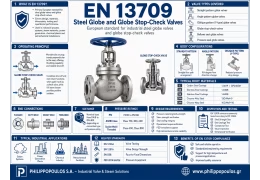
EN 13709 is the primary European standard covering steel globe valves and globe stop-check valves used in industrial...
EN 12569 is the European standard that establishes standardized terminology for industrial valves. The objective of the standard is to provide a common technical language for manufacturers, engineers, inspectors, contractors, suppliers and end users involved in the specification, design, operation and maintenance of industrial valve systems.
What is EN 12569?
EN 12569 provides definitions and technical terms used throughout the industrial valve industry. It standardizes the terminology applied to valve types, valve components, operating principles, pressure-related concepts and connection methods.
The use of standardized terminology reduces misunderstandings in technical specifications, procurement documents, engineering studies and maintenance procedures.
Scope of the Standard
- Gate Valves
- Globe Valves
- Check Valves
- Ball Valves
- Butterfly Valves
- Plug Valves
- Control Valves
- Safety Valves
- Pressure Reducing Valves
- Steam Traps
Basic Valve Definitions
| Term | Definition |
|---|---|
| Valve | A mechanical device used to isolate, regulate, direct or control fluid flow. |
| Isolation Valve | A valve intended to completely stop fluid flow. |
| Control Valve | A valve designed to regulate flow, pressure, level or temperature in response to a control signal. |
| Check Valve | A valve that allows flow in one direction and automatically prevents reverse flow. |
| Safety Valve | A pressure relief device designed to protect equipment against overpressure. |
Main Valve Components
| Component | Description |
|---|---|
| Body | The primary pressure-retaining component of the valve. |
| Bonnet | The cover providing access to internal valve components. |
| Stem | The component transmitting operating force to the closure element. |
| Disc / Plug | The movable closure element controlling flow. |
| Seat | The sealing surface against which the closure element contacts. |
| Packing | The sealing arrangement around the stem. |
| Gasket | The sealing element between pressure-containing components. |
Valve Operating Methods
- Manual Operation
- Gear Operation
- Pneumatic Actuation
- Electric Actuation
- Hydraulic Actuation
End Connection Types
| Connection Type | Description |
|---|---|
| Flanged | Connection using mating flanges and bolting. |
| Threaded | Connection using threaded ends. |
| Butt Weld | Connection using butt-welded pipe joints. |
| Socket Weld | Connection using socket-welded pipe joints. |
| Wafer | Valve installed between two pipeline flanges. |
| Lug | Valve body with threaded mounting lugs for bolted installation. |
Flow Characteristics
- Linear
- Equal Percentage
- Quick Opening
- On-Off Service
- Modulating Service
Pressure and Temperature Terminology
| Term | Definition |
|---|---|
| Nominal Pressure (PN) | Reference pressure designation used in European standards. |
| Pressure Class | Pressure designation according to ASME standards. |
| Design Pressure | The pressure used for equipment design calculations. |
| Design Temperature | The temperature used for equipment design calculations. |
| Maximum Allowable Pressure | The highest pressure permitted during operation under specified conditions. |
Common Valve Terminology Used in Specifications
| Term | Meaning |
|---|---|
| Bubble Tight Shut-Off | No visible leakage during testing. |
| Leakage Rate | Permitted flow through a closed valve during testing. |
| Pressure Drop | Difference between upstream and downstream pressure. |
| Flow Coefficient (Kv) | Metric flow capacity coefficient. |
| Flow Coefficient (Cv) | Imperial flow capacity coefficient. |
Relationship with Other Standards
| Standard | Scope |
|---|---|
| EN 12569 | Industrial Valve Terminology |
| EN 12516 | Valve Design Strength |
| EN 12266 | Valve Inspection and Testing |
| EN 1092-1 | Steel Flanges |
| ISO 5208 | Valve Pressure Testing |
| IEC 60534 | Control Valves |
Benefits of Standardized Terminology
- Consistent engineering communication
- Reduced specification errors
- Improved training and documentation
- Clearer procurement requirements
- Better interoperability between international organizations
- Uniform interpretation of technical documents
Typical Industrial Applications
Steam Systems
Standardized terminology for steam valves, steam traps, pressure reducing valves and condensate systems.
Chemical Industry
Consistent terminology for process valves, control valves and safety devices.
Power Generation
Standard definitions for high-pressure and high-temperature valve applications.
Marine Industry
Common terminology for shipboard piping systems and marine valves.
Frequently Asked Questions
What is EN 12569?
EN 12569 is the European standard defining terminology and technical definitions used for industrial valves.
Does EN 12569 apply to all valve types?
Yes. The standard covers terminology used across the majority of industrial valve categories.
Does the standard contain design requirements?
No. EN 12569 focuses on terminology and definitions rather than design calculations or testing procedures.
Why is standardized valve terminology important?
It ensures consistent interpretation of specifications, drawings, technical manuals and procurement documents.
Is EN 12569 relevant for control valves?
Yes. The terminology includes definitions applicable to control valves and automated valve systems.
Conclusion
EN 12569 serves as the European reference standard for industrial valve terminology. By providing common definitions and technical language, it supports accurate communication, specification development and engineering consistency across industrial valve applications.