

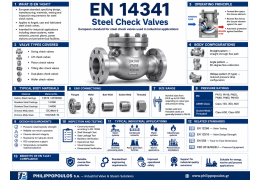
EN 14341 is the European standard specifying the design, manufacturing, material, testing and inspection requirements...
EN 593 is the European standard specifying design, manufacturing, inspection, testing and performance requirements for industrial butterfly valves. The standard establishes common engineering requirements to ensure safe operation, pressure integrity and reliable performance in industrial piping systems.
Butterfly valves manufactured according to EN 593 are widely used in water treatment plants, district heating networks, HVAC systems, power generation facilities, marine applications, chemical processing plants and general industrial services.
What is EN 593?
EN 593 defines the technical requirements for metallic butterfly valves intended for industrial applications. The standard covers valve design, pressure-retaining components, materials, operating characteristics, testing requirements and performance verification.
The objective of the standard is to ensure that butterfly valves provide reliable isolation and control functions under specified pressure and temperature conditions.
Scope of Application
- Wafer Butterfly Valves
- Lug Butterfly Valves
- Double Flanged Butterfly Valves
- Concentric Butterfly Valves
- Double Offset Butterfly Valves
- Triple Offset Butterfly Valves
- Manual Butterfly Valves
- Actuated Butterfly Valves
Butterfly Valve Operating Principle
A butterfly valve uses a rotating disc positioned within the flow path. Rotation of the disc through approximately 90 degrees opens or closes the valve.
Butterfly valves offer compact dimensions, low weight, quick quarter-turn operation and cost-effective installation compared to many other valve types.
Types of Butterfly Valves Covered by EN 593
Concentric Butterfly Valves
The stem is centered within the valve body and disc. Elastomer seats provide shut-off performance for general industrial applications.
Double Offset Butterfly Valves
The stem is offset from the seat centerline, reducing seat wear and improving sealing performance under higher temperatures and pressures.
Triple Offset Butterfly Valves
The sealing geometry eliminates friction during operation and provides metal-to-metal sealing suitable for severe service applications.
Typical Body Materials
| Material | Typical Designation |
|---|---|
| Ductile Iron | EN-GJS-400-15 |
| Carbon Steel | 1.0619 / GP240GH |
| Stainless Steel | 1.4408 |
| Stainless Steel | 1.4308 |
| Duplex Stainless Steel | 1.4469 |
Seat Materials
| Material | Typical Application |
|---|---|
| EPDM | Water and HVAC Systems |
| NBR | Oils and Hydrocarbons |
| FKM (Viton®) | Chemical Applications |
| PTFE | Corrosive Media |
| Metal Seat | Steam and High Temperature Service |
End Connection Types
- Wafer
- Lug
- Double Flanged
- Grooved
Pressure Ratings
| Pressure Rating | Typical Application |
|---|---|
| PN10 | Water Distribution Systems |
| PN16 | General Industrial Service |
| PN25 | HVAC and Process Systems |
| PN40 | Industrial Process Applications |
Design Requirements
- Pressure-retaining body strength
- Stem strength verification
- Seat performance validation
- Operational torque verification
- Pressure integrity requirements
- PED compliance support
Inspection and Testing
Butterfly valves manufactured according to EN 593 are generally tested in accordance with EN 12266.
- Shell Strength Test
- Seat Leakage Test
- Operational Test
- Visual Inspection
- Dimensional Verification
Automation Compatibility
Many butterfly valves are designed for automation using pneumatic, electric or hydraulic actuators.
Actuator mounting interfaces commonly comply with ISO 5211.
Typical Industrial Applications
Water Treatment Plants
Isolation and control of water distribution systems.
HVAC Systems
Flow control in chilled water, hot water and district heating networks.
Steam Systems
High-performance metal seated butterfly valves for steam isolation service.
Chemical Industry
Corrosion-resistant butterfly valves for chemical process applications.
Marine Applications
Seawater, ballast water and cooling water systems.
Relationship with Other Standards
| Standard | Scope |
|---|---|
| EN 593 | Butterfly Valves |
| EN 12266 | Valve Testing |
| EN 12516 | Valve Design Strength |
| ISO 5211 | Actuator Mounting Interface |
| API 609 | Butterfly Valves |
Frequently Asked Questions
What is EN 593?
EN 593 is the European standard covering design, manufacturing and testing requirements for industrial butterfly valves.
Does EN 593 apply to triple offset butterfly valves?
Yes. The standard covers concentric, double offset and triple offset butterfly valve designs.
Which testing standard is commonly used with EN 593?
EN 12266 is commonly used for pressure testing and leakage verification.
Can EN 593 butterfly valves be automated?
Yes. Most industrial butterfly valves can be equipped with pneumatic, electric or hydraulic actuators.
What is the difference between EN 593 and API 609?
EN 593 is the primary European butterfly valve standard, while API 609 is commonly specified in American-standard projects.
Conclusion
EN 593 provides comprehensive requirements for industrial butterfly valves, covering design, materials, testing and performance verification. Compliance with the standard supports reliable operation in water, HVAC, industrial process, marine and energy applications.