

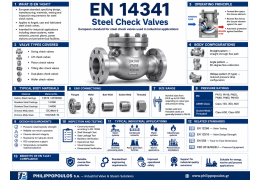
EN 14341 is the European standard specifying the design, manufacturing, material, testing and inspection requirements...
EN 1983 is the European standard that specifies the design, manufacturing, inspection, testing and performance requirements for industrial steel ball valves. The standard establishes requirements intended to ensure safe operation, pressure integrity and reliable shut-off performance in industrial piping systems.
Steel ball valves manufactured according to EN 1983 are widely used in steam systems, power generation facilities, chemical plants, petrochemical installations, district heating networks, marine applications and general industrial services.
What is EN 1983?
EN 1983 defines the technical requirements for metallic ball valves used in industrial process applications. The standard covers valve construction, pressure-retaining components, materials, design verification, pressure testing and operational performance.
The objective of the standard is to provide consistent engineering requirements for ball valves operating under pressure and temperature conditions commonly encountered in industrial environments.
Scope of Application
- Floating Ball Valves
- Trunnion Mounted Ball Valves
- Full Bore Ball Valves
- Reduced Bore Ball Valves
- Manual Ball Valves
- Pneumatic Actuated Ball Valves
- Electric Actuated Ball Valves
- Fire-Safe Ball Valves
Ball Valve Operating Principle
A ball valve uses a spherical closure element with a through bore. Rotation of the ball by 90 degrees opens or closes the flow path.
Ball valves provide fast quarter-turn operation, low pressure loss and excellent shut-off performance.
Types of Ball Valves Covered by EN 1983
Floating Ball Valves
The ball is supported by the valve seats and is free to move slightly under pressure. This design is commonly used for small and medium valve sizes.
Trunnion Mounted Ball Valves
The ball is mechanically supported by trunnions, reducing operating torque and improving performance in large-diameter and high-pressure applications.
Full Bore Ball Valves
The bore diameter closely matches the pipe internal diameter, minimizing pressure drop and facilitating pigging operations.
Reduced Bore Ball Valves
The internal flow passage is smaller than the pipeline diameter, resulting in a more compact and economical valve design.
Typical Construction Materials
| Material | Typical Designation |
|---|---|
| Carbon Steel Castings | 1.0619 / GP240GH |
| Stainless Steel Castings | 1.4408 |
| Stainless Steel Castings | 1.4308 |
| Forged Carbon Steel | P250GH |
| High Temperature Alloy Steel | 13CrMo4-5 |
Common End Connections
- Flanged
- Threaded
- Butt Weld
- Socket Weld
- Wafer
Pressure Ratings
| Pressure Rating | Typical Service |
|---|---|
| PN16 | General Industrial Applications |
| PN25 | Heating and Utility Systems |
| PN40 | Steam and Process Applications |
| PN63 | High Pressure Service |
| PN100 | Critical Process Applications |
Design Requirements
EN 1983 requires ball valves to meet specific design criteria related to pressure containment, operational safety and reliability.
- Pressure-retaining body strength
- Stem strength verification
- Anti-static device provisions
- Blowout-proof stem design
- Safe operation under pressure
- Compliance with PED requirements
Pressure Testing and Inspection
Ball valves manufactured according to EN 1983 are typically tested in accordance with EN 12266 or equivalent valve testing standards.
Testing generally includes:
- Shell Strength Testing
- Seat Tightness Testing
- Backseat Testing (where applicable)
- Operational Testing
Fire Safety Considerations
Where required, ball valves may be tested according to fire-safe standards such as API 607 or ISO 10497 to verify operational integrity following exposure to fire conditions.
Automation Compatibility
Many EN 1983 ball valves are designed for automation using pneumatic, electric or hydraulic actuators.
Actuator mounting interfaces are commonly designed in accordance with ISO 5211.
Typical Industrial Applications
Steam Systems
Isolation of auxiliary steam and condensate lines.
Chemical Industry
Control and isolation of process fluids and chemical media.
Petrochemical Facilities
Hydrocarbon processing, storage and transfer applications.
Power Generation Plants
Utility systems, cooling water circuits and auxiliary process services.
Marine Applications
Fuel systems, seawater systems and onboard utility services.
Relationship with Other Standards
| Standard | Scope |
|---|---|
| EN 1983 | Steel Ball Valves |
| EN 12266 | Valve Testing |
| EN 12516 | Valve Design Strength |
| ISO 5211 | Actuator Mounting Interface |
| API 608 | Metal Ball Valves |
| API 607 | Fire Testing |
| ISO 10497 | Fire Type Testing |
Benefits of EN 1983 Compliance
- Verified pressure integrity
- Reliable shut-off performance
- Standardized design requirements
- Improved operational safety
- Compatibility with European regulations
- Support for industrial quality assurance programs
Frequently Asked Questions
What is EN 1983?
EN 1983 is the European standard covering design, manufacturing and testing requirements for industrial steel ball valves.
Does EN 1983 apply to automated ball valves?
Yes. The standard applies to manually operated and actuated ball valves.
What is the difference between floating and trunnion ball valves?
Floating ball valves rely on seat loading for sealing, while trunnion-mounted designs mechanically support the ball and are typically used in larger or higher-pressure applications.
Which testing standard is commonly used with EN 1983?
EN 12266 is commonly used for valve pressure testing and leakage verification.
Can EN 1983 ball valves be fire-safe certified?
Yes. Fire-safe testing can be performed according to standards such as API 607 and ISO 10497.
Conclusion
EN 1983 provides comprehensive requirements for industrial steel ball valves, covering design, materials, pressure integrity, testing and operational performance. Compliance with the standard supports safe and reliable valve operation across industrial, energy, marine and process applications.