





Tank Sight Glass type R | Mei
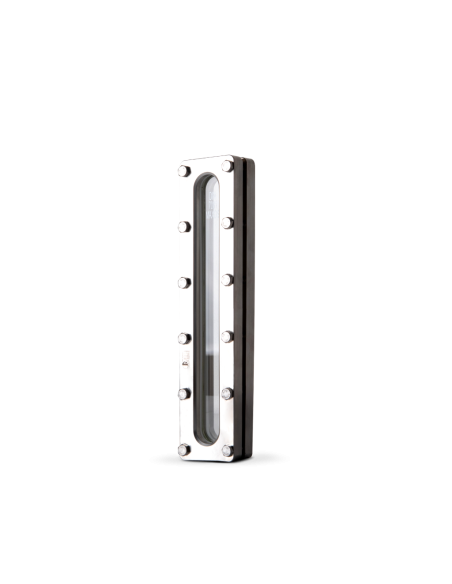
MEI Type R Tank Sight Glass
The MEI Type R is a rectangular sight glass designed for installation on tanks and pipelines, typically by welded mounting to the vessel wall or process line. It is intended for local visual inspection of liquid level, flow, foaming, color, deposits, or presence of solids. This device is not suitable for continuous level measurement or automated monitoring.
Technical Specifications
- Type: Rectangular sight glass
- Connection: Welded mount installation
- Available lengths: D 85 to D 400 mm
- Body material: AISI 316L stainless steel
- Seal/gasket: PTFE
- Glass: Toughened soda-lime (borosilicate optional)
- Temperature limits: up to 130 °C with soda-lime, up to 250 °C with borosilicate
- Construction: Fully disassemblable for maintenance
- Glass certification: Tested to I.S.P.E.S.L. on request
Dimensions
Standard lengths: D 85, 130, 180, 240, 310, 360, 400 mm. Construction height/thickness is fixed: A 31 mm, B 17 mm, E 60 mm, F 24 mm. Overall length C ranges from 115 to 430 mm depending on model.
Selection Criteria
Type R is selected when an elongated viewing area is required, as opposed to the circular MEI Type W. The rectangular geometry is suitable for tanks where zone level monitoring or extended visual access along the flow path is needed.
For operating temperatures above 130 °C, borosilicate glass must be specified. PTFE compatibility with process media, CIP cleaning agents, and temperature must be verified prior to selection.
Typical Applications
- Food, beverage, and chemical storage tanks
- Pipelines requiring visual flow confirmation
- Mixing vessels with foaming or deposit risk
- Inspection points needing elongated viewing slots
FAQ
Is an actuator required?
No. This is a static inspection component with no moving parts.
When is it preferred over Type W?
When a rectangular window and greater linear visibility are required by the application.
What is checked during maintenance?
Inspect glass, PTFE seals, bolts, seating surfaces, and check for leakage after thermal cycling.
Datasheet and documents


Description
Tap to zoom
