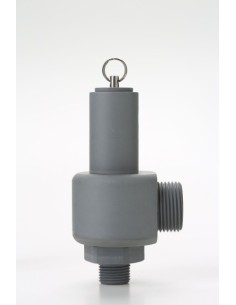

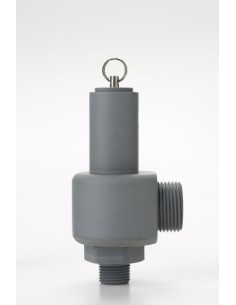
PVC
PVC safety valves are used for overpressure protection in water systems, technical liquid service, and compatible gases where the chemical resistance of a polymer body is required instead of metallic construction. Selection should be based on PVC compatibility with the process medium, operating temperature, set pressure, discharge area, and seat/seal material. For steam service or elevated-temperature duty, additional verification is required, since the available elastomer seat materials are limited to temperatures up to +85 °C depending on NBR, EPDM, Viton, Silicone, or Kalrez.
This category includes Nuova PVC10 and PVC14 safety valves with pressure rating PN16, reduced flow coefficient 0.774, and set pressure range 0.3-16.0 bar. The PVC10 version has a nozzle diameter of 10 mm and discharge area of 78.50 mm², while the PVC14 version has a 14 mm nozzle diameter and discharge area of 153.86 mm². Selection between the two orifice sizes should be based on the required relieving capacity, allowable overpressure, and inlet/outlet line pressure losses.
Connections are to ISO 228, with G 1/2" inlet and G 1" outlet for PVC10, and G 3/4" inlet with G 1" outlet for PVC14. Referenced approvals and certifications include PED 2014/68/EU Cat. IV, EAC, ATEX Ex II 2 G/D c, ASME XIII-CRN, and SELO-TSG, depending on configuration. During installation, attention should be given to discharge direction, piping-induced mechanical loads, seat tightness after lift cycles, and the possibility of periodic testing or recalibration by an authorized body.