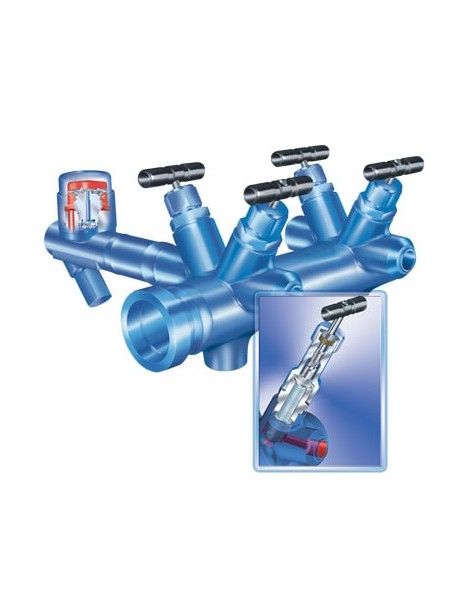

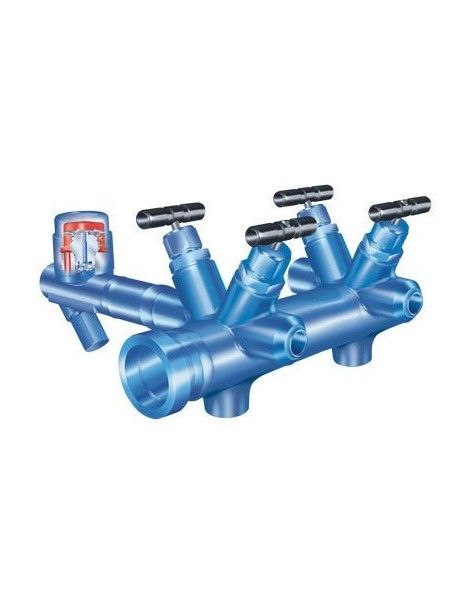
Manifolds
Condensate manifolds and steam distribution headers are used in industrial steam systems to organize multiple drainage or supply branches from a common header body. In condensate service, they collect condensate from individual steam traps or drain points before return to the condensate line. In steam distribution service, they supply independent steam branches with integrated isolation valves, allowing control, sectional isolation, and maintenance of each branch without disturbing the whole header.
This category includes ARI CODI®S units with stuffing box sealing and CODI®B units with bellows seal construction. Selection is based on operating pressure, inlet temperature, number of branches, installation orientation, stem sealing requirements, primary and secondary connection type, and accessibility for inspection and valve maintenance. The integrated valves can be used for on/off duty or limited throttling, while back seating in the fully open position reduces the risk of stem leakage during operation.
DIN versions are available in PN40 and PN63, with BSP, NPT, flanged, socket weld, and butt weld connections. For CODI®S, stated operating limits are up to 32 barg, with inlet temperatures up to 250 °C or up to 400 °C in selected configurations. For CODI®B, operating conditions are stated up to 45 barg and up to 350 °C in PN63 execution. Body materials include forged carbon steel P250GH / 1.0460 and stainless steel 1.4541, supporting typical steam and condensate service requirements, including applications where external leakage control is a selection criterion.
Referenced testing and compliance standards include PED 2014/68/EU, AD 2000, DIN 3230, VDI 2440, and TA-Luft. When specifying a manifold or distributor, the main checks are pressure class, temperature rating, branch configuration, connection standard, shut-off function, and acceptable stem leakage performance under operating and maintenance conditions.