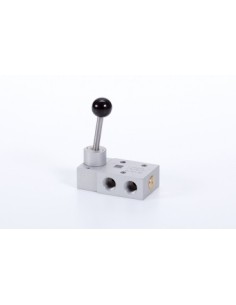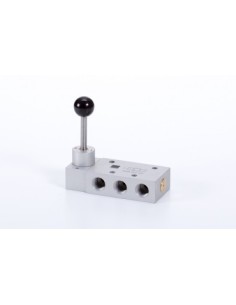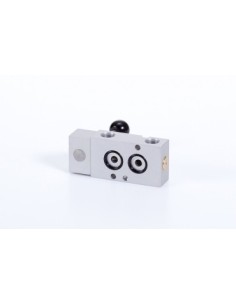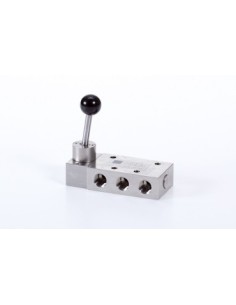

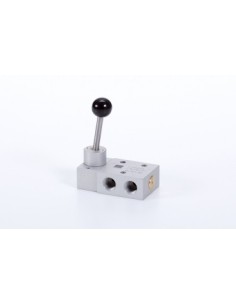
Lever Actuated Valves
Lever-operated pneumatic valves are used for manual switching of compressed air in automation circuits, cylinders, and pneumatic actuators. The lever serves as a local mechanical command device without the need for an electrical signal or pilot pressure. This arrangement is selected where direct operator intervention is required for manual override, commissioning, test operation, circuit isolation, or changeover of circuit state.
This category includes Hafner 3/2, 5/2, and 5/3 valves, together with NAMUR and stainless steel versions. 3/2 valves are used for supply or exhaust of a control line, single-acting actuator circuits, and normally closed or normally open functions. 5/2 valves are applied to double-acting cylinders or actuators. 5/3 valves are specified where a defined centre position is required, including centre closed, centre exhausted, or centre pressurized configurations.
Standard port sizes cover G 1/8" to G 3/4", with flow capacity from 650 to 6000 l/min and operating pressure typically in the 1-10 bar range, depending on valve size and internal spool configuration. Spring-return versions reset mechanically to the initial or centre position, while bistable or indexed versions remain in the selected position until a new manual command is applied.
NAMUR lever valves are intended for direct mounting on pneumatic rotary actuators in accordance with the NAMUR interface, reducing external tubing and associated leak paths. Stainless steel versions are used in environments with moisture, cleaning chemicals, or increased corrosion exposure. A typical stainless configuration uses G 1/4" connections, 1250 l/min nominal flow, and 1-10 bar operating pressure.
Valve selection should consider port function, fail position, return mechanism, flow requirement, air pressure, actuation force, switching frequency, air cleanliness, and operator access. Contamination, condensate, or inadequate lubrication in the pneumatic system can affect spool shifting, internal leakage, seal wear, and repeatability of valve response.