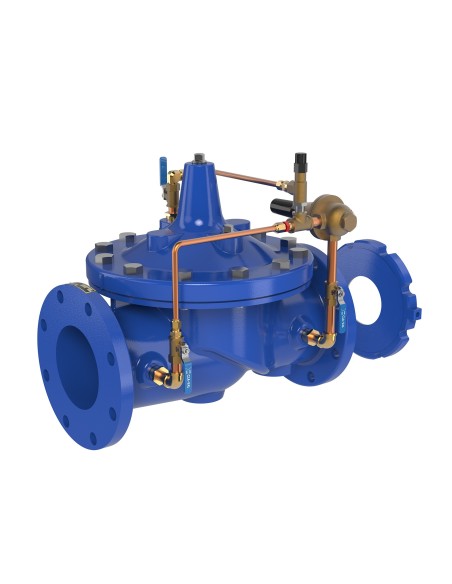


Cla-Val 40-01 and 640-01 Rate of Flow Control Valves prevent excessive flow by limiting flow to a preselected maximum rate, regardless of changing line pressure. They are hydraulically operated, pilot controlled, diaphragm valves. The pilot control responds to the differential pressure produced across an orifice plate installed downstream of the valve. Accurate control is assured as very small changes in the controlling differential pressure produce immediate corrective action of the main valve. Flow rate adjustments are made by turning an adjusting screw on the pilot control.


Hydraulic Rate of Flow Control Valve - 40-01 & 640-01 | Cla-Val
Cla-Val 40-01 / 640-01 – Hydraulic Flow Control Valve
The Cla-Val 40-01 / 640-01 is designed to hydraulically limit water flow to a preset maximum, independent of line pressure fluctuations. This is a pilot-operated, diaphragm-actuated valve. The pilot receives a differential pressure signal from an orifice plate installed downstream and modulates the main valve position accordingly.
Typical Applications
- Potable water distribution and supply networks
- Flow control for pressure filter systems
- Downstream network protection against excessive flow
- Transfer lines with variable pressure conditions
- Industrial process water circuits
Technical Operation
Flow setpoint is adjusted via the pilot screw. The X52E/X52A orifice plate generates a measurable differential pressure, used as the hydraulic control signal. For stable control, the orifice plate is typically installed 1–5 pipe diameters downstream of the valve.
Construction and Options
- Body: ductile iron, ASTM A216 WCB, or brass
- Connections: ANSI flanged, class 150 and 300 lbs available
- Sizes: 40–900 mm, depending on material and version
- Disc/diaphragm: Buna-N
- Stem, spring, trim: stainless steel
- Water temperature: up to 180°F / approx. 82°C
Optional Equipment
Available options include pilot line strainers, isolation valves, check feature for reverse flow prevention, pressure gauge, opening/closing speed adjustment, and valve position indicator.
FAQ
When is it selected? Applied where mechanical/hydraulic flow limitation is required without electric actuators.
What is required for correct selection? Pipe diameter, flow setpoint, pressure, body material, flange class, trim, and orifice plate bore.
Description
Tap to zoom
