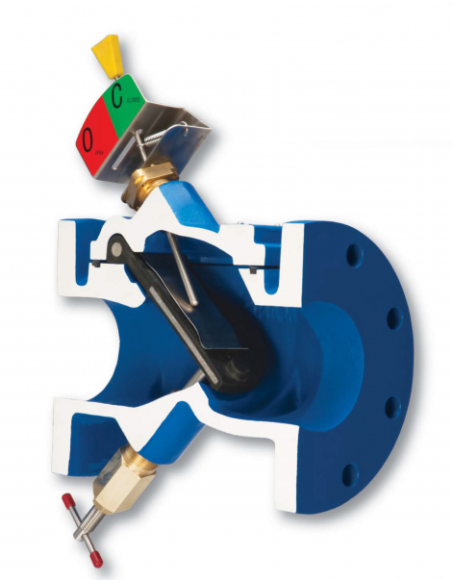


The Cla-Val 587 Series Surge Blocker effectively prevents slamming and resulting surge conditions caused by reverse flow. The valve’s 35°short disc stroke results in rapid closure as compared to a conventional swing check valve with an 80° to 90° typical stroke distance.

Surge Blocker - 587 | Cla-Val
Cla-Val 587 Surge Blocker Check Valve
The Cla-Val 587 Surge Blocker is a hydraulically actuated check valve engineered for transient pressure control in water transmission pipelines. It is typically installed in pump stations and long-distance water mains where pump trip or rapid flow changes can induce hydraulic shock and pressure surges.
Operating Principle
During normal operation, the valve remains fully open. Upon flow reversal, the closure mechanism is hydraulically regulated to prevent abrupt shutoff, thereby mitigating both positive and negative pressure transients (water hammer and vacuum conditions) within the pipeline. This controlled closure reduces mechanical stress on pipes, flanges, pumps, and associated network components.
Technical Specifications
- Type: Surge control check valve
- Closure: Hydraulically controlled, non-slam
- Design: Water hammer mitigation
- Connection: Flanged (various standards available)
- Media: Potable and process water
- Sizes: Available for large-diameter transmission mains
- Pressure classes: Consult datasheet for PN/ANSI ratings
- Sealing: Resilient or metal seat options
- Actuation: Hydraulic pilot system
- Certifications: WRAS, NSF/ANSI, or equivalent upon request
Typical Applications
- Municipal water pump stations
- Long-distance water transmission pipelines
- Booster stations
- Water treatment facilities
- Irrigation networks
- Industrial cooling/process water systems
Comparison: Surge Blocker vs Conventional Check Valve
| Surge Blocker | Conventional Check Valve |
|---|---|
| Hydraulically regulated closure | Immediate mechanical closure |
| Reduces transient pressures | Higher risk of slam and surge |
| Suitable for large-diameter mains | Primarily for basic applications |
| Protects pumps and network | Limited water hammer control |
Selection Criteria
- Discharge main length
- Flow velocity
- Pump inertia time
- Permissible pressure fluctuation
- Surge and water hammer analysis requirements
Hydraulic transient analysis is recommended for critical installations prior to final valve sizing and specification.
FAQ
When is a Surge Blocker preferred over a standard check valve?
Where significant hydraulic transients are expected due to long pipelines, high velocities, or rapid pump shutdowns.
Is it suitable for potable water pump stations?
Yes, commonly specified for water transmission and distribution systems requiring enhanced surge protection.
Does it replace all surge protection devices?
Suitability depends on network analysis. In some cases, it is used in conjunction with air vessels, surge relief valves, or other transient control devices.
Datasheet and documents
Description
Tap to zoom
