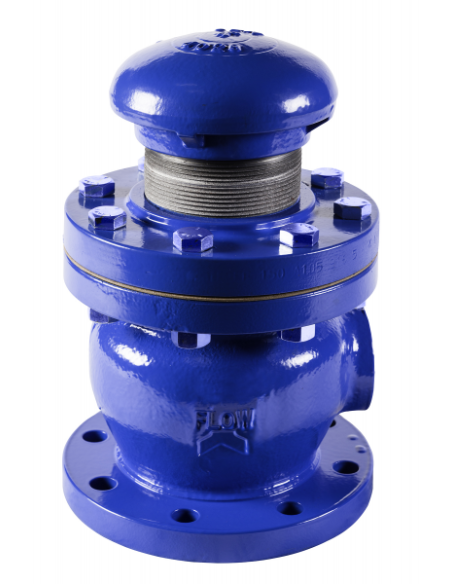


Cla-Val 38VB/AR Series Vacuum Breaker and Air Release Valve provide vacuum prevention and slow air release for pressure surge control. This valve is a reliable and economical pipeline surge control solution that requires no regular maintenance. Standard valves are designed to open with minimal (1/4 psi) pressure differential across the orifice. Higher or lower relief settings are available.


Vacuum Breaker Valve type 38VB/AR | Cla-Val
Cla-Val 38VB/AR Vacuum Breaker & Controlled Air Release Valve
The Cla-Val 38VB/AR is a vacuum breaker valve with slow air release, designed for transient pressure control in water pipelines. It opens to admit air under vacuum conditions and provides regulated air discharge to minimize the risk of pressure surges.
Operation
The valve is engineered to open at a low differential pressure, typically around 1/4 psi at the orifice. Alternative opening setpoints are available to match specific hydraulic requirements. The controlled air release function is intended to limit rapid air expulsion, reducing the likelihood of hydraulic shock.
Applications
- Water transmission pipelines
- Potable water networks with vacuum risk
- High points in piping systems
- Lines subject to surge phenomena
- Locations requiring vacuum prevention and controlled air release
Technical Considerations
- Suitable for potable and process water; consult for chemical compatibility
- Available in standard pressure classes (PN10/16/25/ANSI)
- Temperature range: 0–70°C (consult for higher temperatures)
- Sealing options: EPDM, NBR, FKM
- Flanged or threaded connections per EN/DIN/ANSI
- Manual or automatic actuator options
- Complies with EN 1074-4, WRAS/ACS on request
Difference from 33VB
The 33VB is primarily a vacuum breaker. The 38VB/AR combines vacuum breaking with slow air release, making it suitable where uncontrolled air discharge could exacerbate hydraulic transients.
FAQ
Does it protect against vacuum?
Yes, by admitting air under negative pressure conditions.
Is air released rapidly?
No. Air release is regulated to limit surge effects.
What parameters are considered in selection?
Opening pressure, air flow rate, hydraulic profile, evacuation scenarios, and acceptable vacuum levels.
Datasheet and documents
Description
Tap to zoom
