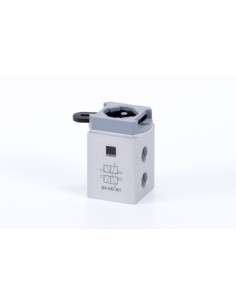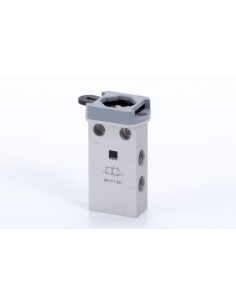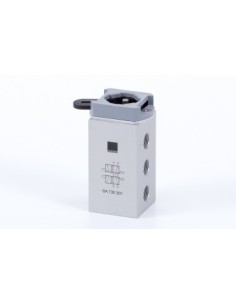

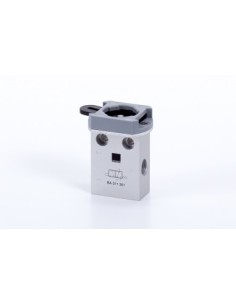
Panel Mounting Valves
Panel-mount pneumatic valves are used in compressed-air circuits where the operator must issue a local manual command from the front of a control panel, machine enclosure, or operator station. Their function is the manual changeover of air flow to cylinders, pneumatic actuators, pilot lines, and auxiliary automation circuits without requiring an electrical signal at the point of operation.
This category includes Hafner panel-mount valves in 3/2, 4/3, 5/2, and 7/3 configurations, together with operating accessories for BA valves. 3/2 valves are used for supply or exhaust of a pneumatic signal, typically in single-acting actuator circuits or NC/NO control logic. 5/2 valves are applied to double-acting cylinders and actuators. 4/3 and 7/3 versions are used where a three-position switching logic is required via a Ø22 mm rotary operator.
Available technical versions include M5, G 1/8", G 1/4", and push-in connections for Ø4 or Ø6 tubing. Nominal flow capacity for the standard 3/2 and 5/2 ranges is stated between 125 and 1250 l/min, depending on port size and valve design. Maximum operating pressure is specified up to 10 bar or 16 bar, depending on model. The three-position 4/3 and 7/3 versions are listed with G 1/8" ports, 280 l/min flow, 14 N actuating force, and use with rotary lever BA 334 01.
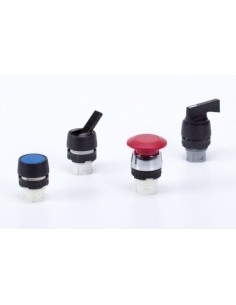
Accessories include push buttons, palm buttons, detented palm buttons, rotary levers, key switches, selector switches, dust protection caps, and couplings for BA valves. Operator selection should be based on the required control sequence, momentary versus maintained command, actuating force, color coding, and protection against dust ingress or unintended actuation.
During installation, the panel cut-out diameter, correct port assignment, compressed-air quality, condensate drainage, service access, and valve reset behavior after operation should be verified. Contamination or moisture in the air system can affect spool shifting, internal leakage, sealing integrity, and repeatability of the pneumatic control signal. Valve selection should also consider media compatibility, operating pressure class, ambient temperature, and maintenance requirements within the pneumatic control assembly.