

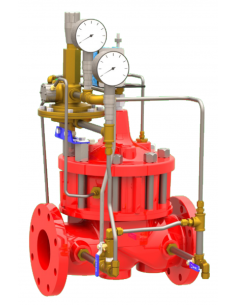
Breach Containment Valves
Breach containment fire-protection valves are used for automatic isolation of a piping section when a catastrophic pipe failure, line rupture, or uncontrolled downstream flow occurs. Under normal service they remain fully open. If flow exceeds the preset threshold corresponding to breach flow, the valve closes tight shutoff and limits water loss from the damaged section. This duty is particularly relevant in sprinkler systems serving multistory buildings, where gravity can rapidly drain stored fire water following a rupture on upper floors.
This category includes the Cla-Val 85-09-1 Automatic Breach Containment Valve. It is a pilot-controlled, hydraulically operated, diaphragm-actuated globe valve based on the Powertrol main valve with a factory-assembled pilot control system. The valve uses line fluid as the operating medium and does not require external power. The pilot senses differential pressure across the valve and is factory set at the actuation point corresponding to the selected breach flow rate.
Available configurations are specified to ANSI standards with flanged end connections, Class 150 and Class 300 pressure ratings, and body materials including ductile iron, ASTM A216 WCB cast steel, and bronze/brass trim options. The technical data covers full internal port model 85-09-1 and reduced internal port model 685-09-1, typically in sizes up to 8 in. Maximum water temperature is 180 °F. A limit switch can be provided for remote closed-position indication or alarm output when the valve has tripped.
During engineering review, the design flow, allowable breach flow, installation location by zone, hydraulic effect on upstream piping, access for testing, and reset capability after downstream pressure recovery should be verified. Maintenance should include inspection of pilot lines, strainer, diaphragm assembly, differential-pressure setpoint, limit switch, and functional testing through the quick-connect ports so the valve distinguishes an actual rupture event from normal transient demand peaks.