
Wastewater air valve type SCF | CSA

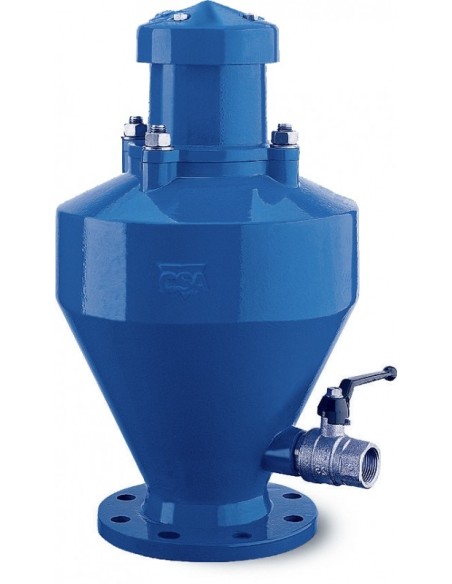
CSA SCF for Wastewater
The CSA SCF is a single-chamber, combined air valve designed for raw sewage pipelines. It evacuates air during filling, releases pressurized air pockets, and admits large volumes of air during pipeline draining or rupture scenarios.
Construction
- Body and cover: ductile cast iron GJS 450-10
- Float: stainless steel AISI 316
- Seat and venting system: stainless steel
- Coating: epoxy powder RAL 5005
- Connection: flanged DN 50–DN 200
- Flange standard: EN 1092-2
- Operating pressure: PN 10 / PN 16
- Minimum pressure: 0.2 bar
- Temperature: up to 60°C, higher on request
- Test/design: EN 1074
Applications
- Pressurized wastewater mains
- Sewage pumping stations
- High points in pressure networks
- Pipelines with gases, odors, and suspended solids
- Lines requiring flanged air valves
Selection vs SCA 2”
SCF is specified for flanged installations DN 50–DN 200. SCA 2” is used for smaller threaded connections. Both designs minimize solids and debris accumulation at the seat and sealing interface.
FAQ
Suitable media?
Raw sewage and wastewater.
Why use a dedicated sewage air valve?
To reduce risk of solids deposition on the seat.
What is checked during sizing?
DN, PN, air flow rate, installation location, and filling/draining scenarios.


Description
Certifications
Quality e certifications
Quality in its entirety is now an essential requirement for all businesses that aim at gaining and maintaining their position in today's market.
For this reason we have always had the objective of guaranteeing a product managing cycle which, developing a synergy between the various sectors of the company ensures:
- Quick and precise information.
- Evaluation of data received and immediate responses.
- Rigorous control of incoming and outgoing products.
The production cycle, targets a constant improvement of our products, aims at complete customer satisfaction ensures predetermined margins of tolerance establishing production standards so as to guarantee that the semi-finished products reach the next production stage with the required specifications.
All our valves are made of ductile cast iron GJS 450-10 and in absolute compliance with Italian and European standards and are designed to work at a pressure of 25-40 bars. The work is carried out only by means of numerically controlled lathes, mills, horizontal machining units and subsequently examined step-by-step following strict procedures. Internal components of our valves are largely made of stainless steel or other high resistant materials for the maximum prevention of cavitation effects and corrosion.
Painting, pre-treated by sand-blasting grade SA 2,5, is carried out inside a fluidized bed containing epoxy powder, which guarantees maximum surface protection.
All our products are tested under water pressure and certified.
Company policy
CSA deals with the design and production of material for pressure systems for aqueduct, sewage and industrial use and the marketing of all types of valves and solutions for the regulation of pressure systems in the aqueduct, sewerage and industrial sectors.
Mission
Its corporate mission is to be recognized as a structured and leading company for the production of pressure systems for aqueduct, sewage and industrial use.
Our target market consists of around 65% of foreign customers and the remaining 35% of customers in the Italian territory.
The Quality Management System of CSA s.r.l. must guarantee:
- customer satisfaction through the creation of products according to the required standards and specifications
- continuous improvement of the effectiveness / efficiency of all the company processes.
For this reason the management of the company together with all the company resources is committed to the continuous improvement of the performance of the company and therefore aimed at managerial, technical and professional growth.
The principles and methodologies of Quality have therefore been an inspiring model in the management and management of the activities of the company, which is constantly engaged in the analysis of the Customer's expectations, to guarantee your maximum satisfaction.
The Quality System is implemented through processes that take place within the company with the collaboration of individual functions and all employees.
Our strengths are:
- Technical development of new products suitable for particular applications also at the request of the customer, in addition to a range of standard products on the price list. The development is carried out by our internal Technical Department with attention aimed at complying with sector regulations and national standards;
- Assistance to the customer in all phases of order acquisition, order fulfilment and post delivery assistance thanks to commercial and operational personnel able to intervene to solve problems;
- Product quality: we guarantee the quality of our products thanks to a careful control of raw materials and selection of qualified suppliers and to the verification of 100% of the products;
- Training and periodic training of our staff;
- Periodic preventive maintenance of the equipment and calibration of the measuring instruments.
Company Strategies
The company sets the following business strategies for achieving its objectives:
- Establish contracts with new retailers worldwide to increase the number of customers also in terms of turnover;
- Development of post-sales assistance service both by telephone and through on-site assistance;
- Strengthening contacts with the customer through commercial contacts and direct meetings;
- Careful selection of suppliers through checks on the same and control of the material in acceptance;
- Warehouse management and production planning in order to meet customer delivery times;
- Development of new products and obtaining approvals for the marketing of products suitable for contact with water intended for human consumption.
ISO certificates
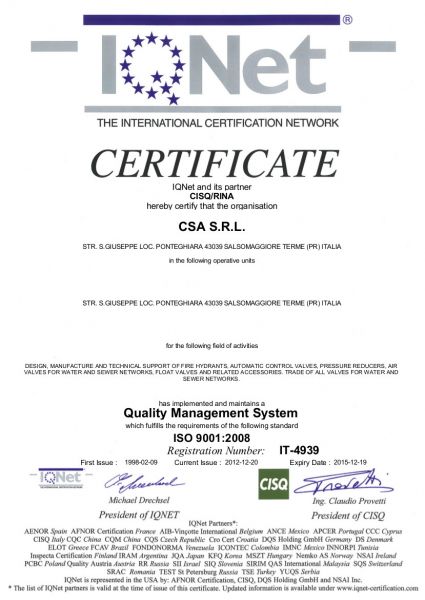
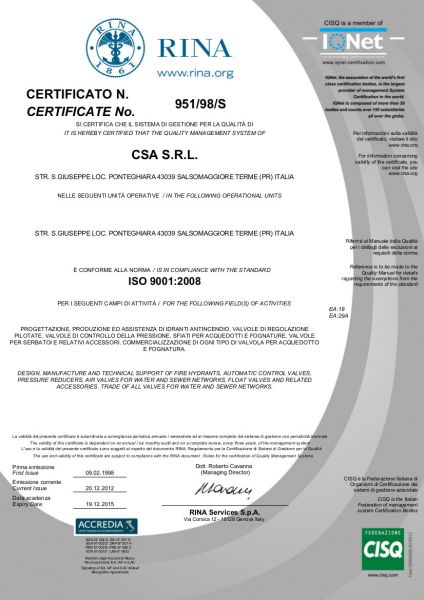
Since 1998 all procedures, without exclusion, are certified according to the regulation ISO 9001:2008 by RINA, Registro Italiano Navale.
Standards applied
Quality management
UNI EN ISO 9000:2005
Quality management system - Fundamentals and vocabulary
UNI EN ISO 9001:2015
Quality management system - Requirements
General standards
UNI EN 1563:2012
Founding - Spheroidal graphite cast irons.
UNI EN 545:2010
Ductile iron pipes, fittings, accessories and their joints for water pipelines - Requirements and test methods
UNI 8574-6:1984
Painted products. Test methods. Surface adherence.
UNI EN ISO 2178:1998
Non-magnetic coatings on magnetic substrates - Measurement of coating thickness - Magnetic method
UNI EN 1092-2:1999
Flanges and their joints - Circular flanges for pipes, valves, fittings and accessories, PN designated - Part 2: Cast iron flanges
Valves
UNI EN 558:2012
Industrial valves - Face-to-face and centre-to-face dimensions of metal valves for use in flanged pipe systems - PN and Class designated valves
UNI EN 1074 -1:2001
Valves for water supply - Fitness for purpose requirements and appropriate verification tests - Part 1: General requirements
UNI EN 12266-1:2012
Industrial valves - Testing of metallic valves - Part 1: Pressure tests, test procedures and acceptance criteria - Mandatory requirements
Air valves
UNI EN 1074-4:2002
Valves for water supply - Fitness for purpose requirements and appropriate verification tests - Part 4: Air valves
Control valves
UNI EN 1074-5:2002
Valves for water supply - Fitness for purpose requirements and appropriate verification tests - Part 5: Control valves
Tap to zoom
