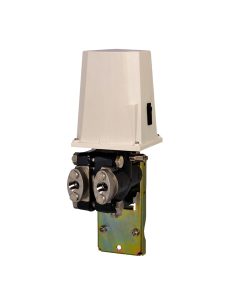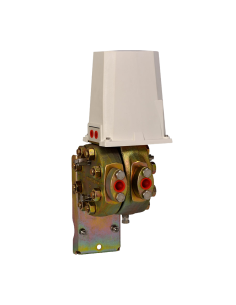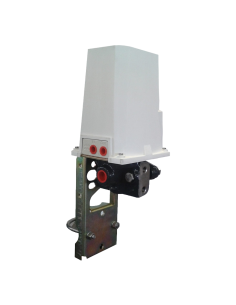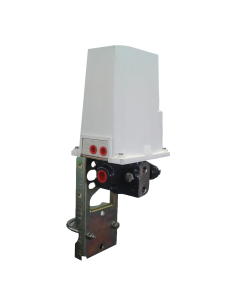

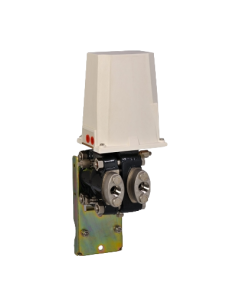
Relative & Differential Pressure Transmitters
Gauge and differential pressure transmitters are used in pneumatic control loops to convert a pressure change into a proportional pneumatic output signal. Gauge pressure is referenced to atmosphere, while differential pressure is the pressure difference between two measurement points, such as upstream and downstream of a filter, pump, primary flow element, or heat exchanger.
This category includes the OMC DP5-A, DP5-B, DP5-D, DP5-H, and DP5-R transmitters. The DP5-A, DP5-B, DP5-D, and DP5-H versions operate on the force-balance principle. The measuring unit detects differential pressure through forged bodies and a measuring capsule, while the transmission unit converts the force acting on the sensing element into an analog pneumatic output by means of a flapper-nozzle relay and feedback bellows.
Static pressure capability varies by model: DP5-A up to 100 bar, DP5-B up to 75 bar, DP5-D up to 400 bar, while DP5-H is specified with a static pressure limit of 100 bar and a differential pressure limit of 100 bar. The DP5-R is intended for gauge pressure measurement and uses bellows rather than a measuring capsule in the sensing section. ATEX 2014/34/EU versions are available for Gas Zone 1 and Dust Zone 21 where installation is in a classified area.
Selection should be based on measuring range, line static pressure, maximum differential pressure, wetted material compatibility, enclosure protection against moisture ingress, instrument air quality, impulse line routing, and any requirement for ATEX certification. In services with pressure pulsation, condensate formation, viscous media, or risk of plugged sensing lines, manifold arrangement and periodic calibration have a direct effect on signal stability and control loop response.